

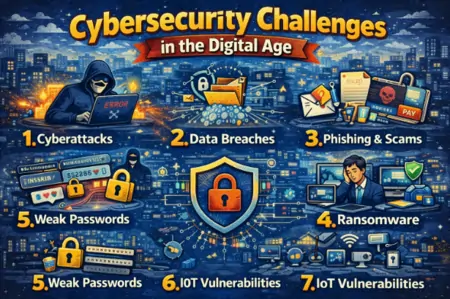
In 2026, Cybersecurity Challenges in the Digital Age are no longer just an “IT issue.” They affect your money, privacy, and daily routine—because banking, school, shopping, and work all run online. For many Filipinos, the most common entry points are simple: a Messenger link, a fake “support” chat, or an OTP request.
This guide breaks down today’s cyber risks in plain English, shows what’s driving them, and gives practical steps you can apply at home or in a small business.
Quick Answer
Cybersecurity Challenges in the Digital Age are growing because we have a bigger attack surface (more apps and devices), faster scams powered by AI, and higher expectations for privacy and reporting. In 2026, major security outlooks highlight AI acceleration, geopolitical fragmentation, and widening “cyber inequity” (uneven preparedness) as key forces shaping risk.
Why Security Feels Harder Now
More devices = more “doors”
One major driver behind Cybersecurity Challenges in the Digital Age is the number of devices connected to your life: phones, laptops, routers, smart TVs, and business devices like POS terminals and CCTV systems. Add cloud storage and third-party tools (payment gateways, chat widgets, analytics), and you get more doors that attackers can try.
AI makes scams cheaper to run
Another driver behind Cybersecurity Challenges in the Digital Age is speed. Attackers can generate convincing phishing messages, fake screenshots, and even chatbot-style scam scripts quickly. Defenders use AI too, but the volume and realism of scams increase the chance that someone clicks at the wrong moment. Gartner specifically calls out the “chaotic rise of AI” as part of what’s shaping 2026 cybersecurity trends.
Rules and trust matter more
Security isn’t only technical anymore. Customers expect privacy, and regulators expect basic protections. In the Philippines, the Data Privacy Act (RA 10173) sets obligations for organizations handling personal information.
The Biggest Cybersecurity Challenges You’ll See Today
1) Phishing and social engineering (now AI-assisted)
Phishing remains one of the biggest cyber risks because it targets people, not machines. This is a major part of Cybersecurity Challenges in the Digital Age because the “weakest link” is often human behavior. Common PH examples include “parcel failed” messages, “account locked” alerts, and bonus offers that push you to click.
Safer habit: type the site yourself, don’t follow chat links. Never share OTPs.
2) Ransomware and extortion
Ransomware still matters because it can stop operations immediately. Many attacks now combine file encryption with data theft and threats to leak. ENISA’s threat landscape tracks ransomware among the prominent threats organizations face.
Safer habit: maintain backups and test restores.
3) Supply chain and third-party exposure
A surprising part of Cybersecurity Challenges in the Digital Age comes from tools you didn’t build: plugins, vendors, SaaS apps, and outsourced support. One weak vendor account can become your breach.
Safer habit: list your vendors, remove what you don’t need, and require MFA for admin access.
4) Identity attacks and stolen credentials
Password reuse is fuel for account takeovers. Attackers buy leaked credentials and try them everywhere.
Safer habit: use a password manager, unique passwords, and MFA—especially on email (your recovery key). This single change reduces a large chunk of Cybersecurity Challenges in the Digital Age for both individuals and SMEs.
5) Cloud misconfiguration
Teams move fast and accidentally expose storage or dashboards to the public internet. That’s why cloud mistakes remain central Cybersecurity Challenges in the Digital Age for startups and SMEs.
Safer habit: least privilege access and quarterly permission checks.
6) API security gaps
APIs power mobile apps and integrations, but weak authentication or missing rate limits can expose data or allow abuse. API weaknesses are a growing part of Cybersecurity Challenges in the Digital Age because more services rely on integrations.
Safer habit: enforce strong auth tokens, rate limiting, and monitoring.
7) IoT and router weaknesses
Unpatched routers and default-password devices (CCTV, smart plugs) are easy targets. They often stay vulnerable for years.
Safer habit: change default passwords, update firmware, and separate IoT devices on a guest network. This helps reduce Cybersecurity Challenges in the Digital Age that come from “forgotten” devices.
8) Insider risk (accidental or malicious)
Many incidents happen because someone shares a file publicly, installs pirated software, or keeps access after leaving.
Safer habit: monthly access review and a clear offboarding checklist.
9) Service disruption (DDoS and outages)
Some attackers don’t steal data—they shut services down. Availability attacks are painful for online ordering, booking, and customer support. ENISA’s threat landscape covers major disruption patterns across the ecosystem.
Safer habit: use a CDN/WAF and basic rate limiting.
10) Skills gap and uneven preparedness
One reason Cybersecurity Challenges in the Digital Age hit smaller organizations harder is the skills gap: not everyone has a security team. The WEF highlights widening “cyber inequity,” meaning security capability is unevenly distributed.
Safer habit: prioritize basics you can sustain—MFA, backups, patching, and training.
What Happens When Things Go Wrong
When Cybersecurity Challenges in the Digital Age become real incidents, the impact usually shows up in four places:
- Money: fraud, stolen funds, recovery costs
- Time: downtime, customer complaints, manual cleanup
- Trust: people stop using services they don’t trust
- Legal exposure: data incidents may require reporting and corrective action (especially if personal info is involved)
For individuals, the most common pain is account takeover. For SMEs, it’s downtime and reputational damage.
Who Is Most at Risk
- Individuals and families: frequent link-clicking, shared devices, weak passwords
- SMEs and startups: fast tool adoption, limited security budget
- Enterprises: complex vendor ecosystems and identity systems
- Critical sectors: health, finance, utilities, and government services
No group is “immune,” but habits and controls determine how often you’ll face Cybersecurity Challenges in the Digital Age and how much damage they cause.
Best Practices That Work in 2026
Use a Zero Trust mindset (simple version)
Zero Trust means “don’t assume trust—verify.” NIST describes zero trust as shifting away from implicit trust based on network location toward verifying users, assets, and resources.
For small teams, that can be as simple as MFA everywhere, strict admin access, and access granted only when needed.
Make identity your first priority
If you fix identity, you reduce a large share of Cybersecurity Challenges in the Digital Age:
- enable MFA on email, banking, and admin tools
- stop password reuse
- remove old accounts and sessions
- turn on login alerts
Backups + restore testing
Backups are only useful if you can restore quickly. Schedule a restore test once per quarter.
Train people against modern scams
Keep training short:
- Don’t click unknown links
- Don’t share OTPs
- Verify the domain yourself
These habits prevent many Cybersecurity Challenges in the Digital Age that start with social engineering.
Reduce data exposure
Collect only what you need, encrypt what matters, and delete what you no longer need. Less stored data means less damage.
30-Day Starter Plan
Week 1: Lock down accounts
MFA on email and finance apps, password manager setup, remove old logins.
Week 2: Patch and protect devices
Update phones/laptops, router firmware, and key apps. Change default passwords.
Week 3: Clean up tools and access
Remove unused plugins/apps, limit admin roles, review shared links.
Week 4: Prepare for incidents
Create a 1-page checklist: who to contact, what proof to save, what passwords to change first, and where backups live. This reduces panic when Cybersecurity Challenges in the Digital Age hit.
PH-Specific Safety Reminders (Quick Wins)
If you want immediate protection, start with the channels where scams spread fastest in the Philippines: Facebook comments, Messenger group chats, Telegram “support,” and SMS. Treat any message with urgency as suspicious. When in doubt, do a manual search, type the domain yourself, and confirm through official help pages. Also review your phone’s app permissions—apps that request SMS access or Accessibility controls deserve extra caution.
FAQs
What is the biggest threat right now?
Phishing remains a top driver of Cybersecurity Challenges in the Digital Age because it targets people, and AI makes it more convincing.
How does AI change cybersecurity in 2026?
It increases scam speed and realism, while defenders use AI for detection and response—one reason Gartner flags AI as a key force shaping 2026 security trends.
What’s the simplest way to avoid OTP scams?
Never share OTPs, even with “support.” Type the website address yourself instead of clicking links.
Final Thoughts
Cybersecurity Challenges in the Digital Age will keep evolving, but the best defenses stay boring and consistent: secure identity, verify links, patch devices, keep backups, and practice a simple response plan. Do these well, and you’ll be safer than most in 2026.