

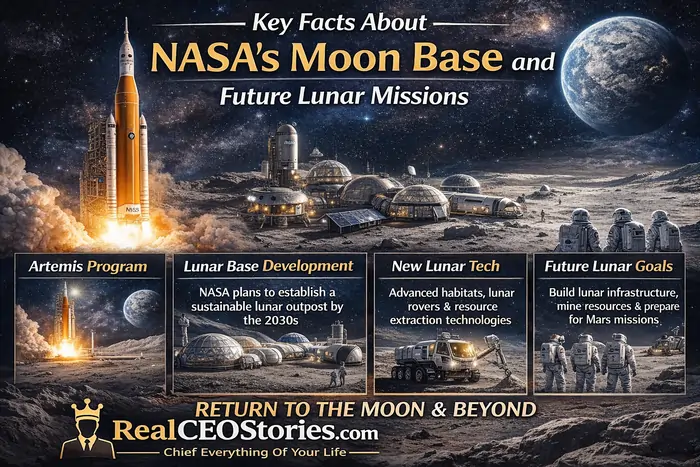
NASA moon base is part of the Artemis program, designed to establish a long-term human presence on the Moon. The project includes building the Lunar Gateway, developing sustainable lunar habitats, and using the Moon as a stepping stone for future Mars missions. With support from international partners and private companies, NASA aims to begin human missions in the late 2020s, marking a new era of deep space exploration and space economy growth.
NASA is no longer just talking about going back to the Moon; it is now laying out a concrete, multi‑phase plan for a Moon base and a steady drumbeat of future lunar missions under the Artemis program. Below are seven key facts that explain where NASA’s lunar strategy stands today, how the first Moon base will work, and what that means for the next decade of exploration.
1. NASA Has Officially Pivoted From Gateway to a Surface Moon Base
For years, NASA’s roadmap revolved around the Lunar Gateway, a small space station in orbit around the Moon that would act as a staging post for landings. In March 2026, NASA formally “paused” Gateway in its current form and shifted resources toward building a sustained Moon base on the surface instead.
At its “Ignition” event, NASA Administrator Jared Isaacman explained that the agency will prioritize infrastructure that directly supports long‑term human presence on the lunar surface. Existing Gateway hardware and some international partner contributions will be repurposed wherever possible for surface systems, cargo delivery and other Artemis needs. This represents a major architectural change: instead of focusing on a station in orbit, the emphasis is now on habitats, power systems, rovers and landers operating near the Moon’s south pole.
For a good overview of this strategic pivot, see: NASA’s lunar Gateway space station is out. Moon bases are in.. A more technical, program‑insider look is here: NASA outlines Moon Base plans, pivots on Gateway.
2. Artemis Base Camp Is the Core of NASA’s Moon Base Vision
The centerpiece of NASA’s lunar surface strategy is the Artemis Base Camp, a permanent outpost concept at or near the Moon’s south pole. This Moon base is designed to support long‑duration crew stays, technology demonstrations, and science missions that will prepare NASA for Mars and beyond.
According to NASA moon base, early Artemis missions will see astronauts living in their landing systems for short stays, but the goal is to gradually build up a base camp that includes:
- A fixed surface habitat that can house 2–4 astronauts for 30–60 day missions.
- A pressurized rover for long‑range exploration away from the base.
- Unpressurized rovers and surface infrastructure for cargo, science and construction.
- A robust power system (likely including nuclear fission) to provide continuous energy.
NASA’s Artemis Base Camp concept envisions astronauts initially staying up to two months at a time as systems mature. The outpost will serve as a testbed for life support, in‑situ resource utilization (ISRU), robotics, and surface operations needed for Mars expeditions.
You can explore NASA’s original concept here: Lunar Living: NASA’s Artemis Base Camp Concept. For a deeper dive into the base camp’s purpose and its role as a stepping stone to Mars, see: What is the Artemis Base Camp and how does this change space exploration?.
3. The Moon Base Will Sit Near the South Pole for Light and Water
A key fact about NASA’s Moon base plan is where it will be built. The Artemis Base Camp is targeted for the lunar south pole, an area of extreme contrasts—regions of near‑permanent sunlight next to permanently shadowed craters containing water ice.
NASA engineers and scientists have identified several critical criteria for selecting the exact site:
- It must be on the Earth‑facing side of the Moon to simplify communications.
- It should receive near‑continuous sunlight to power the base and moderate temperature swings.
- It needs easy access to permanently shadowed regions that may hold water ice.
Water ice is hugely important: it can be split into hydrogen and oxygen for rocket fuel, used for life support, and support experiments in ISRU that reduce the need to ship everything from Earth. At the same time, continuous sunlight reduces reliance on large battery systems and complex thermal management, making base operations more efficient.
NASA summarises these site‑selection needs here: NASA’s Artemis Base Camp on the Moon Will Need Light, Water, and Elevation. For a more narrative treatment of what it will be like to live in such a habitat, this feature is helpful: Living on the Moon: Inside Artemis’ Foundation Habitat.
4. Artemis Missions Have Been Reshaped Around Testing and Landings
NASA’s future lunar missions under Artemis have gone through significant changes in early 2026, directly affecting when humans will set foot on the Moon again and how quickly the Moon base will grow.
Key updates include:
- Artemis II: A 10‑day crewed mission around the Moon, now targeting launch in 2026, with three NASA astronauts and one Canadian Space Agency astronaut. It will test Orion’s life support, navigation and communication systems in deep space.
- Artemis III: Originally planned as the first Artemis lunar landing, it has been re‑scoped. NASA announced that Artemis III in 2027 will now test rendezvous and docking with commercial lunar landers (SpaceX Starship HLS and Blue Origin’s Blue Moon) in low Earth orbit instead of landing.
- Artemis IV: Now designated as the first crewed lunar landing of the Artemis era, targeted for 2028. It will likely use one of the commercial landers and begin delivering base‑relevant hardware to the south pole region.
NASA moon base has committed to at least one surface landing per year after 2028, with some plans calling for two crewed landings annually to accelerate base construction and science operations. This marks a shift from a few “flags‑and‑footprints” missions to a sustained campaign of landings, cargo drops and technology demonstrations.
For a clear summary of these mission changes, see: Major Changes to NASA’s Artemis III and Artemis IV Missions to the Moon. NASA’s own Artemis portal gives the big‑picture context: Artemis – NASA.
5. NASA Plans to Spend About $20 Billion on the Moon Base by the Early 2030s
Another key fact is the scale of investment. NASA’s revised plan calls for roughly $20 billion in spending over the next seven years to build out the Moon base infrastructure near the south pole.
According to reporting from Spaceflight Now and NASASpaceflight, this funding will cover:
- Surface habitats (initial “Foundation Habitat” modules and later expansions).
- Pressurized and unpressurized rovers for exploration and logistics.
- Power systems, including fission surface power units for continuous energy.
- Cargo landers to deliver equipment, supplies and scientific payloads.
- Upgrades to life support, communications and navigation infrastructure.
NASA’s goal is to enable semi‑permanent human presence on the Moon, with crews rotating through the Artemis Base Camp on multi‑week to multi‑month missions. As operations mature, the base will support more ambitious science (like deep drilling, seismology and astronomy) and industrial experiments in ISRU and construction.
For a detailed breakdown of the budget and mission cadence, read: NASA outlines ambitious $20 billion plan for moon base. NASA’s broader policy framing is in this release: NASA Unveils Initiatives to Achieve America’s National Space Policy.
6. Transportation Is Shifting From Government SLS to Commercial Lunar Systems
To support a Moon base and regular lunar missions, NASA needs a more frequent and cost‑effective transportation system than the current SLS‑centric model alone. A major part of the updated plan is a transition toward commercial launch vehicles and landers for both crew and cargo.
In the near term (through about Artemis V), NASA will continue using its Space Launch System (SLS) rocket and Orion crew capsule, but with some changes such as standardizing on the ULA Centaur V upper stage instead of Boeing’s Exploration Upper Stage to simplify the fleet. Longer term, NASA intends to:
- Move away from government‑operated SLS as the sole pathway to the Moon.
- Rely increasingly on commercially sustained lunar transport systems, including multiple launch providers.
- Use at least two competing commercial human landing systems (SpaceX Starship HLS and Blue Origin’s Blue Moon) to ferry crews and cargo to the surface.
NASA moon base has already issued requests for information and contracts aimed at creating a commercial lunar transportation ecosystem capable of supporting a crewed landing every six months once the system is fully mature. This approach mirrors how NASA transitioned from flying its own space shuttles to buying cargo and crew flights to the ISS from private companies.
For more background on this transportation strategy and the decision to standardize SLS before pivoting, see: NASA outlines Moon Base plans, pivots on Gateway. The Artemis program entry also summarizes the shift in mission roles and commercial integration: Artemis program – Wikipedia.
7. The Moon Base Is a Stepping Stone to Mars and Deep Space
The last key fact is why NASA is doing all this: the Moon base and future lunar missions are explicitly framed as a bridge to Mars and other deep‑space destinations. Artemis is not just about revisiting Apollo‑style landings; it is designed to test systems, operations and human performance in a low‑gravity environment that is close enough to Earth for relatively fast rescue and resupply.
At the Artemis Base Camp, NASA and its partners plan to:
- Develop and refine closed‑loop life‑support systems for months‑long missions.
- Practice using local resources (like water ice) for fuel and consumables.
- Test construction techniques for habitats, landing pads and radiation shielding.
- Study how human bodies, plants and possibly animals respond to 1/6 Earth gravity.
These capabilities are all essential for Mars missions, where crews will be far more isolated and must live off local resources to a much greater extent. By the end of this decade, NASA envisions a cadence of Moon missions that makes the surface feel less like an expedition and more like a remote research frontier—an environment where astronauts rotate in and out, but the base remains.
For a big‑picture perspective on how Artemis underpins future exploration, NASA’s main page is a great starting point: Artemis – NASA. For a more speculative and conceptual look at how Artemis Base Camp will change deep‑space exploration, this article is insightful: What is the Artemis Base Camp and how does this change space exploration?.
If you are fascinated by how fast technology and big engineering projects like NASA’s Moon base and future lunar missions are reshaping the future, it is worth keeping an eye on other fast‑moving parts of the digital and financial world too.
For a look at how audio platforms are evolving in real time, check out 9 New Spotify Updates That Are Changing Music Streaming Right Now here: 9 New Spotify Updates That Are Changing Music Streaming Right Now. And if you want to understand how markets are reacting to all this innovation and macro uncertainty, you might also like 9 Shocking Dow Jones Moves That Could Impact Investors Right Now: 9 Shocking Dow Jones Moves That Could Impact Investors Right Now.
FAQs About NASA Moon Base and Lunar Missions
What is NASA moon base?
NASA’s moon base is a planned lunar outpost that will support long-term human exploration under the Artemis program.
When will NASA build a moon base?
NASA aims to begin establishing the base in the late 2020s, with expansion expected in the 2030s.
Why is NASA building a moon base?
The goal is to enable scientific research, test space technologies, and prepare for Mars missions.
What is the Artemis program?
The Artemis program is NASA’s initiative to return humans to the Moon and build a sustainable lunar presence.
What is the Lunar Gateway?
The Lunar Gateway is a planned space station orbiting the Moon that will support astronaut missions and logistics.
Will astronauts live on the Moon permanently?
Not yet, but NASA aims for a long-term human presence with extended stays in the future.
How will the NASA moon base be powered?
It will likely use solar energy systems, along with advanced power storage technologies.
What technologies will be used in the NASA moon base?
NASA is developing lunar habitats, autonomous robots, and life-support systems for sustainability.
Who is working with NASA on the moon base?
NASA is collaborating with international space agencies and private companies like SpaceX and others.
How will astronauts travel to the Moon?
Astronauts will use the Orion spacecraft and the Space Launch System (SLS) rocket.
What role does the Moon play in Mars missions?
The Moon serves as a testing ground for systems needed for future human missions to Mars.
How much will the NASA moon base cost?
Costs are expected to reach tens of billions of dollars, depending on mission scope and timeline.
Can the Moon be used for resources?
Yes, scientists are exploring lunar resources like water ice that could support fuel and life systems.
Will private companies build parts of the NASA moon base?
Yes, commercial partnerships are essential for building landers, habitats, and supply systems.
Why is the NASA moon base important for the future?
It supports deep space exploration, boosts the space economy, and advances scientific discovery.