


Calorie counting helps with weight loss by creating a consistent calorie deficit, but it only works when done in a sustainable and realistic way. The most effective approach combines accurate tracking, balanced nutrition, hunger management, and flexible habits that can be maintained long term.
1. Understand How Many Calories You Really Need
Before you start logging, you need a ballpark idea of how many calories your body uses in a day.
Your total daily energy expenditure (TDEE) is the number of calories you need to maintain your current weight, based on your age, size, and activity level. Most healthy weight‑loss approaches create a moderate calorie deficit of around 500 calories per day, which typically leads to about 0.5 kg (or 1 lb) of weight loss per week for many people. Government and clinical guidelines generally recommend a reduced‑energy diet rather than extreme restrictions, emphasising balanced meals and modest daily deficits.
You can read more about calorie deficits and safe weight loss rates in WebMD’s guide to calorie deficit and the scientific overview in “Optimal Diet Strategies for Weight Loss” (NIH).
2. Use Tools That Make Tracking Almost Effortless
Calorie counting is far easier if you offload the boring maths to apps and tools.
There are three main approaches you can use:
- Traditional logging, where you look up foods in a database and input portions manually.
- Photo‑based tracking, where you snap your meals and let AI estimate calories for you.
- Hybrid approaches, where you weigh or measure some foods and estimate others.
A detailed comparison of old‑school logging versus newer AI‑powered methods is available in The Complete Guide to Calorie Counting in 2025, which shows that photo‑based tracking can significantly improve accuracy and consistency for many people. For more conventional advice on using counters and apps, see Mayo Clinic’s calorie counting basics and Healthline’s guide on how to count calories.
The best tool is the one you’ll actually use daily with minimal friction, so experiment with 1–2 options and pick the simplest system that fits your routine.
3. Weigh and Measure at First (So You Can Eyeball Later)
Most people underestimate how much they eat, especially with calorie‑dense foods like oils, nut butters, cheese, and snacks.
For the first few weeks, learning what realistic portions look like can transform your results:
- Use a food scale for tricky items (rice, pasta, meat, nuts) to see what, say, 100 g actually looks like.
- Use measuring cups/spoons for cereal, sauces, dressings, and cooking oils.
- Cross‑check your portions against food labels and app entries so your logging is closer to reality.
Once you’ve done this consistently, you’ll be able to estimate portions much more accurately even when you’re eating out or away from your usual tools. Both Healthline’s calorie counting guide and the UK NHS page on calorie counting recommend weighing or measuring portions at the beginning, then gradually transitioning to informed eyeballing as your “portion awareness” improves.
4. Focus on a Sustainable Calorie Deficit, Not Extreme Restriction
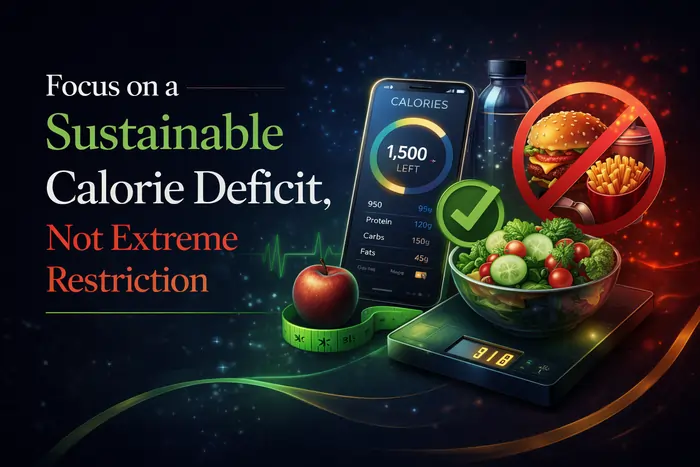
Calorie counting only works long‑term if your target is sustainable.
Research consistently shows that:
- Moderate deficits (about 500–750 calories below maintenance) produce steady, manageable weight loss and are easier to maintain over time.
- Very‑low‑calorie diets (often under 800 calories per day) can produce rapid weight loss but generally require medical supervision and are not appropriate for most people.
- Behaviour‑focused, hypocaloric diets, where you still eat balanced meals but less total energy, are standard in clinical weight‑management guidelines.
A scientific overview in the NIH article “Optimal Diet Strategies for Weight Loss” explains that energy deficit is the key driver of weight loss, but extreme approaches trigger stronger metabolic adaptations that can make maintenance harder. The Australian Obesity Management Algorithm similarly recommends reduced‑energy diets (REDs) for most people, emphasising whole foods and modest deficits rather than crash diets.
If you’re unsure where to start, public health resources like the CDC’s Steps for Losing Weight outline realistic goals and timelines for healthy weight loss.
5. Make Hunger Management Part of Your Strategy
Calorie counting gets hard when you’re constantly hungry, so smart food choices are just as important as the numbers.
Some evidence‑based principles that make sticking to your target easier include:
- Prioritising lean protein (chicken, fish, eggs, Greek yoghurt, tofu, legumes), which increases fullness and helps preserve muscle during weight loss.
- Eating plenty of high‑fibre foods like vegetables, fruits, legumes, and whole grains, which add volume for relatively few calories.
- Limiting ultra‑processed, high‑sugar and high‑fat foods that are very energy‑dense but not very filling.
An accessible list of practical hunger‑handling tactics is outlined in LiveSmart’s article “Counting Calories? Nine Tips to Handle Your Hunger” (focus on fibre, protein, hydration, and smart snacking), which you can read at LiveSmart – nine tips to handle your hunger.
For broader healthy eating guidance, the Australian Dietary Guidelines and the government’s Eat for Health – Australian dietary guidelines 1–5 explain how to build balanced meals that support both weight and overall health.
6. Plan Your Meals Instead of Wing It
Calorie counting is dramatically easier when you make decisions once (during planning) instead of at every single meal and snack.
Planning doesn’t need to be complicated:
- Sketch out 2–3 go‑to breakfasts, 3–4 lunches, and a handful of dinners that you enjoy and can rotate.
- Pre‑log your day in your app in the morning, then eat to the plan with minimal adjustments.
- Meal prep basics like cooked protein, chopped veg, and pre‑portioned snacks to reduce “decision fatigue” on busy days.
Macro‑focused approaches, like those described in Practical Tips for Losing Weight in 2025 (and beyond!), show how planning around protein, carbs, and fats can help you hit calorie and nutrient targets at the same time. The Complete Guide to Calorie Counting in 2025 also includes a simple “Week 1–4” action plan for building consistent tracking and planning habits.
The less you leave to chance, the easier it is to stay within your target without feeling like you’re constantly negotiating with yourself in front of the fridge.
7. Track More Than Just Calories (But Keep It Simple)
Calories matter for weight loss, but they’re not the only thing that influences how you feel and whether you stick with it.
To make calorie counting more insightful (without becoming overwhelming), consider also:
- Tracking protein to ensure you’re getting enough to support muscle and satiety (many people aim for at least 1.2–1.6 g/kg of body weight, though needs vary).
- Noting hunger levels, mood, sleep quality, and stress to see patterns that might explain overeating or plateaus.
- Logging steps or exercise, not to “earn food,” but to understand how movement and appetite interact for you.
Scientific reviews, like the NIH chapter “Weight-Loss and Maintenance Strategies”, emphasise that behavioural tracking and self‑monitoring are key components of successful long‑term weight loss. Combining calorie counts with a couple of simple behaviour metrics gives you a more complete picture and helps you adjust intelligently when progress slows.
8. Build in Flexibility So You Don’t Burn Out
Rigid, all‑or‑nothing calorie counting is one of the fastest ways to burn out, binge, and give up.
To keep things sustainable:
- Aim for accuracy over perfection – being within 50–100 calories of your target is fine; you don’t need to hit it exactly every day.
- Use weekly averages as your main metric, allowing some days to be higher and others lower, as long as the weekly total reflects your intended deficit.
- Plan for flexibility – pre‑log social events, restaurant meals, or higher‑calorie days, and adjust earlier or later in the week.
Articles like “Is Calorie Counting Still Effective for Weight Loss in 2025?” point out that counting works best when it’s combined with mindful eating, portion control, and overall diet quality, not used as a rigid rulebook. Public health resources such as the NHS’s calorie counting guide and the CDC’s Steps for Losing Weight similarly emphasise sustainable habits over extremes.
Remember that weight loss never follows a perfectly straight line, and building in some flexibility helps you stay in the game long enough for the trend to matter more than any single day.
9. Pair Calorie Counting With Movement and Overall Health Habits
Calorie counting is a powerful tool, but it’s just one piece of the weight‑loss puzzle.
Evidence‑based guidelines consistently recommend combining dietary changes with physical activity, sleep, and stress management for the best results. For example:
- The Australian Dietary Guidelines and Eat for Health advise being physically active while choosing amounts of nutritious food and drinks that match your energy needs.
- The CDC’s Steps for Losing Weight notes that even a 5–10% reduction in body weight can significantly lower the risk of chronic diseases, especially when combined with regular activity.
- Clinical reviews like “Optimal Diet Strategies for Weight Loss” and “Weight-Loss and Maintenance Strategies” emphasise ongoing behaviour change, not just short‑term diet phases.
You don’t need to become an athlete overnight; even small increases in walking, some basic strength training, and prioritising sleep can make your calorie deficit more effective and sustainable.
Conclusion
Calorie counting can make weight loss easier by turning vague “eat less” goals into clear, trackable actions, but it only works if you use it in a realistic, flexible way that fits your life. By understanding your true calorie needs, using tools that minimise friction, learning portion sizes, choosing a sustainable deficit, and managing hunger with high‑protein, high‑fibre foods, you stack the odds in your favour.
Layering in planning, basic behaviour tracking, movement, and flexibility helps you move from short‑term dieting to long‑term habit change, which is what actually maintains your results. If you want more structured guidance while you implement these tips, you can start with accessible resources like Mayo Clinic’s calorie counting basics, Healthline’s guide to counting calories, and the Australian Dietary Guidelines.
To dive deeper into what’s happening across the country, including recent outbreaks and regulatory concerns, check out 9 Shocking Facts About Legionnaires’ Disease in Australia Right Now for a current, plain‑English breakdown.