

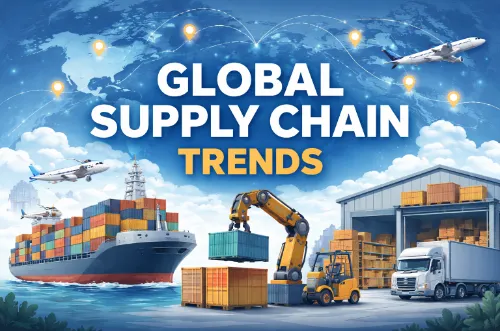
Global supply chain trends in 2026 are being reshaped by AI, nearshoring, resilience, and increasing geopolitical and sustainability pressures. Businesses that adapt their networks, data capabilities, and risk management around these trends are better positioned to compete and avoid costly disruptions.
1. Resilience Over Pure Efficiency
Supply chains are shifting from just‑in‑time efficiency to resilient, risk‑aware networks.
Key themes:
- Multi‑sourcing and geographic diversification to avoid over‑reliance on single suppliers or regions.
- Higher safety stock for critical components while keeping lean practices where risk is lower.
- More scenario planning and stress tests to anticipate disruptions before they hit.
RELEX’s State of Supply Chain report shows leading companies using scenario modeling and predictive analytics to move from reactive firefighting to proactive resilience. Marsh’s 2026 outlook notes that rising trade barriers and sudden tariffs make this kind of risk‑aware design essential.
Helpful external resource: Supply chain resilience in 2025 – RELEX Solutions.
2. AI, Automation, and Digital Control Towers
AI has moved from experimental pilot to baseline capability in supply chain planning and execution.
Developments:
- Predictive and generative AI embedded in planning platforms for demand forecasting, inventory optimization, and exception management.
- AI‑driven “control towers” providing end‑to‑end visibility across ERPs, WMS, TMS, and external data (ports, weather, traffic).
- Robotics and warehouse automation scaling to boost throughput and accuracy.
KPMG notes that AI is now integrated into Source‑to‑Pay and planning tools, moving beyond proof‑of‑concept into everyday operations. RFgen describes AI as “the new baseline” for fast insight, risk detection, and execution across daily supply chain work.
Helpful external resources:
- Key trends impacting supply chains in 2026 – KPMG
- Supply Chain Trends in 2026: AI, Automation, and Risk Resilience – RFgen
3. Nearshoring and Regionalization
Cost‑only sourcing models are giving way to risk‑balanced, more regional networks.
What’s happening:
- Nearshoring and “friend‑shoring” move production and distribution closer to end markets to reduce lead times and exposure to distant disruptions.
- Regional clusters and shorter networks improve agility and make it easier to respond to demand swings and geopolitical shocks.
- Companies selectively reconfigure plants and distribution centers to address underused capacity and high logistics costs.
Slimstock’s 2026 trend report highlights nearshoring as a key strategic move away from purely cost‑driven global networks. KPMG likewise points to suppliers and production relocating closer to key markets to increase agility in the face of recurring tariff and trade disruptions.
Helpful external resource: Supply chain trends 2026 – Slimstock.
4. Fragmentation, Geopolitics, and Trade Risk
Geopolitical tensions and protectionism are fragmenting global trade and complicating supply chains.
Key forces:
- New tariffs, export controls, and sanctions that can change landed costs overnight.
- Route disruptions (for example, Red Sea tensions, port congestion) that raise freight rates and force network redesigns.
- Higher volatility in demand due to macroeconomic uncertainty and shifting consumer confidence.
KPMG’s 2026 supply chain outlook warns that ongoing tariffs and non‑tariff barriers will keep forcing companies to reconsider sourcing, routes, and pricing. Supply Chain Dive’s “5 supply chain management trends to watch in 2026” cites geopolitical risk and economic turbulence as major drivers of network diversification and cost optimization moves.
Helpful external resource: 5 supply chain management trends to watch in 2026 – Supply Chain Dive.
5. Data, Trade Intelligence, and Real‑Time Visibility
High‑quality, centralized data and trade intelligence are becoming strategic assets.
Trends:
- AI‑driven trade intelligence platforms ingest customs, port, weather, and market data to identify risks and opportunities in real time.
- Real‑time visibility across multi‑modal networks helps detect bottlenecks early and suggest alternative routes.
- Clean, integrated data is a prerequisite for effective AI, control towers, and scenario planning.
Global Trade Magazine explains how AI‑driven trade intelligence is reshaping supply chain decision‑making by forecasting disruptions and recommending sourcing and routing changes. Global Trade’s related tech trends piece highlights “centralized data as a strategic asset” and “scenario planning as a core capability” for 2026.
Helpful external resource: How AI‑Driven Trade Intelligence Is Reshaping Global Supply Chain Decision‑Making in 2026 – Global Trade.
6. Sustainability, ESG, and Ethical Sourcing
Sustainability and ESG (environmental, social, governance) are now core supply chain priorities, not add‑ons.
Key developments:
- More regulations and reporting requirements around carbon footprints, deforestation, and due diligence in supply chains.
- Increased demand for traceability and ethical sourcing, often supported by blockchain or similar technologies.
- Pressure from customers and investors to reduce emissions, waste, and social risks while maintaining service levels.
Slimstock’s and APS Fulfillment’s trend reports both emphasize ESG and ethical sourcing—such as fair trade and responsible sourcing—as central to brand reputation and compliance. ASCM’s top 10 trends list ESG and sustainable logistics as competitive differentiators, not just risk controls.
Helpful external resources:
7. Cost Optimization Under Persistent Volatility
Inflation, elevated transport costs, and uneven demand are keeping cost optimization high on the agenda.
Companies are:
- Consolidating and optimizing manufacturing and distribution networks, including closing or repurposing underutilized sites.
- Balancing lean operations with resilience by selectively holding more stock where needed and staying lean elsewhere.
- Using automation and AI to reduce labor costs, cut waste, and improve forecast accuracy.
Supply Chain Dive notes that rising costs are driving network optimization and consolidation decisions in 2026. RELEX’s resilience analysis shows companies rebalancing lean vs safety stock and leveraging digital tools to protect margins under inflation and volatility.
Helpful external resource: Supply chains in 2026: A continuation of complexity and risk – Marsh.
8. Human–Machine Collaboration and Talent
As AI and automation spread, human roles in supply chains are evolving rather than disappearing.
Shifts include:
- Planners and managers moving toward exception management, scenario design, and strategic decision‑making while AI handles routine analysis.
- Growing need for talent in data analytics, risk management, and digital tools alongside traditional logistics expertise.
- Human–machine collaboration frameworks that define responsibilities, governance, and trust in AI recommendations.
KPMG’s “human‑machine collaboration” theme underscores the need to upskill teams to work effectively with embedded AI tools. ASCM’s trend overview highlights workforce transformation and capability building as critical to unlocking value from new technologies.