

Bitcoin Price (USD) is drawing global attention, but it represents only one part of a much broader financial landscape. Smart investors are not just watching crypto—they are also tracking macroeconomic signals, stock market volatility, and policy changes that can influence overall portfolio performance.
Movements in major indices like the Dow Jones Industrial Average often reflect deeper economic shifts, and sharp swings can signal increased risk or opportunity across multiple asset classes. Understanding how these fluctuations interact with crypto markets is essential for building a balanced investment strategy in 2026.
At the same time, regional financial policies—such as updated Centrelink payments in Australia—can directly affect household cash flow, spending power, and economic stability. These changes may not seem directly tied to crypto or equities, but they play a key role in shaping broader market conditions.
For investors, the takeaway is clear: Bitcoin may be leading headlines, but true financial awareness comes from monitoring the full picture—including stocks, macro trends, and government policy. A diversified, well-informed approach remains the most effective way to navigate today’s rapidly evolving financial environment.
1. Post-Halving Supply Shock Is Kicking In
One of the clearest reasons the Bitcoin price USD is surging is the delayed impact of the most recent Bitcoin halving, which cut miner rewards and reduced new BTC supply entering the market. Historically, halvings reduce the number of new coins miners receive per block, and over the following 12–18 months this structural scarcity tends to translate into higher prices as long as demand stays flat or rises. In the latest cycle, this pattern has continued, although 2025–2026 price action has shown that each halving era can look different from the last.
In April 2024, Bitcoin completed its fourth halving, slashing the block reward from 6.25 BTC to 3.125 BTC per block. That instantly cut new daily issuance in half, making fresh supply more scarce for spot buyers and institutional funds accumulating via regulated products. Research from Fidelity Digital Assets on the 2024 halving one year later shows that Bitcoin climbed from around 63,762 USD on halving day to above 83,000 USD as supply tightened and demand stayed firm. These data points reinforce a key takeaway: halvings tend to compress supply while demand either holds steady or grows, which is structurally bullish over time.
Not everyone believes the classic four-year cycle remains intact, and some analysts argue that 2026 is “rewriting the halving playbook.” Still, the core mechanics are unchanged: fewer coins are being created each day, while long-term holders and institutions are locking up a larger share of the circulating supply. If you want a plain-language primer on how halving works and why it matters, the explainer on Investopedia’s Bitcoin halving page is a helpful starting point.
2. Massive Spot Bitcoin Price (USD) ETF Inflows
A second major reason Bitcoin is surging is the wave of spot Bitcoin ETF inflows in the U.S. and other markets. These funds make it easy for institutions and traditional investors to gain exposure to BTC without managing private keys or dealing directly with crypto exchanges. When money flows into these funds, the issuers must buy the underlying BTC, which creates steady buy pressure.
In March 2025, U.S. spot Bitcoin ETFs saw a net inflow of about 167 million USD in a single day, reversing brief outflows and signaling renewed institutional confidence. You can see this trend in more detail via the CoinGlass Bitcoin ETF fund flows dashboard, which tracks daily inflows, outflows, and total BTC holdings across the major spot products. More recent reports in March 2026 highlight strong cumulative net inflows again, suggesting that large investors are still building positions instead of exiting.
Analysts emphasize that ETF inflows are particularly impactful because they remove BTC from the liquid trading float and move it into long-term custodial structures. A CryptoRank analysis of surging Bitcoin ETF inflows shows how quickly sentiment can flip when capital rotates back into these products. For traders, tracking ETF demand alongside price action is becoming as essential as watching traditional on-chain data.
If you want a broader view across multiple crypto ETFs, including Ethereum and other assets, the CoinGlass crypto ETF overview provides real-time flows and assets under management (AUM) across the entire segment.
3. Improved Macro Environment and Rate Expectations
Beyond crypto-specific themes, the macro backdrop has turned more supportive for risk assets, and Bitcoin is benefiting. After years of aggressive rate hikes, markets now see a more stable path for interest rates, with fewer surprises and some potential for easing if growth softens. That environment often encourages investors to move away from cash and low-yield bonds toward assets with higher return potential, including equities and digital assets.
Traditional finance outlets have connected these dots explicitly. For example, CNBC’s coverage of Bitcoin price predictions for 2026 discusses how softer inflation readings and a more predictable Federal Reserve path have boosted risk appetite. Meanwhile, Investopedia’s articles on Bitcoin’s 2026 rally highlight that strategists see “legs” to the move as long as policy doesn’t take an unexpectedly hawkish turn.
Geopolitical tensions and long-term debt concerns in major economies have also kept alive the narrative of Bitcoin as “digital gold.” When headlines raise questions about fiat stability or sanctions risk, some investors look to assets that are independent of any single government’s monetary system. For a deeper macro/investment perspective, Fidelity provides a rigorous framework in its white paper, “The case for bitcoin”, which outlines why they view BTC as a distinct alternative asset in diversified portfolios.
4. Growing Institutional Adoption and Market Maturity
Another powerful driver behind the surging Bitcoin price is the continued institutional adoption and the maturation of supporting infrastructure. In 2017, most institutional exposure was indirect and experimental; today, regulated custody, prime brokerage, data platforms, and ETF wrappers give large investors a more familiar toolset.
Fidelity Digital Assets’ Coin Report on Bitcoin (BTC) explains how BTC’s scarcity, censorship resistance, and network effects underpin its role as a long-term store of value. Their broader research and insights hub shows how professional investors are treating Bitcoin as a separate asset class, distinct from other digital assets. This distinction matters: when institutions buy BTC as “digital gold,” they typically do so with multi-year horizons and small percentage allocations that can still be large in absolute terms.
On the market-data side, platforms like CoinGlass provide institutional-grade derivatives, spot, and ETF analytics, allowing funds to manage risk and liquidity more effectively. For developers and quants, the CoinGlass Crypto Data API offers programmatic access to futures, options, spot, and ETF data across dozens of exchanges. This kind of infrastructure simply didn’t exist in earlier cycles, and it helps support deeper, more stable markets.
All of this adds up to a structural shift: Bitcoin isn’t just a speculative retail trade anymore; it’s increasingly integrated into institutional workflows, long-term investment theses, and multi-asset portfolio construction.
5. Falling Exchange Supply and Long-Term Holder Accumulation
The fifth factor is the shrinking supply of Bitcoin on exchanges and rising long-term holder accumulation. When fewer coins are parked on centralized exchanges, there’s less readily available inventory for traders to dump during volatility, which can make upward moves more explosive when new demand appears.
Research from Investing.com on Bitcoin ETF inflows and exchange supply notes that the combination of strong ETF demand and declining exchange balances is strengthening Bitcoin’s “price floor.” At the same time, on-chain analyses discussed in outlets like Bitcoin Magazine point out that a large share of BTC is held by addresses that have not sold in over a year. These “diamond hands” holders effectively reduce the volume of coins responsive to short-term price moves.
For on-chain enthusiasts, tools such as Glassnode or CryptoQuant (both well-known analytics platforms) can show you metrics like long-term holder supply, realized price, and the Puell Multiple. These platforms provide charts that make it easier to see how much Bitcoin is likely “locked up” versus how much is actively traded. Pairing those charts with ETF-flow data from CoinGlass can give you a powerful view of the supply-demand balance.
6. Geopolitical Uncertainty and the Digital Gold Narrative
Geopolitical risk has also been pushing some investors toward Bitcoin as an alternative or complement to traditional safe havens. News coverage over the last few years has chronicled how conflicts, sanctions, and financial instability can drive interest in assets that are uncorrelated to any single country’s political decisions.
For example, analyses on sites like Coingape have linked specific price moves to developments in the U.S.–Iran conflict and shifting expectations around energy and trade disruptions. When tensions ease, risk assets often rally; when they escalate, some capital rotates into perceived hedges, which now increasingly includes Bitcoin. This behavior reflects a growing acceptance of BTC as part of the “macro toolkit” rather than just a niche tech asset.
Bitcoin’s performance relative to gold strengthens this narrative further. A March 2026 report from MEXC noted that Bitcoin outperformed gold and silver over a 24-hour period, with BTC gaining over 4% against gold and around 3% against silver. When investors see Bitcoin beating classic hedges during macro uncertainty, the “digital gold” tagline starts to feel less like marketing and more like a market reality.
If you’re new to these macro narratives, beginner-friendly explainers such as Coursera’s “How Does Cryptocurrency Work?” and AIBC’s Bitcoin for Dummies guide can help you understand why Bitcoin’s fixed supply and global accessibility make it attractive in volatile times.
7. Market Sentiment, Technical Breakouts, and Momentum
Finally, there’s the classic crypto ingredient: sentiment and momentum. Once Bitcoin breaks above key resistance levels, positive feedback loops often kick in. Short sellers are forced to cover, funding rates reset, algorithms flip from selling to buying, and sidelined capital rushes in for fear of missing the move.
A recent analysis from Finance Magnates describes how Bitcoin’s test of 74,500 USD coincided with deeply negative funding rates and crowded short positions that were suddenly squeezed out. At the same time, ETF inflows recovered and macro headlines stayed relatively calm, creating a perfect backdrop for a strong breakout. Other market recaps, such as the piece on Yahoo Finance describing Bitcoin’s sharp market reversal, highlight how quickly sentiment has flipped from fear to optimism.
For traders who rely on technical analysis, resources like Investopedia’s cryptocurrency hub and VanEck’s “Bitcoin 101: A Beginner’s Guide” explain common chart patterns, moving averages, and ETF-related considerations. Combining these with real-time data from CoinGlass can help you understand when a breakout is backed by strong volume and healthy derivatives positioning versus purely speculative blow-offs.
Conclusion
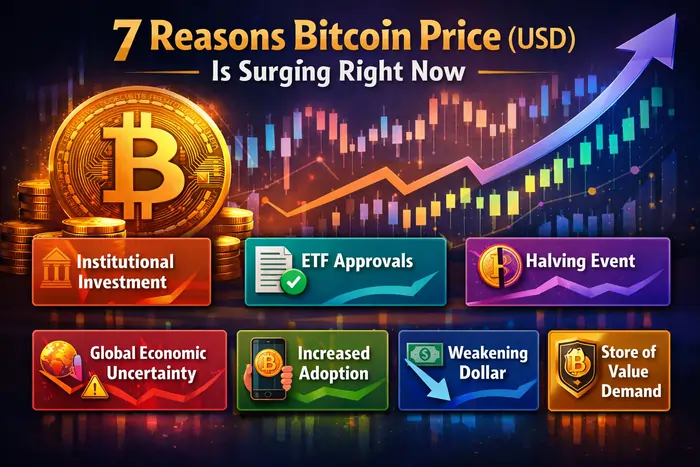
Together, these seven forces—halving-driven supply shock, ETF inflows, a friendlier macro environment, growing institutional adoption, falling exchange supply, geopolitical uncertainty, and bullish sentiment and momentum—help explain why the Bitcoin price in USD is surging right now and why many analysts think the move has structural support beneath the short-term volatility.
While Bitcoin’s surge is capturing global attention, it is only one piece of the wider market puzzle investors should be watching. If you are tracking macro risk and equity volatility alongside crypto, it is worth reading 9 Shocking Dow Jones Moves That Could Impact Investors Right Now for a deeper look at how dramatic swings in the Dow Jones Industrial Average may affect diversified portfolios. And if you are in Australia or follow local policy shifts, 7 Big Centrelink Cash Boost Changes That Could Increase Your Payments is an essential guide to understanding how updated Centrelink rules and cash‑boost mechanisms might change household cash flow and overall financial resilience.