

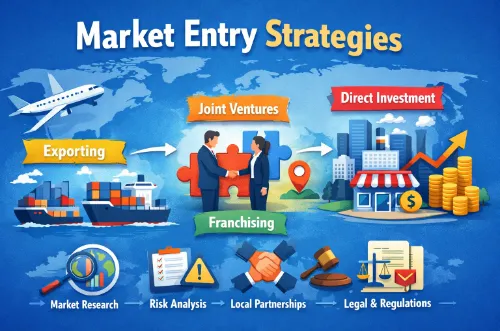
Market entry strategies are the plans and methods a business uses to sell its products or services in a new market—whether that’s another country, a new region, or a new customer segment. The right strategy balances opportunity with risk, investment, and control so you can expand without over‑stretching your resources.
What Is a Market Entry Strategies?
A market entry strategy outlines how you’ll enter a new market, who you’ll target, what you’ll offer, and which mode of entry you’ll use. It covers research, positioning, pricing, distribution, partnerships, and the specific structure you’ll use to operate in that market.
What is a Market Entry Strategy? – NMS Consulting defines it as a roadmap that details the steps, resources, and methods a business will use to tap into a new market. Market Entry Strategy Guide: 6 Ways to Enter New Markets – Shopify calls it a “blueprint” for expansion and walks through research, choosing a market, and picking an entry mode.
Common Types of Market Entry Strategies
There are several standard ways to enter a new market, each with different levels of cost, risk, and control.
1. Exporting
You produce in your home market and ship goods to the new market.
- Typically lowest investment and risk.
- Often uses intermediaries (agents, distributors) who handle local sales.
10 International Market Entry Strategies – Indeed lists indirect and direct exporting as foundational options for international expansion. Modes of Entry into Foreign Markets – Fiveable describes exporting as a good starting point before deeper commitments.
2. Licensing and Franchising
You grant a local company the right to use your brand, IP, or business model in exchange for fees or royalties.
- Licensing: they make or sell your product under agreed terms.
- Franchising: they run a business using your brand and systems.
What are the top market entry strategies? – Kadence highlights licensing and franchising as “light‑touch” approaches that trade some control for quicker, lower‑risk access. Indeed also includes these in its list of 10 international strategies.
3. Joint Ventures and Partnerships
You partner with a local business to share resources, risk, and market knowledge.
- Can involve co‑owned companies, co‑production, or distribution agreements.
- Useful where local regulations, culture, or networks are complex.
5 Steps to Create a Winning Market Entry Strategy – BDC identifies partnerships and joint ventures as key entries for export‑oriented SMEs. Fiveable’s notes show joint ventures as a common mode when firms need local legitimacy and know‑how.
4. Direct Investment / Wholly Owned Subsidiary
You set up your own operations in the new market (subsidiary, branch, or new facility).
- Highest control but also highest cost and risk.
- Best when the market is strategic and long‑term, and you need full control over brand and quality.
What Are The Five Methods For Entering Foreign Markets – GEOS describes foreign direct investment and wholly owned subsidiaries as deep‑commitment strategies suited to large or highly committed entrants.
5. Acquisition (Buying a Local Business)
You buy an existing company in the target market.
- Faster access to customers, staff, licenses, and infrastructure.
- Integration risk and often a large upfront investment.
Kadence lists “buying a business” as one of the top four strategies, particularly when you need immediate scale and local presence. BDC also notes acquisitions as a way to accelerate international expansion when the fit is strong.
How to Choose the Right Market Entry Strategy
The best strategy depends on your goals, risk tolerance, resources, and the specifics of the target market.
Key factors:
- Market size and growth potential.
- Regulatory complexity and trade barriers.
- Required investment and available capital.
- Need for local control vs speed to market.
- Your experience, brand strength, and internal capabilities.
BDC’s 5 Steps to Create a Winning Market Entry Strategy recommends aligning your entry mode with your objectives, financial capacity, and risk profile. GEOS likewise suggests matching your method (export, licensing, JV, FDI, etc.) to your long‑term strategic intent.
10 International Market Entry Strategies – Indeed is useful for comparing multiple modes side by side.
Steps to Develop a Market Entry Strategy
You can use a straightforward process to build your own plan.
1. Set Clear Objectives
Define what you’re trying to achieve:
- Revenue targets and timelines.
- Market share or brand awareness goals.
- Learning objectives (for example, “test viability with minimal capital”).
NMS Consulting emphasizes starting with clear strategic goals before selecting markets or modes.
2. Research and Select the Target Market
Analyze:
- Demand, customer segments, and buying behavior.
- Competitors and their positioning.
- Legal, cultural, and logistical factors.
Market Entry Strategy Guide: 6 Ways to Enter New Markets – Shopify walks through market selection and validation, including using online data and test campaigns.
3. Define Your Value Proposition and Positioning
Clarify how you’ll stand out:
- Price vs quality vs niche specialization.
- Unique benefits for local customers.
- How you compare to existing alternatives.
NMS Consulting’s article explains how a strong value proposition underpins every other element of your entry plan.
4. Choose Your Market Entry Mode
Based on research and constraints, decide whether to:
- Export (direct or via intermediaries).
- License or franchise.
- Partner or form a joint venture.
- Invest directly or acquire a local company.
Indeed and Kadence both give simple breakdowns of when each mode is most appropriate, which is helpful when you’re weighing trade‑offs.
5. Build Your Implementation Plan
Outline:
- Timeline and milestones for entry.
- Budget and funding sources.
- Required hires, partners, and suppliers.
- Marketing, sales, and support approach.
BDC’s 5‑step framework and Shopify’s guide both include checklists for implementation, risk management, and performance tracking.
6. Monitor, Learn, and Adjust
Once you enter, track:
- Sales, margins, and customer acquisition cost.
- Partner performance and channel effectiveness.
- Regulatory and operational issues as they arise.
Use this feedback to refine your positioning, pricing, or even your entry mode over time.
Market Entry Tips for Small Businesses and Startups
Small businesses and startups usually have limited capital and teams, so they must be extra strategic.
Practical tips:
- Start with lower‑risk modes: exporting, online channels, or partnerships before committing to offices or FDI.
- Use e‑commerce, marketplaces, and digital marketing to test demand quickly and cheaply.
- Leverage local distributors, agents, or service partners for logistics and compliance.
- Focus on one or two high‑potential markets instead of spreading thin.
Market Entry Tips for Small Businesses – Crestmont Capital stresses defining your niche, doing solid market analysis, and choosing a mode that matches your resources. Shopify’s and BDC’s guides provide practical examples tailored to smaller firms.