

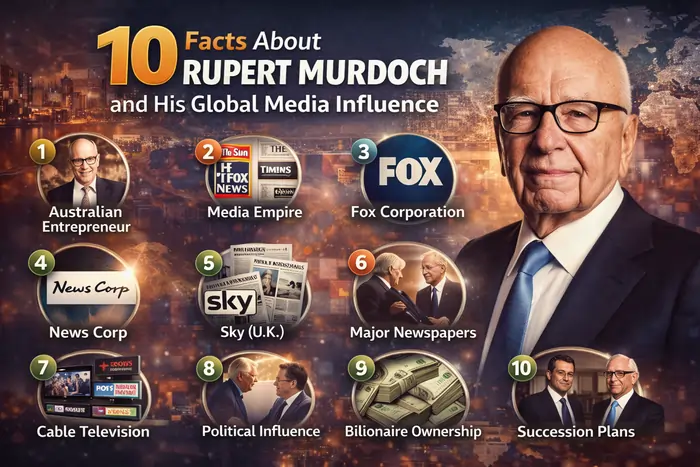
Rupert Murdoch has spent more than seven decades building a sprawling media empire that reaches into newspapers, television, film, and digital platforms across multiple continents, giving him one of the most consequential personal footprints in modern media history. Understanding how he accumulated this power, how he uses it, and why it is so controversial is essential to grasping the dynamics of global news, politics, and culture today.
10 key facts about Rupert Murdoch and His global media influence
1. From Melbourne Heir to Global Media Architect
Rupert Murdoch was born in Melbourne in 1931, the son of journalist and publisher Sir Keith Murdoch, and grew up around newsrooms and political power. When his father died in 1952, the 21‑year‑old Murdoch inherited a controlling interest in a modest Adelaide newspaper, The News, which became the launchpad for his expansion.
Through the 1950s and 1960s, Murdoch steadily bought up Australian papers, including titles in Sydney and other major cities, developing a populist formula focused on crime, sex, scandal, and bold headlines that drove circulation. In 1964 he launched The Australian, the country’s first national daily, signalling his ambition to shape national political debate, not just local city gossip.
For a concise overview of his early career and rise, you can read the Rupert Murdoch biography on Britannica.
2. Building a Cross‑Continental Newspaper Empire
Rupert Murdoch’s empire really took off when he moved beyond Australia and into the British and American markets. In 1969, he bought the London Sunday tabloid News of the World, and in 1970 acquired The Sun, transforming it into a racy, mass‑market paper that relied on sport, celebrity scandal and aggressive political campaigning.
By the 1980s, he had taken over The Times and The Sunday Times in the UK, and acquired the New York Post and eventually The Wall Street Journal in the United States. At its peak, his company controlled hundreds of newspapers worldwide, making him arguably the single most powerful newspaper proprietor of the late 20th century.
To see how extensive this print empire became in Australia, the UK, and beyond, the BBC’s explainer on the global reach of Murdoch’s News Corp provides a useful snapshot of titles and holdings.
3. Reinventing Television with Fox and Satellite Networks
Rupert Murdoch’s influence is not limited to print; he reshaped television news and entertainment through aggressive investment in broadcast and satellite networks. In the United States he created the Fox Broadcasting Company in the 1980s, challenging the dominance of ABC, CBS and NBC with edgier entertainment shows and sports rights that appealed to younger audiences.
Fox later launched the 24‑hour cable channel Fox News in 1996, which grew into one of the most influential – and controversial – news outlets in American politics. Globally, Murdoch’s companies built or acquired stakes in platforms such as Sky UK, Sky Italia, Sky Deutschland, Foxtel in Australia, and satellite operations in New Zealand and India, giving him a major role in pay‑TV and subscription news markets.
For an investor‑oriented breakdown of how Murdoch used acquisitions to knit together a multi‑platform empire, see Investopedia’s feature, “Rupert Murdoch’s Legacy: Media Empire and Influence”.
4. Structuring Power: News Corp, 21st Century Fox and Family Control
Over the decades, Rupert Murdoch’s holdings were reorganised several times, but core control remained in the family through super‑voting shares and tight ownership structures. The original News Corporation eventually split in 2013 into two entities: 21st Century Fox (film and television) and a new News Corp (newspapers and publishing).
Although this corporate separation was presented as a way to unlock shareholder value and reduce risk, media‑reform advocates have argued that the split is “largely on paper”, noting that both entities remained effectively under the influence of Rupert Murdoch and his sons. In 2019, much of 21st Century Fox was sold to Disney, but Murdoch retained control of Fox Corporation (including Fox News) and the publishing‑focused News Corp.
For a critical discussion of the ongoing concentration of ownership, the UK media‑reform group has a detailed PDF submission, “Twenty‑First Century Fox Inc and Sky plc European Intervention”, which explains how family control persisted across the split.
5. Political Influence in Australia, Britain and the United States
Rupert Murdoch’s outlets have long been accused of using their reach to shape elections and policy debates in multiple countries. In the UK, The Sun famously splashed “It’s The Sun Wot Won It” after backing the Conservatives in the 1992 general election, symbolising its perceived ability to sway voters. In Australia, his papers have consistently championed conservative economic and social positions, while in the United States Fox News became synonymous with right‑leaning commentary and Republican politics.
Rupert Murdoch has publicly downplayed his personal political clout, telling the Leveson Inquiry that he had “never asked a prime minister for anything,” but critics point to cosy relationships with leaders from Margaret Thatcher and Tony Blair to Australian and US presidents. Scholars describe him as an “elite outsider” – a figure who operates across borders, able to influence national politics while never being entirely bound by one country’s political system.
A good starting point for understanding this dimension is the BBC’s profile “Who is Rupert Murdoch?”, which outlines his relationships with political elites and the criticisms that followed.
6. Controversies: Phone‑Hacking, Ethics and Misinformation
Perhaps the darkest chapter in Murdoch’s career was the UK phone‑hacking scandal, in which journalists at News of the World and other titles were found to have hacked the voicemails of celebrities, politicians and, notoriously, a murdered schoolgirl, Milly Dowler. Public outrage forced Murdoch to close News of the World in 2011, and he later admitted to a “cover‑up” within the company and apologised for not uncovering the wrongdoing sooner.
The scandal provoked multiple inquiries, hundreds of civil cases, and a broader debate about media ethics, press regulation and the dangers of concentrated ownership. Critics argue that the culture of ruthless competition and sensationalism encouraged by Murdoch’s leadership contributed to systemic abuses, while supporters say he took decisive action once the full extent was known.
CNN’s report “Rupert Murdoch admits phone‑hacking ‘cover‑up,’ apologizes” offers a detailed account of his testimony and the fallout.
7. Shaping Public Discourse Through Story Choices and Style
Beyond ownership, Rupert Murdoch’s influence shows up in the editorial tone and story selection of his outlets. From British tabloids to Fox News, his organisations often favour emotionally charged topics – crime, immigration, culture‑war issues – framed through a populist, anti‑establishment lens.
Media scholars argue that this formula has altered expectations for “news” itself, blurring lines between reporting and opinion, and amplifying “infotainment” that prioritises engagement and outrage over nuance. Even critics who oppose his politics acknowledge that he forced legacy media to adapt to changing audience tastes and competitive pressures in ways that reshaped the industry.
For a deeper critical analysis, see the academic article “Rupert Murdoch: Elite Outsider”, which explores how his outlets influence political discourse across borders.
8. Global Reach: A Network Spanning Three Continents
One of the most striking facts about Rupert Murdoch is the sheer geographic spread of his influence. At various points, his companies owned or controlled major outlets in:
- Australia and New Zealand – including around 150 newspapers, a large share in pay‑TV networks like Foxtel and Sky, and sports channels.
- Europe – holdings in Sky UK, Sky Italia, Sky Deutschland, and several of the UK’s most prominent national newspapers.
- United States and Canada – Fox broadcast network, Fox News, 20th Century Fox (until the Disney sale), the Wall Street Journal, the New York Post, and more.
Because these outlets often cross‑promote each other and share editorial approaches, Murdoch’s companies can set or reinforce narratives that echo from one country to another, shaping how global issues – from climate policy to elections – are discussed. This transnational network is why many analysts consider him one of the first truly global media barons.
The BBC’s map‑style overview, “The global reach of Murdoch’s News Corp”, illustrates how his holdings linked multiple media markets at once.
9. Succession, Retirement and the Future of His Empire
As Rupert Murdoch aged, questions about who would control the empire after him became more pressing, both for investors and for politicians used to dealing directly with him. In 2023, he announced he would step down from key leadership roles at Fox and News Corp, handing the reins to his son Lachlan Murdoch while remaining as chairman emeritus.
This transition has sparked debate about whether the political and editorial direction of his outlets will change significantly under Lachlan, who is widely seen as sharing his father’s conservative instincts and combative style. At the same time, long‑term structural trends – digital disruption, streaming competition, and regulatory scrutiny – mean the empire faces new strategic challenges that are less about acquiring traditional outlets and more about adapting to fragmented audiences.
The New York Times piece “How Rupert Murdoch Built His Media Empire” not only recounts his rise but also touches on what his retirement means for the future.
10. Why Rupert Murdoch Still Matters in 2026
Even after selling major assets and stepping back from day‑to‑day management, Murdoch’s imprint remains visible in how news is packaged and sold worldwide. His companies helped normalise partisan cable news, tabloid‑style politics sections in serious papers, and a business model that rewards attention, provocation and emotional engagement.
Supporters argue that he championed free markets, challenged complacent elites, and gave voice to audiences who felt ignored by mainstream media. Critics counter that his outlets have undermined trust in journalism, amplified misinformation, and deepened political polarisation across democracies. Whichever view you take, it is difficult to understand contemporary media or politics in Australia, Britain or the United States without considering Rupert Murdoch’s role.
For a broader critical narrative of the scandals and ethical questions around his empire, The Conversation’s longform essay “new revelations of the Murdoch empire’s underbelly” is a useful, reflective read.
Murdoch’s Global Media Influence
| Aspect | Key details |
|---|---|
| Birth and origins | Born 1931, Melbourne; inherited The News in Adelaide in 1952. |
| Key newspaper titles | The Sun, News of the World, The Times, The Sunday Times, Wall Street Journal, New York Post. |
| Major TV assets | Fox network, Fox News, Sky (various countries), Foxtel, multiple cable and satellite channels. |
| Corporate structure | Split into 21st Century Fox and News Corp; later sale to Disney, with Fox Corp and News Corp remaining. |
| Political influence | Strong conservative editorial lines, close ties with leaders in UK, US, Australia. |
| Major scandals | UK phone‑hacking scandal, ethics controversies, criticism of Fox News coverage. |
| Global reach | Print, TV and digital outlets across Australia, Europe, North America. |
| Succession | Leadership passed to son Lachlan; Murdoch remains a powerful figurehead. |
Conclusion: A Media Legacy That Shapes Democracies
Rupert Murdoch’s story is not just the story of one billionaire; it is the story of how media ownership, political power and public opinion became deeply intertwined across the late 20th and early 21st centuries. From local Australian newspapers to global satellite networks and partisan cable news, his companies have set agendas, toppled politicians, and helped define what “news” looks and feels like for hundreds of millions of people.
As debates continue over misinformation, media regulation and the future of democracy, understanding Murdoch’s global media influence remains essential for citizens, policymakers and journalists alike. Whether you see him as a visionary entrepreneur or a symbol of media excess, his legacy will continue to shape our information landscape long after he leaves the stage.
If you’re interested in how fast‑moving trends ripple through the broader economy and consumer markets, you can also read Why Australia Is Facing a Greek Yoghurt Shortage.