

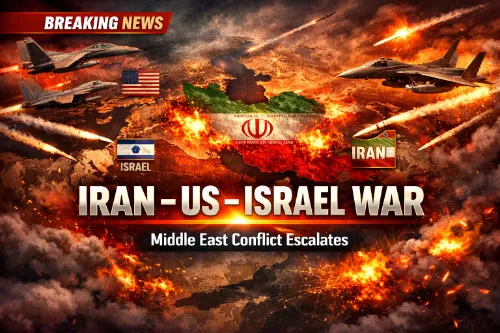
Iran US Israel War– The 2026 Iran war is an open conflict in which the United States and Israel are conducting large‑scale strikes on Iranian territory, while Iran responds with missile and drone attacks across the region. What began as a “shadow war” of covert operations and proxy clashes has now escalated into direct, state‑to‑state warfare involving multiple Middle Eastern countries.
According to an overview by Encyclopaedia Britannica, the current phase of the conflict began on 28 February 2026, when the U.S. and Israel launched coordinated strikes on Iranian military and nuclear targets under “Operation Epic Fury.” A useful high‑level background on these events is available in the Britannica entry on the 2026 Iran conflict.
How Did The Iran–US–Israel War Start?
Although the war formally erupted in 2026, its roots go back decades to Iran’s 1979 Islamic Revolution, Israel’s concerns about Iranian proxies, and U.S. worries over Iran’s nuclear ambitions. Over time, repeated crises and failed negotiations laid the groundwork for today’s confrontation.
- The long‑running Iran–Israel proxy conflict has seen Iran support groups like Hezbollah in Lebanon, Hamas in Gaza, and militias in Iraq and Yemen to pressure Israel indirectly. A concise background is provided in the Iran–Israel proxy conflict article.
- After the 2023 Gaza war and escalation across the region, Israel and Iran exchanged direct missile and drone strikes in 2024 and fought a brief “Twelve‑Day War” in June 2025, during which the U.S. also hit Iranian nuclear facilities.
- In early 2026, large anti‑government protests inside Iran and stalled nuclear talks with Washington raised the stakes further.
On 28 February 2026, Israel carried out coordinated air and missile strikes on Iranian targets, including sites in and around Tehran, with active U.S. military support. Al Jazeera provides a detailed timeline of negotiations and threats leading up to these attacks in its piece on how the US and Israel bombed Iran.
Iran US Israel War– Operation Epic Fury And The Death Of Iran’s Supreme Leader
The opening salvo of the current war was unusually dramatic: Israeli strikes, backed by the U.S., killed Iran’s Supreme Leader Ayatollah Ali Khamenei and several senior officials. This assassination transformed a tense standoff into a full‑scale regional crisis overnight.
- NPR reports that Khamenei died in Israeli airstrikes with U.S. support as “Operation Epic Fury” began, and President Donald Trump promised the operation would be “massive and ongoing.” You can read NPR’s explainer on what to know about the U.S. and Israeli attacks on Iran.
- A special report by the Institute for the Study of War (ISW) notes that U.S. and Israeli objectives include destroying Iran’s missile forces, degrading its nuclear program, and encouraging regime change by calling on Iranians to rise up. ISW’s analysis is available in its Iran Update Special Report.
- The Wikipedia entry on the 2026 Iran war provides a chronological summary of how this operation unfolded and how Iran responded.
These opening strikes marked the most dramatic escalation in U.S.–Iran and Israel–Iran relations since the 2003 invasion of Iraq, and they immediately drew global attention and concern.
Iran US Israel War– Why Did The US And Israel Attack Iran?
Washington and Tel Aviv say they are acting to neutralize Iranian threats, while critics argue the war is about dominance and regime change rather than imminent danger.
Official justifications
- U.S. and Israeli officials claim Iran’s ballistic missile program and regional proxies pose an unacceptable threat to U.S. forces, Israel, and key allies.
- TIME’s explainer on Trump’s war with Iran notes that Trump framed the strikes as a defensive move to eliminate “imminent threats,” even as intelligence officials privately acknowledged they had no clear evidence of an immediate Iranian attack.
- Israeli leaders describe Iran as an “existential threat,” pointing to Tehran’s nuclear advances and support for anti‑Israel militias.
Critical perspectives
- Al Jazeera and other regional outlets highlight that the strikes came just days after nuclear talks in Geneva appeared close to an agreement that would have sharply limited Iran’s enrichment and opened its facilities to international inspection.
- Global Witness argues that energy politics also play a role, suggesting in its report on why the US and Israel attacked Iran and what it means for oil that the conflict follows months of U.S. military build‑up near key shipping lanes and oil infrastructure.
- An analysis by the Istituto Affari Internazionali (IAI) contends that the deeper goal is to remove a major challenger to U.S. influence and Israel’s military edge, even if talk of regime change is officially downplayed. Their perspective is laid out in “The Long, Dark Shadow of the War on Iran.”
For a rounded view of motives, readers can compare these official statements with critical analyses from investigative and policy organizations.
Iran US Israel War– Iran’s Response And Regional Escalation
Iran has responded to the U.S.–Israeli campaign with missile, drone, and cyberattacks against military bases, energy facilities, and allied targets across the region. The conflict has quickly spread beyond Iran’s borders.
- Al Jazeera’s day‑by‑day coverage shows that Iranian missiles have targeted Israel directly as well as U.S. bases and infrastructure in countries such as Iraq, Qatar, Saudi Arabia, and the United Arab Emirates. You can follow developments in their rolling live coverage of the Iran war.
- CNN reports that Israel is simultaneously striking Hezbollah positions in Lebanon and issuing evacuation orders for parts of southern Lebanon amid fears of a wider front. CNN’s explainer on what we know on the fifth day of the war details these cross‑border operations.
- Deutsche Welle notes Israeli strikes on Iranian oil facilities while Iran’s leadership promises to resist pressure, even as it apologizes for missile launches that hit some Gulf states. You can watch DW’s report on Israel hitting Iran oil sites.
This regional escalation raises fears of a broader Middle East war drawing in Hezbollah, Iraqi militias, and possibly Gulf states—an outcome many diplomats are desperately trying to avoid.
Iran US Israel War– The Role Of Proxies: Hezbollah, Militias, And Beyond
Even before 2026, Iran and Israel were engaged in a long proxy struggle through allied groups across the Middle East. The current conflict builds on this network and could further activate it.
- Iran has historically backed Hezbollah in Lebanon, Hamas and other factions in Gaza, Shia militias in Iraq, and the Houthis in Yemen. These groups allow Iran to pressure Israel and the U.S. without always engaging directly.
- The Iran–Israel proxy conflict article outlines how Hezbollah received training, weapons, and hundreds of millions of dollars from Iran, enabling it to become a dominant military force in Lebanon.
- Analysts warn that if the conventional war in Iran drags on, Tehran may rely more heavily on these proxies to hit U.S. and Israeli interests across multiple fronts.
Understanding this proxy network is crucial for grasping why the Iran–US–Israel war has such wide potential to destabilize places far beyond Iran’s borders.
Humanitarian Impact And Civilian Suffering
As with any major conflict, civilians are bearing the brunt of destruction, displacement, and economic disruption. Airstrikes on urban areas, retaliatory missile attacks, and damage to oil infrastructure all create cascading humanitarian crises.
- Al Jazeera and other media document civilian casualties in Iran from airstrikes on military facilities located near residential zones.
- Inside Iran, the war compounds the trauma of recent crackdowns on protests, fuel shortages, and internet disruptions.
- Across the region, fears of widened war have led to partial evacuations in Lebanon and emergency measures in Gulf states, as highlighted in both CNN and Al Jazeera coverage.
Aid organizations and UN agencies are warning about potential refugee flows, disrupted food and medical supplies, and the risk that a prolonged war could push millions deeper into poverty. For current humanitarian assessments, readers can monitor updates from UN OCHA and the International Committee of the Red Cross on their official sites.
International Reactions And Diplomatic Efforts
Global reaction to the Iran–US–Israel war has been mixed, with some Western allies backing U.S. and Israeli actions and others calling for an immediate ceasefire.
- Time, NPR, and other U.S. outlets note that Congress is divided over the legal basis for the strikes and whether Trump has exceeded his authority without a formal declaration of war.
- Many European governments have expressed “understanding” of Israel’s security concerns but are pressing for restraint and renewed diplomacy to avoid a larger regional meltdown.
- Al Jazeera’s Inside Story segment on what dangers the Iran war poses for Israel brings together analysts to discuss how this conflict might backfire on Israel’s own security and international standing.
Policy institutes such as the IAI and ISW provide deeper strategic takes on where diplomacy might still be possible, and what a post‑war regional order could look like.
Risks Of A Wider Middle East War
One of the gravest concerns around the Iran–US–Israel war is the possibility of miscalculation or spillover drawing in more states and non‑state actors.
- Israel’s simultaneous strikes on Hezbollah and Iranian oil sites risk triggering direct confrontation with Lebanon and further entangling Syria and Iraq.
- Iran’s missile attacks on or near Gulf states strain relations with countries that host U.S. bases but also maintain economic ties with Tehran.
- Analysts at IAI warn that with no clear end‑state strategy, the conflict could leave either a fragmented, unstable Iran or a hardened, more isolated regime—both scenarios carrying long‑term risks.
For ongoing strategic assessments of escalation pathways, readers can follow think‑tank reports from organizations like the Istituto Affari Internazionali and the Institute for the Study of War.
Iran US Israel War– Oil Markets, Global Economy, And Energy Security
Because Iran is a major oil producer and the war affects key shipping routes, the conflict has significant implications for global energy markets.
- Global Witness notes that the U.S. military build‑up and the timing of attacks have heightened fears of disruptions to oil supplies and shipping through the Strait of Hormuz. Their briefing on what the war means for oil examines this in detail.
- DW reports that Israeli strikes have hit Iranian oil facilities directly, and Iran has threatened to retaliate against energy infrastructure in neighboring countries if the campaign continues.
- Energy analysts warn that sustained conflict could drive up global fuel prices, worsen inflation, and pressure import‑dependent countries in Europe, Asia, and Africa.
Readers interested in the economic angle can track updates from organizations like the International Energy Agency (IEA) and OPEC, which regularly publish market outlooks on their websites.
Iran US Israel War– Media Narratives, Disinformation, And How To Stay Informed
In a fast‑moving war, information is contested terrain. Governments, state‑aligned media, and social media influencers all push different narratives about who started the war and how it is going.
- TIME and NPR highlight contradictions between official U.S. claims of “imminent threats” and later intelligence briefings that show a more ambiguous picture.
- Regional outlets like Al Jazeera provide alternative framing, focusing on the collapse of nuclear talks and civilian suffering, while Western outlets often emphasize deterrence and security.
- Think‑tank and NGO reports—such as those from ISW, IAI, and Global Witness—aim to add independent analysis but can still reflect particular institutional perspectives.