

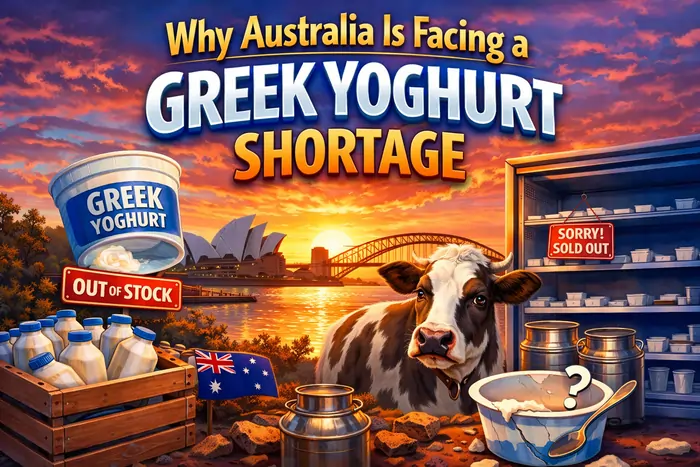
Australia is facing a Greek yoghurt shortage because demand has exploded faster than producers and supermarkets can respond, driven by a viral dessert trend and an ongoing obsession with high‑protein foods. At the same time, structural pressures in the dairy industry and rigid supermarket supply chains are turning that demand spike into empty shelves across the country.
The Great Greek Yoghurt Shortage of 2026
Over recent months, shoppers across Australia have started noticing that Greek yoghurt — especially thick, plain and high‑protein varieties — has become increasingly hard to find in major supermarkets. Coles, Woolworths and Aldi have all experienced patchy stock levels, with many stores seeing entire sections of their yoghurt aisle cleared out while other dairy products remain available. In some locations, you might still find flavoured or non‑Greek yoghurt, but the classic tubs of plain Greek yoghurt used for cooking, snacks and “healthy” desserts disappear as soon as they’re restocked.
This isn’t limited to a single brand. Budget supermarket labels, mid‑range options and premium lines alike are all affected, which suggests a category‑wide imbalance between supply and demand rather than an isolated production glitch. For shoppers, it feels reminiscent of pandemic‑era shortages, except this time the hot commodity is dairy rather than toilet paper. Social media is full of photos of empty yoghurt fridges and jokes about people hoarding tubs in their carts, adding a layer of urgency and FOMO to every supermarket visit.
If you want a mainstream news breakdown of what’s happening on the ground, this explainer from SBS News covers the shortage, shopper experiences and expert commentary in more detail.
How a TikTok Cheesecake Hack Emptied the Fridges
At the centre of the current frenzy is a wildly popular “Japanese yoghurt cheesecake” hack that has taken off on TikTok, Instagram Reels and YouTube Shorts. The recipe looks tailor‑made for virality: grab a tub of thick Greek yoghurt, press a layer of biscuits into it (often digestives, Biscoff or simple tea biscuits), let it chill, and you end up with a creamy, cheesecake‑like dessert that feels indulgent but is marketed as “lighter” and higher‑protein than a traditional baked cheesecake. Because it’s no‑bake and uses only a handful of ingredients, it fits perfectly into the social media formula of fast, visually satisfying food hacks.
The catch is that the recipe depends on a specific style of yoghurt: thick, strained Greek yoghurt with enough body to hold its shape when chilled. That pushes millions of viewers to chase the same grocery items: large tubs of plain or vanilla Greek yoghurt, preferably low‑fat or high‑protein versions marketed as healthier options. Instead of buying one tub a week for breakfast, many people are buying multiple tubs at once to batch‑prep dessert cups, experiment with flavours or feed the trend to their own audience.
Australian media has directly linked this viral dessert to the shortage. Outlets like The New Daily have reported that the Japanese yoghurt cheesecake trend is partly to blame for the rapid depletion of stock, tracing how an idea that started as a niche online recipe quickly scaled into a nationwide craze. Entertainment and culture platforms such as Happy Mag have echoed this, dubbing the phenomenon “the great Greek yoghurt shortage of 2026” and highlighting the way a single viral recipe can distort an entire grocery category.
If you want to see how creators are presenting the recipe, just search for “Japanese yoghurt cheesecake” on TikTok or check fitness‑oriented Reels that showcase high‑protein desserts.
Protein‑Maxxing and Australia’s High‑Protein Obsession
The cheesecake hack didn’t appear in a vacuum. It landed on top of a broader, steadily building trend: Australia’s fixation with high‑protein eating. Across supermarket aisles, you’ll see “high protein” splashed across everything from cereals and yoghurts to chips, bars and drinks. Greek yoghurt in particular has been marketed as a multipurpose powerhouse: breakfast base, snack, dessert substitute, smoothie ingredient and cooking staple all in one.
This has created a perfect storm of demand. Gym‑goers, macro‑trackers and people following weight‑loss or muscle‑building programs often use Greek yoghurt as a staple, sometimes consuming it daily or even multiple times a day. Nutrition and “fitfluencer” accounts promote it as a gut‑friendly, low‑sugar way to bump up protein intake. When those same accounts start posting hacks like Japanese yoghurt cheesecake, they tap into both the desire for protein and the desire for indulgent, low‑guilt treats. As a result, Greek yoghurt is no longer a niche fridge item — it’s a hero product for several overlapping health and fitness communities.
Dietitians and nutrition experts quoted in coverage like the SBS News piece have pointed out that this surge in interest isn’t driven by new dietary guidelines or a sudden increase in human protein requirements. Most Australians already get sufficient protein from a balanced diet, and the marginal gains from aggressively “protein‑maxxing” are limited for the average person. However, social media and marketing messaging have elevated protein to a kind of nutritional status symbol: more is seen as better, regardless of whether it’s necessary.
At the same time, market research — like the TechSci Research analysis of the Australian yoghurt market — shows that the yoghurt category has been growing, with high‑protein products and health‑positioned lines driving much of that expansion. When demand is already trending upward, a viral recipe doesn’t need to create a new habit from scratch; it just needs to accelerate and intensify behaviour that’s already taking hold.
Supply Constraints: Why Producers Can’t Just Make More
If demand were the only factor, you might expect manufacturers to simply ramp up production and solve the shortage quickly. In practice, several constraints make that far more difficult — especially for a product like Greek yoghurt.
First, Greek yoghurt is more resource‑intensive than standard yoghurt. It’s strained to achieve that thick, creamy texture, which means it usually requires more litres of milk per kilogram of finished product. When people suddenly demand much more Greek yoghurt, processors can’t just “stretch” the existing milk supply further; they either need more raw milk, more processing capacity, or both. Because dairy is a fresh product with relatively short timelines, there isn’t a vast buffer of spare capacity just waiting to be switched on.
Second, the Australian dairy industry has been under sustained pressure for years. Farmers have faced droughts and climate variability, high feed and energy costs, labour shortages and volatile farmgate prices. Analyses such as this LinkedIn article on Australia’s dairy industry crisis describe how many family farms are struggling with profitability and long‑term viability. When milk supply is tight or expensive, processors become cautious about adding new commitments or dramatically increasing output for any one product line.
Third, yoghurt production relies on more than just milk. Manufacturers need packaging (tubs, lids, labels), cultures, flavourings and reliable access to refrigeration and logistics. Global supply chain disruptions over the past few years have made everything from plastics to transport more expensive and sometimes slower to secure. Even if a plant could theoretically add another shift, it may be constrained by staffing, equipment limitations or previously negotiated contracts with retailers that restrict how quickly volumes can change.
Market‑level reports like the TechSci yoghurt market study highlight these vulnerabilities, noting that raw‑material cost volatility and supply‑chain bottlenecks remain key risks for producers. In such a finely balanced system, a sudden spike in demand doesn’t just cause a brief blip; it can create sustained out‑of‑stock conditions until new capacity, sourcing and logistics are properly aligned — a process measured in months, not days.
Supermarkets, Pricing Power and a Tight Duopoly

The Greek yoghurt shortage is also exposing how concentrated Australia’s supermarket landscape is, and how that shapes both pricing and availability. Coles and Woolworths together control the bulk of the national grocery market, with Aldi a strong third player but still a minority by share. This duopoly means the big chains have significant bargaining power over suppliers in terms of price, volume commitments, promotions and shelf space.
Marketing professor Mark Ritson has described this period as the “Great Yoghurt Shortage” and argued that it’s as much a test of supermarket and brand strategy as it is a story about dairy supply. In commentary reported by industry sites like Mumbrella, he frames Greek yoghurt as a case study in how a category can suddenly become starved of stock when inflexible planning collides with viral demand. Supermarkets must decide whether to raise prices to dampen demand, accept recurring out‑of‑stocks, or urgently renegotiate and expand supply — each option carrying different risks to their brand image and margins.
From the shopper’s perspective, that dynamic shows up as inconsistent availability, subtle price moves and narrowed ranges. You might see fewer brands or sizes on shelves, purchase limits on popular lines, or certain flavours quietly disappearing. Some customers report that inner‑city or higher‑income suburbs seem to get restocked faster, while regional or lower‑income areas remain bare for longer. That pattern reflects both logistics (proximity to distribution centres, delivery routes) and commercial decisions about where scarce stock will sell quickest at a profitable price.
For those interested in the intersection of marketing strategy and supermarket power, Ritson’s analysis via Mumbrella is a useful read, as it places the yoghurt shortage within broader debates about retail concentration, consumer trust and pricing behaviour.
Social Media Hype, Culture and Consumer Behaviour
Social platforms are doing more than simply reporting on the Greek yoghurt shortage; they are actively shaping how and what people buy. TikTok, Instagram and YouTube Shorts all reward content that is quick to watch, visually satisfying and easy to replicate at home. A no‑bake cheesecake that promises “maximum protein, minimum guilt” is perfect for this environment. Each new video that goes viral doesn’t just inspire a few extra purchases — it can trigger thousands of people to add Greek yoghurt to their shopping lists that same week.
Mainstream media segments amplify this effect. When morning shows or news programs demonstrate the dessert on air, they normalise it and introduce it to audiences who may not be heavy social media users. Coverage like that referenced by SBS News turns the trend into a talking point at workplaces and in families, encouraging even more people to try it “just to see what the fuss is about.” Entertainment outlets such as Happy Mag lean into the humour of the situation, comparing it to previous panic‑buying episodes and playing up the idea of “mass hysteria over yoghurt.”
At the same time, health and fitness influencers keep framing Greek yoghurt as a daily essential, not a once‑off dessert ingredient. On Instagram and TikTok, you’ll see Greek yoghurt used in overnight oats, smoothie bowls, savoury dips, protein pancakes and more. That multi‑use positioning means Greek yoghurt sits at the intersection of multiple content themes: meal prep, gut health, weight loss, muscle gain, and even budget‑friendly cooking. When a product has that many “jobs” in people’s routines, demand becomes very resilient.
This feedback loop — viral recipes driving demand, which drives news coverage, which drives more curiosity and content — helps explain why the shortage hasn’t resolved quickly. Every photo of an empty shelf or every joke about “hunting for yoghurt” reinforces the perception of scarcity, which in turn can motivate shoppers to buy extra when they do find stock.
Episodes like the Greek yoghurt shortage highlight how important technology, data and advanced processing have become in keeping modern food systems resilient and responsive. Resources like Australia’s Food Technology Guide 2026 showcase the emerging tools and platforms — from automation and AI to smart packaging and supply‑chain analytics — that Australian food manufacturers are using to adapt to shocks, manage costs and meet changing consumer demand.
How Long Could the Shortage Last?
Predicting the exact end of the Greek yoghurt shortage is difficult because it depends on both human behaviour and structural capacity. If the Japanese yoghurt cheesecake trend fades quickly and social media moves on to a new obsession, demand could fall back towards baseline levels, making it easier for existing production to catch up. However, if Greek yoghurt remains entrenched as a high‑protein staple, and if similar viral recipes keep emerging, elevated demand may become the new normal.
On the supply side, processors can invest in more capacity, renegotiate milk supply contracts or tweak their product mix, but none of those changes happen overnight. They involve capital expenditure, labour, planning permissions and long‑term demand forecasts. Given the existing pressures on dairy farmers and the broader cost environment described in analysis like this dairy industry crisis overview, manufacturers will likely be cautious about over‑expanding unless they are confident the demand spike will sustain.
What the shortage does make clear is how vulnerable tightly optimised grocery systems can be to sudden shifts in consumer behaviour. Just as toilet paper, rapid antigen tests and certain pasta shapes experienced temporary scarcity when demand spiked, Greek yoghurt is now serving as a textbook example of how quickly a single category can become constrained. Industry‑oriented commentary, such as the piece on Mumbrella, suggests that unless retailers and manufacturers build more flexibility into their planning, similar episodes are likely to recur whenever the next big viral food trend hits.
For a cultural snapshot of how this moment is being framed, Happy Mag’s article offers an accessible overview of the situation’s lighter and more absurd side.
What Shoppers Can Do in the Meantime
While individual shoppers can’t rebalance national dairy supply, there are practical steps you can take to navigate the Greek yoghurt shortage with less frustration.
- Be flexible with brands and styles
If your favourite brand or fat percentage is out of stock, consider switching to another Greek yoghurt label or trying “Greek‑style” and skyr alternatives. Icelandic‑style skyr and some strained natural yoghurts can mimic the thickness and protein content you’re used to, even if the flavour profile is slightly different. Market overviews like the TechSci yoghurt report highlight that there are multiple product segments within the yoghurt category, so a bit of experimentation can keep you covered until supply normalises. - Try smaller or independent retailers
National chains are not the only source of yoghurt. Smaller independents, ethnic grocers and local convenience stores may have different suppliers or buy on different cycles, which sometimes means they still have stock when the big players don’t. Keeping an eye on local Facebook community groups or neighbourhood chats can help you discover which nearby stores are currently stocking Greek yoghurt. - Avoid unnecessary stockpiling
It’s tempting to grab every tub you see when shelves are usually empty, but stockpiling can turn a temporary tightness into a prolonged shortage. Buying what you realistically need for a week or two helps ensure more households can access limited stock. Commentators in pieces like SBS News stress that more measured buying behaviour is one of the simplest ways consumers can ease pressure during shortages. - Make your own “Greek‑style” yoghurt at home
If you can only find plain natural yoghurt, you can create a thicker, Greek‑style version by straining it. Line a sieve with a clean muslin cloth or coffee filter, place it over a bowl, pour in the yoghurt and refrigerate for several hours. The longer you strain it, the thicker it gets. While the result won’t be identical to commercial Greek yoghurt, it’s usually close enough for dips, savoury recipes and some desserts. - Adapt viral recipes creatively
For Japanese yoghurt cheesecake and similar desserts, experiment with substitutes if Greek yoghurt is unavailable. Some creators are testing versions using blended cottage cheese, quark, high‑protein custards or a mixture of regular yoghurt and a small amount of cream cheese. These alternatives may change the texture or flavour, but they can still deliver the protein hit and “cheesecake” feel you’re after while easing demand on a single product type. - Stay informed about the broader context
Understanding that the shortage is the result of a complex mix of social media trends, health marketing, dairy‑industry pressures and supermarket dynamics can help reduce frustration. Resources like SBS News for the consumer side, The New Daily for the viral‑trend angle, Mumbrella for the marketing and retail perspective, and TechSci Research for structural market insights provide a rounded view of why this is happening and what might come next.