

Introduction
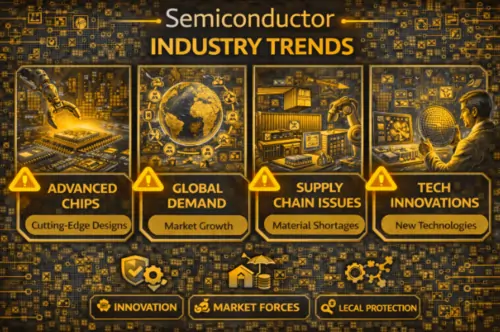
The biggest semiconductor industry trends in 2026 are no longer just about cyclical recovery. The industry is being reshaped by structural demand from artificial intelligence, heavier investment in advanced memory, renewed focus on domestic manufacturing, and rising geopolitical pressure around trade, tariffs, and export controls.
WSTS said in late 2025 that the global semiconductor market was on track to approach $1 trillion in 2026, while Deloitte also pointed to very strong 2025 and 2026 growth driven largely by AI infrastructure demand.
That does not mean every part of the market is moving at the same speed. High-performance compute, advanced packaging, HBM, and leading-edge logic are attracting intense investment, while other segments remain more exposed to pricing pressure, inventory cycles, and slower consumer recovery.
At the same time, industry leaders surveyed by KPMG said tariffs and trade policy had become their top concern for 2026, showing that the next phase of growth is happening alongside serious operational and geopolitical risk.
For companies, investors, and readers following the chip space, understanding today’s semiconductor industry trends means looking beyond simple market growth and focusing on where demand, capital, and technology leadership are actually moving.
AI Is the Main Growth Engine
The strongest force behind current semiconductor industry trends is artificial intelligence. Deloitte’s 2026 semiconductor outlook says AI data centers are driving rising demand for more powerful chips, chiplets, and memory integration, especially as manufacturers bring HBM closer to logic in advanced packaging and 3D stack designs.
Tech-focused outlooks from Deloitte also projected semiconductor revenue to rise sharply in 2025 and again in 2026 because of demand for AI-optimized processors, edge-computing devices, and other high-performance chips.
This matters because AI demand is not limited to one product category. It affects GPUs, NPUs, memory, packaging, interconnects, foundry utilization, and even electricity-intensive manufacturing plans. In practical terms, AI is pulling more of the value chain toward advanced nodes, higher bandwidth, and more complex system-level integration.
HBM and Advanced Memory Are Becoming Central
Another of the most important semiconductor industry trends is the rise of HBM and AI-linked memory demand. Deloitte highlighted closer integration of HBM with logic chiplets as a major 2026 direction, and TechInsights’ 2026 memory outlook also identified AI, HBM, and CXL as major forces reshaping memory markets.
SEAJ’s 2026 forecast for Japanese semiconductor equipment sales similarly pointed to strong DRAM investment, especially in HBM, as one of the key reasons for expected growth in fiscal 2026.
This trend is important because memory is no longer just following the traditional boom-bust cycle in the same way. AI infrastructure is changing the product mix. Higher-value memory categories are getting more attention, and that is influencing equipment demand, packaging demand, and supply priorities across the industry.
Advanced Packaging and Chiplets Are Moving to the Center
One of the less obvious but highly influential semiconductor industry trends is the shift from relying only on monolithic die scaling to using chiplets and advanced packaging to improve performance, bandwidth, and efficiency. Deloitte’s 2026 outlook specifically points to chiplets as a response to AI data-center performance needs, while memory and logic integration is increasingly happening through silicon interposers and 3D approaches.
This is a major industry change because it broadens competition. Leadership is no longer defined only by who has the smallest process node. Packaging, interconnect design, thermal management, yield strategy, and heterogeneous integration now matter much more than before. In other words, advanced packaging is becoming a strategic capability, not just a manufacturing afterthought.
2nm and Gate-All-Around Are the Next Major Manufacturing Shift
Leading-edge manufacturing is also entering a new phase. TechInsights said the industry is reaching a pivotal point in 2026 with the transition from FinFET to gate-all-around transistor structures in next-generation 2nm manufacturing. SEAJ’s forecast also cited full-scale 2nm investment by Taiwanese foundries as one of the factors supporting equipment demand.
This is one of the most important semiconductor industry trends because it shows that process innovation is still moving forward even as cost and complexity keep rising. Advanced logic leadership remains essential for AI, high-performance compute, and premium-edge applications, but the investment required is becoming even harder for smaller players to match.
Equipment Spending Remains Strong
Semiconductor manufacturing equipment is another area showing strong momentum. SEMI said in late 2024 that global total semiconductor equipment sales were forecast to reach a record $139 billion in 2026, with front-end and back-end growth both contributing. More recent industry coverage citing SEMI said forecasts had risen further, with AI demand, HBM, and leading-edge logic contributing to higher tool spending through 2027.
This suggests that one of the key semiconductor industry trends is continued capital intensity. Even when some end markets are uneven, leading players are still spending heavily on capacity, technology transitions, memory, and packaging. That benefits tool makers, materials suppliers, and equipment ecosystems tied to advanced production.
Geopolitics and Tariffs Are Now Core Industry Risks
Not all major semiconductor industry trends are technological. Geopolitical friction is now central to the industry outlook. KPMG reported that 93% of surveyed semiconductor leaders expected revenue growth in 2026, but it also found that tariffs and trade policy had become the top concern for the first time.
That is a meaningful signal. It suggests that even in a strong demand environment, companies are worried about cost inflation, restricted market access, export controls, national-security rules, and supply-chain disruption. The chip industry is increasingly global in revenue and specialized in manufacturing, but policy is pushing firms and governments toward more regional resilience and technology sovereignty.
Supply Chains Are Becoming More Regional and Strategic
A related trend is the push toward supply-chain resilience and local production. PwC’s Semiconductor and Beyond 2026 report says the industry is being reshaped by AI growth, geopolitical shifts, and increased government investment in domestic production. The report also says supply-chain resilience and technology sovereignty are becoming top priorities for both businesses and governments.
This makes semiconductor industry trends more regional than they once were. Instead of optimizing only for cost, companies increasingly have to think about geography, policy support, trusted manufacturing, and long-term access to strategic customers. That affects where fabs are built, where equipment goes, and how firms manage sourcing and partnerships.
Automotive and Edge Demand Still Matter
Even though AI dominates headlines, automotive and edge markets remain important. McKinsey’s outlook on automotive software and electronics through 2030 says several automotive electronics segments are expected to keep growing, helped by advanced driver assistance and increasing software and sensor content.
That supports the broader idea that semiconductor demand is spreading across more parts of the economy, not just traditional PCs and phones.
This is worth watching because one of the longer-term semiconductor industry trends is rising silicon content per device. Vehicles, industrial systems, and connected infrastructure are all becoming more chip-intensive, which supports demand even when individual consumer categories cool.
What These Semiconductor Industry Trends Mean
Taken together, today’s semiconductor industry trends point to an industry growing quickly but becoming more unequal, more expensive, and more strategic.
The winners are likely to be firms positioned in AI compute, advanced memory, advanced packaging, equipment, and high-value manufacturing. Companies more exposed to policy risk, slower legacy segments, or weak differentiation may find the environment harder even if the market headline numbers look strong.
The broader lesson is that semiconductors are no longer just a cyclical tech industry. They are now central to AI infrastructure, industrial policy, national competitiveness, and next-generation computing. That is why the current wave of semiconductor industry trends matters well beyond the chip sector itself.
FAQ
What are the biggest semiconductor industry trends right now?
The biggest semiconductor industry trends include AI-driven chip demand, HBM growth, advanced packaging, 2nm manufacturing, equipment expansion, and geopolitical supply-chain shifts.
Why is AI so important to semiconductor growth?
AI is important because it is driving demand for high-performance processors, HBM, advanced packaging, and data-center infrastructure across the semiconductor value chain.
What is HBM in semiconductors?
HBM stands for high-bandwidth memory. It is a premium memory technology widely used in AI accelerators because it provides very high data-transfer performance in a compact form factor.
Are geopolitics affecting the semiconductor industry?
Yes. Tariffs, trade policy, export controls, and domestic manufacturing incentives are playing a bigger role in investment and supply-chain decisions.
Is the semiconductor market still expected to grow?
Yes. Recent WSTS-related releases and Deloitte outlooks indicate strong continued growth into 2026, with forecasts approaching the trillion-dollar level.