

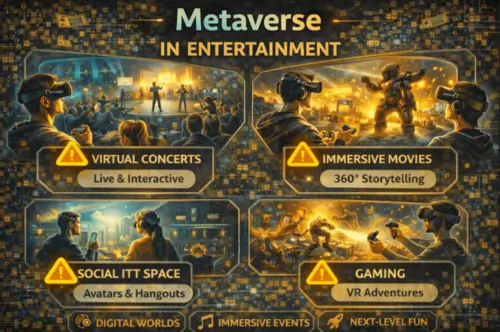
Metaverse in entertainment is a simple idea with a big impact: instead of only watching entertainment on a screen, people enter digital spaces where they can watch, play, chat, take photos, buy digital items, and experience events together.
In 2026, the “metaverse” most people actually use is not just VR headsets. It’s often game-style worlds and mobile-first social spaces that feel like interactive hangouts. That shift is important because it changes who can join: mobile access is cheaper, easier, and more common than owning a headset.
A strong sign of this shift is Meta’s recent move with Horizon Worlds. Multiple reports describe Meta separating Horizon Worlds from Quest and focusing it “almost exclusively” on mobile, aiming to compete more directly with platforms like Roblox and Fortnite.
This article explains where metaverse entertainment shows up today, why it’s growing (in some areas), how creators and brands make money from it, and what Filipino audiences should watch out for.
What “metaverse in entertainment” means in plain terms
Metaverse in entertainment is any experience where fans don’t just consume content—they participate inside a shared digital environment.
Think of it like this:
- Traditional entertainment: you watch a concert video.
- Metaverse entertainment: you enter a virtual venue, see the performance, move around, react with friends, and sometimes complete mini-games or unlock items.
The key ingredients are:
- shared space (you and others are there together)
- real-time interaction (chat, emotes, reactions)
- persistence (some worlds stay open even when events end)
- digital goods (skins, wearables, passes, collectibles)
The 2026 reality check: it’s less “VR-only” and more “platform worlds”
A few years ago, many people assumed “metaverse” meant VR headsets and fully immersive worlds. In 2026, the practical metaverse for entertainment looks more like:
- game worlds that host concerts and interactive events
- creator-built experiences inside large platforms
- mobile-first social spaces where people hang out and explore
Meta’s pivot is a good example: reports say Horizon Worlds is moving away from being primarily a VR destination and is prioritizing mobile access for scale.
This matters because entertainment depends on audience size. If an experience requires expensive hardware, fewer people can join. If it runs on phones, the audience can be much bigger—especially in the Philippines.
Where metaverse entertainment shows up today
Metaverse in entertainment usually appears in a few proven formats.
Virtual concerts and music events
Music events inside major platforms remain one of the clearest examples of metaverse entertainment. In 2025, Fortnite continued to host high-profile interactive music experiences—such as TechRadar’s coverage of the “Daft Punk Experience,” described as an immersive, interactive event with themed rooms and activities.
Sony Music has also launched a virtual concert experience in Fortnite using Unreal Editor for Fortnite (UEFN) and motion capture tools, showing how the production quality is becoming more “show-like” and less “just a game mod.”
Why this format works:
- fans can attend together with friends
- the event can be replayed or remixed as clips
- digital merch can be sold instantly
- the experience feels “limited-time,” which creates hype
Interactive storytelling and “playable episodes”
Instead of watching a story, fans interact with it:
- explore a set
- solve simple challenges
- unlock scenes through quests
This format turns entertainment into something closer to a theme park ride—short, repeatable, and shareable.
Sports watch spaces and fan hubs
Some metaverse entertainment is less about the main event and more about the fan ritual:
- watch parties
- highlight rooms
- fan challenges
- meetups and hangouts
For sports and esports, the goal is to turn “game day” into a community experience, not just a stream.
Creator-led worlds and roleplay
This is one of the biggest long-term drivers: creators build worlds where fans hang out, roleplay, or join community events. It’s entertainment powered by people, not only studios.
What’s driving metaverse in entertainment right now
Social connection is the product
A huge reason metaverse entertainment works is that people don’t only show up for the content—they show up for the shared moment.
That’s why “watch with friends” has value. It turns entertainment into a memory.
Short clips are the new front door
A clip posted on social media can bring new fans into a world. The world then keeps them there longer than a normal video would.
Metaverse in entertainment benefits from this loop:
clip → curiosity → visit the world → stay longer → share again
Better creator tools are lowering the barrier
UEFN-style toolkits make it easier to build higher-quality experiences. When big labels are using these tools for concerts and collaborations, it signals the ecosystem is maturing.
Mobile-first access expands the audience
Meta’s Horizon Worlds pivot shows an industry lesson: to reach mass audiences, you often need mobile.
For the Philippines, this is huge because entertainment adoption is often driven by phone access, not console or VR ownership.
How metaverse entertainment makes money
Metaverse in entertainment is not only “cool.” It also has business models.
Ticketed access and premium zones
Some events can be free to enter but have paid VIP areas, exclusive experiences, or perks.
Digital merch and cosmetics
Selling digital items is common in these worlds:
- skins, wearables, emotes
- limited edition bundles tied to events
The TechRadar coverage of a Fortnite music experience also mentions a bundle in the Fortnite shop, which is a classic example of how entertainment and commerce combine.
Sponsorships and branded experiences
Brands sponsor worlds, rooms, challenges, or “quests,” especially when the experience is designed to be shareable.
Creator revenue share
In some ecosystems, creators earn when their experiences attract players and engagement. This is part of why UGC worlds keep expanding: creators have a reason to build.
What makes metaverse entertainment “stick”
A lot of metaverse projects fail because they focus on tech, not on human behavior. The ones that stick usually have:
A reason to return
Weekly events, seasonal drops, and community rituals.
A clear identity
Fans know what the world is “for” (music fans, sports fans, roleplay, hangout).
Recognition
Fan spotlights, leaderboards, and rewards for participation.
Safety and moderation
If the space feels unsafe or chaotic, people stop coming back—especially parents.
Risks and challenges you should take seriously
Metaverse in entertainment can be fun, but it also comes with real risks—especially for kids and teens.
Child safety concerns are real
RAND has published research discussing risks to child safety in metaverse-like environments, including challenges for governance and protection as these platforms grow.
A 2025 university-led study (reported via Middlesex University) also warned about risks children face in immersive environments, including harassment and exposure to inappropriate content, and called for stronger safeguards and education.
Practical takeaway: the “metaverse” is not automatically safe just because it looks like a game.
Harassment and toxic behavior
Live social spaces can attract harassment, especially when moderation is weak. This is why community rules and reporting tools matter.
Privacy and data issues
Some platforms collect behavioral data to improve recommendations and monetization. Users should understand privacy settings, especially minors.
Platform dependency
If your whole experience lives on one platform, policy changes can break your strategy overnight. This affects creators, brands, and even fans who lose access to favorite worlds.
The Philippines angle: why it can work, and what blocks it
Metaverse in entertainment can work well in the Philippines for a few reasons:
- mobile-first culture
- strong fandom communities (music, sports, creators)
- love for social sharing and group experiences
But there are real blockers too:
- data costs
- device performance (older phones struggle)
- unstable internet in some areas
A practical approach for PH creators and brands is to start inside existing platforms (where the audience already is) instead of building a “from-scratch metaverse.” Use lightweight experiences, clips, and community events first—then scale.
What to watch next in 2026 and beyond
Metaverse in entertainment is likely to keep evolving in these directions:
More mobile-first experiences
Meta’s Horizon Worlds change is one visible signal that “metaverse reach” is heading toward phones, not only headsets.
More interactive concerts and brand events
Fortnite-style events continue to blend performance, mini-games, and digital merch—showing what a “concert” can become in a digital world.
Higher expectations for safety
As research continues highlighting risks to minors, platforms will face pressure to improve protections and moderation.
FAQs
What is metaverse in entertainment?
It’s entertainment experienced inside shared digital worlds where people can watch, play, socialize, and interact in real time.
Do you need VR to enjoy metaverse entertainment?
Often, no. Many popular experiences run inside game-style platforms and are increasingly designed for mobile access.
What is metaverse in entertainment?
It’s entertainment experienced inside shared digital worlds where people can watch, play, socialize, and interact in real time.
Do you need VR to enjoy metaverse entertainment?
Often, no. Many popular experiences run inside game-style platforms and are increasingly designed for mobile access.
Are virtual concerts still growing?
Yes. Major platforms keep launching new interactive concert-style events and branded music experiences.
How do creators earn money in metaverse entertainment?
Common models include ticketed access, digital merch/cosmetics, sponsorships, and creator revenue-sharing depending on the platform.
What are the risks for kids and teens?
Key risks include harassment, exposure to inappropriate content, and other safety concerns highlighted by research and policy discussions.