

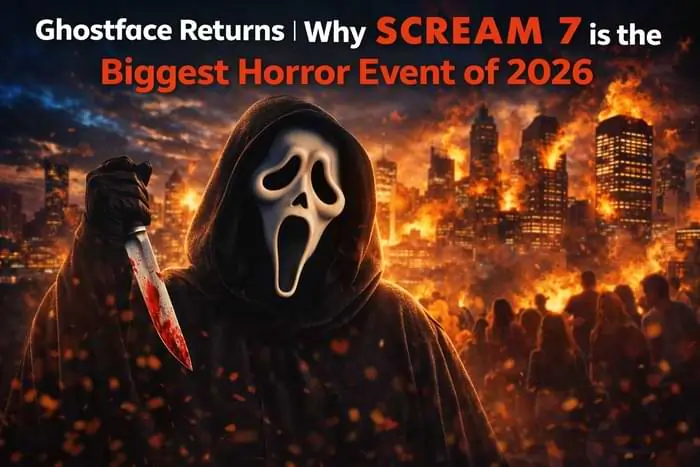
Ghostface is back, Sidney Prescott is front and center again, and Scream 7 has arrived as one of the most talked‑about horror releases in years. In its 30th‑anniversary moment, the franchise leans hard into nostalgia, legacy casting, and “event movie” marketing to claim its place as the horror film everyone is arguing about in 2026.
Introduction: Ghostface Strikes Again in 2026
Scream 7 lands three decades after the original Scream rewrote the rules of slasher movies and meta‑horror. This time, the hook is simple but powerful: Neve Campbell returns as Sidney Prescott, Kevin Williamson steps up from writer to director, and a new Ghostface terrorises the next generation while dragging the old guard back into the nightmare.
Whether critics love it or not, the movie has become a cultural flashpoint. Its mix of legacy characters, new blood, and heavy franchise nostalgia, plus a global theatrical rollout, is exactly why Scream 7 is being treated as the biggest horror event of 2026 rather than just another sequel dropped into a busy release calendar.
Scream 7 at a Glance: Release Date, Rating, and Where to Watch
Scream 7 is a 2026 American slasher film continuing the long‑running horror series that began in 1996. It’s directed by original Scream writer Kevin Williamson, from a script written by Williamson and Guy Busick, based on a story they developed with James Vanderbilt. The film is produced by Spyglass and distributed by Paramount Pictures, keeping the franchise in familiar studio hands.
Key essentials:
- It premiered in late February 2026 and opened widely in U.S. theaters on February 27, 2026, with near‑simultaneous releases in major international markets, as detailed on IMDb’s Scream 7 page and film guides.
- It runs a little under two hours (around 114 minutes), giving it enough room for multiple kill set‑pieces and a layered whodunit, without drifting into epic runtime territory.
- It carries an R rating in the U.S. for strong bloody violence and language, with similar age restrictions across most territories.
- The official hub includes trailers, cast lists, and ticket info at the Scream 7 official website, positioning the film openly as a “30‑year event.”
For a quick, fan‑oriented FAQ that covers release date, cast, continuity, and Ghostface trivia, The Popverse guide to Scream 7 is a great pre‑watch read.
The Return of Ghostface: What Makes This Killer Different
At its core, Scream 7 sticks to the series’ primary blueprint: Ghostface is back, a new string of murders begins, and the survivors once again find themselves trapped in an elaborate horror movie come to life. What changes here is context. Instead of being centered on Woodsboro or the New York setting of Scream VI, the killings follow Sidney into the quiet town where she has tried to rebuild her life with her family.
The new Ghostface fixates on Sidney’s teenage daughter, turning the notion of a “next generation final girl” into the emotional heart of the story. Critics and fan resources like the Scream 7 page on Rotten Tomatoes and Scream Wiki outline how this killer directly targets Sidney’s family and weaves in references to earlier Ghostface identities.
Classic elements remain—taunting calls, horror‑movie references, and rules for surviving a franchise instalment—but Scream 7 also nods to modern anxieties. Technology, deepfakes, and voice‑changing tools get woven into the Ghostface tactics, playing on fears about how easily identity and reality can be manipulated in the age of AI, while still retaining the analog terror of someone with a knife on the other end of the phone.
The result is a Ghostface that feels both familiar and updated: the same mask, the same voice (again performed by Roger L. Jackson), but with methods that reflect 2026’s paranoia about surveillance, digital footprints, and the blurred line between fiction and reality.
Legacy Characters and New Blood
One of the main reasons Scream 7 feels like an event is its cast. The film pulls together multiple generations of characters, deliberately bridging the original trilogy, the mid‑series sequels, and the recent revival entries.
On the legacy side:
- Neve Campbell returns as Sidney Prescott, marking her first appearance since sitting out Scream VI; outlets like The New York Times and CBC both frame her comeback as a major draw for long‑time fans.
- Courteney Cox is back as Gale Weathers, continuing her long streak as the franchise’s investigative, opportunistic, but ultimately loyal survivor.
- Familiar faces from earlier instalments appear via flashbacks, footage, or other story devices, tying Scream 7 tightly to the history of Woodsboro and the Stab films, as outlined in The Hollywood Reporter’s Scream 7 franchise overview.
- Roger L. Jackson once again voices Ghostface, maintaining the unsettling consistency that’s been present since the original film, as noted in fan resources like Scream Wiki.
Alongside them is a younger ensemble:
- Sidney’s daughter (played by Isabel May, per casting lists on IMDb and Popverse) steps into an updated “final girl” position, giving the story an emotional angle about inherited trauma and the cost of living with a legacy of violence.
- Supporting characters from the recent reboot era, like the Meeks‑Martin twins (Jasmin Savoy Brown and Mason Gooding), help connect this movie to the fifth and sixth entries and anchor it in the broader modern Scream timeline.
- New friends, romantic interests, and red‑herring suspects populate Sidney’s new town, providing a fresh pool of potential victims and mystery suspects.
The casting evolution and behind‑the‑scenes changes—especially after the highly publicised exits of Melissa Barrera and Jenna Ortega—are traced in The Hollywood Reporter’s “Everything We Know About the Next Slasher Film”.
Kevin Williamson’s Vision and the Franchise “Homecoming”
Scream 7 has been described as a “homecoming” because of who is behind the camera as much as who is in front of it. Kevin Williamson, who wrote the original Scream and helped define its self‑aware tone, returns not only as co‑writer but as director. Variety’s review, “‘Scream 7’ Review: Neve Campbell Returns for a Back‑to‑Basics Slasher”, highlights this shift and frames the film as an attempt to stabilise the franchise with a more classic Scream sensibility.
The New York Times review describes the film as emerging “amidst a gentle haze of nostalgia,” calling it a reunion for core contributors like Campbell and Williamson, who were absent from the sixth film. That sense of reconnection—after the controversies and creative reshuffles around Scream VI—is a big part of the movie’s “event” status.
Popverse emphasises that Scream 7 is heavily connected to earlier films, threading in references to past Ghostface killers and long‑standing continuity details, even as it steps back from the heavier meta‑twist structures of the middle sequels. For fans of the classic Scream tone, the combination of Williamson’s return and Sidney’s central role gives this film a “must‑see” status that goes beyond a typical slasher sequel.
Plot Teases (Spoiler‑Light): Setting, Stakes, and Survival

The film opens by establishing Sidney’s new life, complete with a family, a quieter town, and routines that look nothing like the chaos of Woodsboro or New York. The opening kill sequence—a hallmark of every Scream movie—fuses new tech and old‑school stalking, setting a tone that marries series tradition with the anxieties of 2026.
Very quickly, the attack pattern makes it clear that Sidney’s daughter is no random target. The killer knows who she is, what the Prescott name means, and how to use that history to terrorise both Sidney and the town. Phone calls and messages reference past Ghostface killers, prior massacres, and details only a true fan—or someone obsessively studying the case history—would know. Popverse’s Scream 7 FAQ and the Scream 7 entry on Scream Wiki both highlight how deep those continuity nods go.
As the bodies start to drop, the film weaves in investigators, skeptical locals, and returning survivors who rush to help Sidney. Familiar Scream staples appear:
- A re‑examination of “the rules” for surviving horror movies in 2026, with nods to streaming culture, TikTok true‑crime content, and spoiler‑obsessed fandoms.
- Suspicion that falls on nearly everyone at some point, with the script deliberately planting clues and misdirects.
- A third act that pulls all the major players into a single location for an extended siege, unmasking, and motive monologue.
For those wanting a spoiler‑heavy breakdown of specific kills and twists, Inverse’s “‘Scream 7’ Review: The Good, The Bad, And The Meta” walks through the film’s biggest swings and where they land.
Kills, Tension, and Meta Commentary: Does Scream 7 Deliver the Scares?
On the visceral level, Scream 7 is determined to prove it belongs in a theatrical setting. The kills are louder, bloodier, and more elaborate than many earlier entries, with set‑pieces staged in locations designed for maximum suspense—suburban houses, public spaces where no one intervenes, and claustrophobic interiors where every shadow could hide Ghostface.
The San Francisco Chronicle review notes that the movie hits all the familiar beats: a meta opening scene, phone calls, “the rules,” and a finale where Ghostface pauses stabbing to monologue through the exposition. Some critics feel the film leans too heavily on those familiar rhythms, but for many fans, that formula is part of the appeal.
The meta commentary is present, though opinions differ on how sharp it is this time:
- Mashable’s “‘Scream 7’ review: Kevin Williamson makes Ghostface fun again” argues that Williamson recaptures much of the original’s playful tone, making Ghostface “fun again” with sharp dialogue and clever references.
- Inverse contends that Scream 7 “fails to bring back the franchise’s meta‑magic,” suggesting the commentary on reboots, fandom, and franchise fatigue feels less incisive than in earlier films.
- CBC’s review says that despite the callbacks and gore, “something essential is noticeably and puzzlingly absent” from the core Scream identity.
Rotten Tomatoes’ Scream 7 page, highlighted in The Hollywood Reporter’s write‑up, currently shows this entry trending toward the bottom of the franchise in critic scores, even as some reviews praise its kill scenes and exploration of an older Sidney. That split—between appreciative nostalgia and disappointment with the execution—is exactly what keeps the film at the center of fan debates.
Box Office Buzz: Why It’s the Biggest Horror Event of 2026
From a business perspective, Scream 7 has all the hallmarks of a horror event film rather than a mid‑tier genre release. Deadline’s box‑office preview, “‘Scream 7’ Bound for $60M Opening at Worldwide Box Office”, reports that the film is tracking around a 60‑million‑dollar global debut, making it the second‑best opening in the franchise’s 30‑year history.
The marketing campaign leans heavily on three pillars:
- Legacy: “Sidney Prescott returns” is front‑and‑center in trailers, posters, and interviews, reinforcing that this isn’t just another Scream—it’s the Scream that brings the original final girl back.
- Anniversary: The 30‑year milestone is baked into the branding, reminding audiences how long Ghostface has been part of pop culture. The official Scream 7 website and social promos echo this, with taglines about the mask returning and the terror escalating.
- Event framing: Taglines and social campaigns sell it as “the horror event of the year,” deliberately prompting FOMO and encouraging theatrical viewing over waiting for streaming. Cinema‑chain posts like SM Cinema’s “The mask returns, the terror escalates” teaser reinforce that event framing.
In a 2026 horror landscape filled with new IP, streaming premieres, and smaller‑scale indies, a theatrical Scream film led by Neve Campbell and Kevin Williamson stands out. Even detractors tend to acknowledge that, for better or worse, it’s the title most horror fans are either lining up to see or eager to argue about.
Critical and Fan Reactions: Hit, Miss, or Cult Classic in the Making?
Critical response to Scream 7 is sharply divided:
- The New York Times review frames it as a nostalgic reunion that brings back familiar faces, appreciating the return of Campbell and Williamson even as it questions how much new ground the film truly breaks.
- Variety’s back‑to‑basics slasher review describes the film as having a “weirdly restricted agenda,” suggesting that, while it restores some of the original spirit, it also feels cautious and hemmed in.
- CBC’s “Even Neve Campbell can’t save controversy‑laden Scream 7” argues that despite nostalgic nods and plenty of blood, the core essence of what made Scream special is missing.
The Hollywood Reporter’s Rotten Tomatoes score piece notes that Scream 7 may end up with the lowest critic score in the series, even as some reviews praise its kill scenes and exploration of an older Sidney. Meanwhile, more positive takes like Mashable’s review and some fan‑driven breakdowns suggest that, flaws and all, the movie still delivers enough tension and character beats to justify the hype for franchise devotees.
Fan reactions across platforms and in communities like Scream Wiki show the movie functioning as a flashpoint: people are celebrating the return of Sidney and Gale, arguing over Ghostface’s identity and motives, and debating whether the franchise should continue or finally be laid to rest. That level of engagement—even when divisive—is part of what makes Scream 7 feel like an event rather than a typical genre outing.
What Scream 7 Means for the Future of the Franchise
Scream 7 clearly positions itself as a turning point. By pulling Sidney back into the center, reuniting her with Gale, and bringing Kevin Williamson behind the camera, it feels both like a culmination of 30 years and a test of how much appetite remains for more Ghostface stories. Articles like The Hollywood Reporter’s franchise look‑ahead and analysis across fan communities speculate about whether this is a quasi‑finale or the springboard for a new chapter centered on Sidney’s daughter and the younger survivors.
Depending on how you read the ending and its final images, the film can be seen as:
- A quasi‑finale that gives Sidney some measure of closure, even if Ghostface as an idea can never fully die.
- A soft reset that shifts the emotional weight to the next generation, signaling where a potential Scream 8 might go.
- A commentary on how hard it is to truly “end” a profitable franchise in an era where horror IP and nostalgia are evergreen assets.
For the studio, box‑office performance and long‑tail streaming interest will determine whether Scream 8 becomes a near‑term reality or whether they let Ghostface rest for a while. For fans, Scream 7 offers plenty to argue over: Did it do right by Sidney? Did the meta commentary land? Is there still creative juice left in the mask?
In a year crowded with major cultural moments—from stadium‑filling live shows like Ed Sheeran Melbourne Setlist: Massive 30-Song Loop Tour Hits to deeply personal feel‑good headlines such as Miraculous News: Magda Szubanski Announces Cancer Remission and global fan celebrations like Pokémon Day 2026: Australia Celebrates 30 Years of Pocket Monsters—Scream 7 stands out as horror’s own blockbuster event, reminding us how powerful a familiar mask and a well‑timed scare can be in shaping the pop‑culture conversation of 2026.