

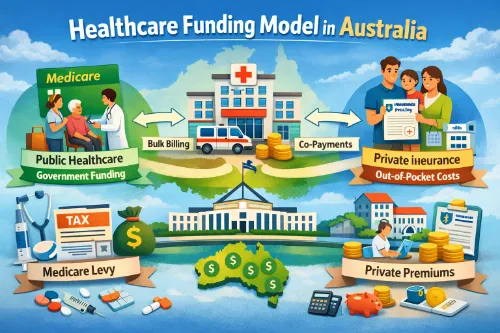
Australia’s healthcare funding model is built on a tax‑financed universal scheme (Medicare), layered with private health insurance, state hospital funding, and significant out‑of‑pocket payments. Understanding how these pieces fit together is essential for anyone analysing health policy, investing in health services, or simply trying to make sense of who pays for what in the Australian system.
1. Overview: a mixed public–private healthcare funding model
Australia runs a universal public health insurance program (Medicare) alongside a large private health insurance sector and direct patient payments.
The Australian Government Department of Health describes this as a system where the Commonwealth, states and territories, private insurers and individuals all contribute to funding care. The Commonwealth Fund’s profile of Australia summarises it simply: Medicare is financed through general taxation and a specific levy; public hospitals are funded jointly by federal and state governments; and roughly half of Australians buy private insurance for faster access and additional services.
A recent explainer on How Australia’s healthcare system works in 2025 notes that the system’s core aim is to reduce out‑of‑pocket expenses while ensuring broad access across urban and regional areas, using a mix of rebates, subsidies and public hospital funding.
2. Medicare: tax‑funded universal health insurance
Medicare is the backbone of Australia’s health funding model.
The Department of Health explains that Medicare is Australia’s universal health insurance scheme and guarantees eligible residents access to free or subsidised treatment in public hospitals and for many medical services in the community. The government information portal What is Medicare? adds that Medicare covers part or all of the costs of GP and specialist visits, tests, some allied health services, and public hospital care.
How Medicare is funded
Funding comes from general taxation plus a dedicated levy:
- According to the Commonwealth Fund profile, Medicare is financed through the national tax system and “in part by a government levy”, raising billions of dollars annually.
- A policy review in BMC Health Services Research notes that Medicare is funded by tax dollars and an income‑based Medicare levy, commonly 1.5%–2% of income, with higher‑income households without private cover paying a higher effective rate.
- The Medicare (Australia) Wikipedia entry explains that the Medicare levy is currently 2% of a resident taxpayer’s taxable income, but revenue from the levy falls short of total Medicare expenditure, so the shortfall is covered from general government spending.
- Healthdirect confirms that Australian taxpayers fund Medicare by paying 2% of their taxable income via the Medicare levy, calculated automatically through the tax system.
In short, Medicare is not fully levy‑funded; it is a general‑revenue program with a symbolic and practical surcharge to earmark some funding for health.
3. Commonwealth and state roles in Healthcare funding model
Healthcare funding is a shared responsibility between the Commonwealth (federal) government and the state and territory governments.
A Senate committee chapter on the role of Commonwealth and state/territory governments describes Australia’s health system as financed by a mix of public and private arrangements, with the Commonwealth subsidising access to primary care and pharmaceuticals through Medicare and the Pharmaceutical Benefits Scheme (PBS), and contributing to public hospital funding through intergovernmental agreements.
The Department of Health’s page on the Australian health system explains that the federal government:
- Funds Medicare and the PBS,
- Provides funding to states and territories for public hospital services under the National Health Reform Agreement,
- Funds health and medical research, veterans’ healthcare and Aboriginal Community Controlled Health Organisations, and
- Supports the health workforce (for example, university places for doctors).
States and territories, in turn, own and operate public hospitals and fund many community services, with Commonwealth money flowing through long‑term funding agreements. Recent reporting by the ABC highlights how these negotiations work in practice: in January 2026, the Albanese government agreed to an extra AUD 25 billion for public hospitals as part of a new five‑year, AUD 220‑billion hospital funding deal with the states, including a higher cap on annual funding growth (up to 10.25% in year one, then 8% medium‑term).
4. How public hospitals are funded
Public hospitals consume a large share of health funding and are financed through a structured, activity‑based model.
The Commonwealth Fund profile reports that 92% of public hospital funding comes from government—split between the federal government and the states—with the remainder from private patients and insurers. It notes that most recurrent spending (about 66%) goes on salaries for employed physicians and staff.
A 2025 survey of healthcare financing and reimbursement in Australia explains that public hospitals are funded under the National Health Reform Agreement and paid using activity‑based funding. The Independent Health and Aged Care Pricing Authority sets an “efficient price” for hospital services, and the Commonwealth funds a fixed share of the growth in services based on that price. People with Medicare receive free treatment in public hospitals as public patients, covering doctors’ fees, accommodation, and clinical services.
The ABC’s reporting on the 2026 hospital funding deal underscores how political these funding formulas can be, with states pushing for higher growth caps to keep up with demand and cost pressures.
5. Private health insurance: funding parallel care
Australia has a large private health insurance (PHI) sector operating alongside Medicare.
The Commonwealth Fund profile notes that about half of Australians purchase private supplementary insurance, primarily to:
- Access private hospitals and private rooms,
- Choose their own doctor,
- Cover services Medicare doesn’t fully fund (for example, dental, some allied health), and
- Avoid higher tax penalties at higher incomes.
An OECD case study, “Private Health Insurance in Australia: A Case Study”, explains that policymakers have actively encouraged private financing and provision to operate in parallel with the public system, using regulation and subsidies to expand PHI coverage. PHI is seen as a way to reduce pressure on public hospitals and increase choice, but subsidies to private cover also add to public expenditure and have created ongoing debate about equity and cost‑effectiveness.
The Australian Prudential Regulation Authority (APRA) is the prudential regulator for PHI. In “APRA’s role in private health insurance premium round”, APRA explains that it assesses insurers’ annual premium increase requests, focusing on whether proposed premiums will keep insurers solvent and able to pay claims while remaining sustainable for policyholders. The Department of Health consults APRA before approving premium changes, illustrating how government steers PHI pricing.
A policy statement from the Public Health Association of Australia notes that around 44.9% of Australians have PHI for hospital treatment, and that PHI premiums are subsidised by a means‑tested rebate, averaging about 27.8% of the premium cost, at a public cost of roughly AUD 6.7 billion per year. This public funding of private insurance is a key feature of Australia’s hybrid model.
6. Out‑of‑pocket payments and cost‑sharing
Despite universal coverage, out‑of‑pocket spending remains a significant component of healthcare funding.
The Commonwealth Fund profile reports that out‑of‑pocket payments accounted for 16.5% of total health expenditures in 2016–2017, with:
- 68% of OOP spending going to primary care (GPs, specialists, allied health),
- Around 37% of that primary‑care OOP attributable to medications, and
- About 11% of OOP going to hospital care.
The BMC policy review on the Australian healthcare system notes that while Medicare and the PBS subsidise many services, patients often face copayments and gaps (the difference between the Medicare rebate and the provider’s fee), especially when seeing specialists or using private providers.
Healthdirect also emphasises that Medicare does not cover everything—such as most dental care, some allied health and alternative therapies—so people either pay OOP or use private insurance. This means individuals directly fund a meaningful slice of the system alongside taxes and premiums.
7. Funding public health and prevention
Public health and prevention are funded through a mixture of Commonwealth and state spending, but still represent a relatively small share of total health expenditure.
A recent article in Health Promotion Journal of Australia, “How do we fund Public Health in Australia? How should we?”, notes that Australia spent around AUD 140 per person on public health in 2019–20, or 1.8% of total health spending, with significant variation between states and territories. The authors argue that this level of investment is low relative to the potential benefits of prevention and that public health funding often lacks stable, long‑term arrangements.
The Department of Health’s system overview explains that the Commonwealth funds health and medical research through vehicles like the Medical Research Future Fund and the National Health and Medical Research Council, and also funds community‑controlled Aboriginal health services and national screening programs. These investments support prevention and system capacity, even though they are not always visible to patients.
8. How the model works in practice
Putting the pieces together, Australia’s healthcare funding model operates roughly as follows:
- Commonwealth taxation and the Medicare levy finance Medicare benefits, PBS subsidies, public health programs, research, and a large share of public hospital funding.
- State and territory budgets (supported by Commonwealth transfers) fund and operate public hospitals and many community health services.
- Private health insurance premiums (subsidised by government rebates and regulated by APRA) fund much of private hospital care and some extras (dental, optical, allied health).
- Out‑of‑pocket payments fill gaps where Medicare and PHI don’t fully cover costs or where individuals choose non‑covered services.
The Medicare and Australian health system pages provide official overviews of how funding flows from the Commonwealth to services. The Commonwealth Fund’s country profile offers an accessible international comparison, including statistics on government vs private shares of spending. For a more critical policy perspective, the BMC review of the Australian healthcare system and the OECD’s Private Health Insurance in Australia case study discuss tensions around equity, efficiency and the public subsidy of private coverage.