

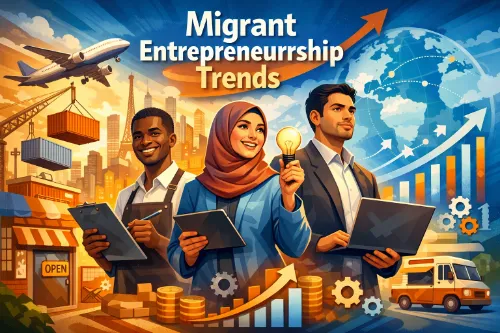
Migrant entrepreneurs are reshaping economies around the world. From family businesses and local services to high‑growth tech startups, migrants are launching companies at growing rates and playing a major role in job creation, innovation and international trade.
Recent global studies show that migrants are now over‑represented among self‑employed people in many OECD countries, and that their entrepreneurial activity accounts for a significant share of new jobs. At the same time, migrant founders often face unique barriers around regulation, finance, networks and language, which means their full potential is still far from realised.
Global Overview: Migrants as a Growing Share of Entrepreneurs
Across OECD countries, migrants are becoming an increasingly important part of the entrepreneurial landscape.
- The OECD’s International Migration Outlook 2024 reports that, on average, migrants represented about 17% of the self‑employed population in OECD countries in 2022, up from 11% in 2006.
- According to Chapter 4 of that report, “Migrant entrepreneurship in OECD countries”, roughly 80% of the increase in migrant self‑employment share is due to the growing migrant population itself, while the remaining 20% reflects migrants becoming more likely to be self‑employed over time.
- Between 2011 and 2021, migrant self‑employment generated about 3.9 million additional jobs across 25 OECD countries—around 15% of total employment growth in those economies.
These figures underscore an important point: migrant entrepreneurship is not a marginal phenomenon. It is a core component of how many economies are generating jobs and adapting to demographic and technological change.
Why Migrants Turn to Entrepreneurship
Migrants start businesses for a mix of opportunity‑driven and necessity‑driven reasons, and these motivations shape the types of ventures they create.
- Overcoming labour‑market barriers: Many migrants face challenges in wage employment, including non‑recognition of foreign degrees, language barriers, limited local experience, or discrimination. Self‑employment can provide a way around these obstacles.
- Leveraging transnational networks: Migrant founders often have unique knowledge of foreign markets and cross‑border relationships, enabling them to import goods, export local products, or serve diaspora customers.
- Filling local gaps: Migrant entrepreneurs frequently address underserved needs in food, retail, logistics, care services and multicultural products in their host communities.
- Seizing digital opportunities: The spread of e‑commerce, freelancing platforms and remote work has lowered entry barriers and made it easier for migrants to launch micro‑enterprises from anywhere.
The OECD’s chapter on migrant entrepreneurship in OECD countries emphasises that these dynamics vary by country and migrant group, but the overall trend is clear: migrants are an increasingly vital source of entrepreneurial energy.
Economic Impact: Jobs, Innovation and Trade
Migrant‑founded businesses contribute to host economies in several key ways.
- Job creation: OECD modelling suggests that, across the 25 countries studied, migrant entrepreneurship has accounted for about 3.9 million net additional jobs over a decade. In simplified terms, the OECD notes that for every 10 additional migrants of working age, around two extra jobs are created through entrepreneurship alone.
- Innovation and dynamism: Migrants are over‑represented among founders in innovative sectors, including tech, biotech and digital services. Their diverse perspectives and global networks can spur new ideas, products and business models.
- Trade and internationalisation: Migrant entrepreneurs are often at the forefront of export activity, using cross‑border ties to expand into new markets, connect suppliers and customers and bring foreign investment into host economies.
The OECD’s migration outlook, alongside entrepreneurship research published in journals such as Entrepreneurship & Regional Development, shows strong associations between migrant entrepreneurship and increased innovation and trade intensity in local economies.
Migrant Entrepreneurship in OECD Countries: Policy Context
Policymakers have started to pay closer attention to migrant entrepreneurship as part of broader migration and economic strategies.
- Many OECD countries have introduced or expanded startup, entrepreneur and talent visas to attract high‑potential founders, especially in tech and knowledge‑intensive sectors.
- Some governments provide dedicated entrepreneurship support for migrants, including training, mentoring and access‑to‑finance programs, often delivered through chambers of commerce, NGOs or city governments.
- International organisations encourage countries to better integrate migrant entrepreneurship into mainstream SME and innovation policies rather than treating it solely as a niche social‑policy issue.
The policy chapters in the OECD International Migration Outlook 2025 stress that if countries want to compete in the “global race for talent,” recognising and supporting migrant entrepreneurs should be part of their economic playbook.
New Forms of Migrant Entrepreneurship: Platforms and Digital Work
Digitalisation and platform‑based work are changing what migrant entrepreneurship looks like on the ground.
- Gig and platform work: Migrants are heavily represented in ride‑sharing, food delivery, and on‑demand home services, often as independent contractors or sole traders. This can be a stepping stone into entrepreneurship, but it also comes with risks and limited protections.
- E‑commerce and online services: Many migrant entrepreneurs run online shops on global marketplaces, provide digital services (design, programming, tutoring) or operate cross‑border dropshipping businesses.
- Remote and hybrid teams: Some migrant founders build remote‑first startups that serve international clients and employ globally distributed teams, blending migration and digital enterprise.
The OECD cautions that while these models can lower entry barriers, they also blur the lines between entrepreneurship and precarious work, so policies need to ensure adequate rights and support for migrant “solo entrepreneurs” in the platform economy.
Dedicated Section: Migrant Entrepreneurship in Australia
Australia offers a vivid example of how migrant entrepreneurship is shaping a national economy. As a country built on immigration, Australia has a long history of migrant‑run businesses—from corner shops and restaurants to global tech companies—and recent research suggests their importance is growing.
Scale and Characteristics of Migrant Entrepreneurship in Australia
OECD and Australian government data paint the following picture:
- OECD figures indicate that migrants now account for about 16% of self‑employed people in Australia, slightly above the OECD average and up from earlier decades.
- The Department of Home Affairs’ Migration Trends 2023–24 report shows that skilled and family migrants form the bulk of permanent arrivals, but entrepreneurial activity spans many visa categories.
- In the OECD’s migrant entrepreneurship chapter, Australia is listed among countries where migrant self‑employment has grown consistently since the mid‑2000s, especially in large cities.
- Migrant‑owned businesses are common in retail, food services, transport and construction, but migrants are increasingly visible in professional services, tech and international education‑related ventures.
These trends mirror the broader Australian story: a highly urbanised, services‑oriented economy where new migrants participate across traditional small business sectors and newer knowledge‑intensive industries.
Refugees and Humanitarian Migrants: High Rates of Entrepreneurship
Within Australia’s migrant communities, refugees and humanitarian entrants stand out for their high levels of entrepreneurial activity.
- The Refugee Council of Australia, summarising research by the Centre for Policy Development and OPEN, notes that refugees are “almost twice as likely to be entrepreneurs as the wider Australian population.”
- A study cited in the Refugee Council’s article “Refugees are the most entrepreneurial migrants in Australia” found that refugees start businesses at higher rates than other migrants and the Australian‑born population.
- Sectorally, refugee‑owned businesses are often found in food, retail, transport and personal services, but there are also examples in trades, professional consulting and social enterprise.
- Economic modelling mentioned in the same report suggests that if refugee entrepreneurship were properly supported, it could add nearly 1 billion AUD to Australia’s economy within ten years through job creation and local economic activity.
These findings challenge stereotypes about refugees as passive recipients of assistance and highlight their role as active economic contributors when given the chance.
Business Migration and Policy Changes
Australia’s formal “business migration” channels have shifted in recent years, which affects some segments of migrant entrepreneurship.
- The Business Innovation and Investment Program (BIIP) long served as Australia’s main pathway for substantial business and investor migrants.
- According to the Department of Home Affairs’ Migration Trends 2024–25 summary, only 1,000 BIIP visa places were delivered in 2024–25—a 47.4% drop from 1,900 places in 2023–24.
- Within those 1,000 visas, around 39% went to Business Innovation stream visas, 21% to Significant Business History visas, 19% to Investor visas, and approximately 8% to Significant Investor visas.
- On 31 July 2024, the government closed the BIIP to new applications as part of a wider migration system reform, signalling a shift away from large capital‑based business visas.
At the same time, other pathways that can support entrepreneurial migrants remain, such as Skilled, Global Talent and Distinguished Talent visas. Migration trends reports note that a portion of recipients in these categories go on to start businesses, especially in tech and high‑skill professions.
Integration, Community and Migrant‑Run Small Businesses
Beyond formal business visa programs, much of migrant entrepreneurship in Australia emerges organically as people settle and identify opportunities.
- Local shops, cafés, hair salons, transport services and small construction or trade businesses owned by migrants are central to the daily life of many suburbs and regional towns.
- These enterprises often act as community hubs, providing culturally specific goods and services and helping new arrivals access jobs and information.
- In many cases, family businesses provide employment for relatives and friends who are also migrants, increasing labour force participation and income in migrant communities.
The Refugee Council and other NGOs argue that targeted support for migrant and refugee‑owned small businesses—such as micro‑finance, mentoring and simplified regulation—can have outsized impacts on both integration and local development.
Barriers Migrant Entrepreneurs Face
Despite their significant contributions, migrant entrepreneurs face common structural barriers, in Australia and other OECD countries alike.
- Regulatory complexity: Business registration, licensing and taxation processes can be daunting, especially when coupled with language barriers.
- Visa uncertainty: Temporary visas and complex migration rules may limit the willingness of migrants to invest or restrict business activities.
- Finance and credit access: Lack of collateral, limited credit history and unfamiliarity with local banking systems make it hard to obtain loans or attract investors.
- Limited networks and information: Migrant founders often have smaller local professional networks and less awareness of support programs or market opportunities.
- Language and cultural barriers: Communication challenges and unfamiliar business norms can affect negotiations, marketing and customer relationships.
The OECD’s chapter on migrant entrepreneurship concludes that, without tailored support, many migrants end up confined to low‑margin micro‑enterprises even when they have skills and ambition to scale.
Policy Responses and Good‑Practice Programs
In response, countries and cities are experimenting with programs designed to unlock migrant entrepreneurs’ potential.
- Startup and talent visas: Special visa categories for founders and highly skilled workers aim to attract high‑potential entrepreneurs and provide legal stability.
- Training and incubators: Many initiatives offer business training, coaching and incubation tailored to migrant founders, often in partnership with NGOs and universities.
- Micro‑finance and blended finance: Micro‑loans, guarantee schemes and blended public‑private funds help migrants overcome collateral and credit‑history barriers.
- Mentoring and networking: Programs match migrant entrepreneurs with local mentors, advisors and networks, helping bridge cultural and informational gaps.
One example outside Australia is the Global EIR (Entrepreneur‑in‑Residence) model in the United States, which allows foreign founders to work on startups via university‑linked visas while receiving business support. The Global EIR 2024 Impact Report details how such programs can help retain high‑potential migrant founders and generate jobs and investment in host regions.
Future Trends Shaping Migrant Entrepreneurship
Looking ahead, several macro trends are likely to shape migrant entrepreneurship around the world and in countries like Australia.
- Changing migration patterns: The OECD’s International Migration Outlook 2025 notes that permanent migration to OECD countries has reached new record levels, with rising shares of labour migrants and humanitarian entrants.
- Digital skills and remote work: As digital skills spread and remote work becomes more accepted, more migrants will be able to build businesses serving global markets without being limited to local clientele.
- Demographic pressures: Ageing populations and labour shortages in many OECD countries make migrant‑led businesses—especially in care, health, and essential services—more important to economic resilience.
- Entrepreneurial culture among youth and migrants: Global Entrepreneurship Monitor’s latest global report shows strong entrepreneurial aspirations among young adults and migrants, even as fear of failure has increased in uncertain times.
Together, these forces suggest that migrant entrepreneurship will remain a central feature of economic and social landscapes, with growing importance for innovation, social cohesion and regional development.
Conclusion: Unlocking the Potential of Migrant Entrepreneurs
Migrant entrepreneurs are already a powerful engine of growth, innovation and community building in OECD countries and in Australia in particular. They create millions of jobs, bring new ideas and connect local economies to global markets. Yet many operate in spite of, rather than because of, existing systems: facing regulatory obstacles, financing gaps, limited networks and persistent bias.
Global evidence from the OECD, GEM and national case studies points to a clear conclusion: countries that recognise and actively support migrant entrepreneurship—not only through visas but through inclusive SME and innovation policies—gain a competitive edge in the global economy. For Australia, that means viewing migrant and refugee founders as central partners in future‑facing industries, regional revitalisation and community resilience, and designing policies and programs accordingly.