

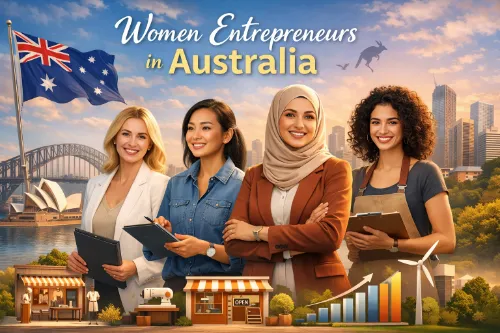
Women entrepreneurs in Australia are reshaping the country’s business landscape. They are starting companies at record rates, creating jobs and driving innovation across services, digital products and impact‑driven ventures.
At the same time, they still receive a small fraction of available funding and often operate without the same networks and support as their male counterparts. Understanding the latest Australian statistics, funding gaps and support programs is essential for anyone interested in women’s entrepreneurship, whether as a founder, policymaker, investor or ally.
The Rise of Women Entrepreneurs in Australia
Over the last decade, women have become one of the most dynamic forces in Australia’s small‑business and startup sectors.
- The Australian Small Business and Family Enterprise Ombudsman (ASBFEO) reports that women now own or lead roughly one‑third of Australia’s small businesses, and their numbers have been growing faster than male‑owned firms.
- Between 2009 and 2019, the number of women‑owned businesses increased by about 46%, compared with a 27% increase for male‑owned businesses, according to small‑business research cited by women’s business networks.
- Women‑owned small businesses are more likely to be newly established: many have been founded in the last five to ten years as more women turn to entrepreneurship for flexibility, autonomy and impact.
The Australian Small Business and Family Enterprise Ombudsman’s media release on women‑owned small business highlights that these businesses are a core part of Australia’s economic future, and calls for continued policy focus to help them thrive.
Key Australian Statistics on Women in Business
Recent surveys provide a clearer picture of where and how women are doing business in Australia.
- Mums & Co’s analysis of key statistics on women in business shows that women now make up a large share of business owners in several sectors:
- Healthcare and social assistance: women own about 54.2% of businesses.
- Education and training: 50.5%.
- Retail trade: 47.6%.
- Accommodation and food services: 46.1%.
- Other services (such as personal services): 45.6%.
- Women are under‑represented in more capital‑intensive, male‑dominated industries like mining, construction and manufacturing, where only a small minority of businesses are women‑owned.
These figures highlight both the strength and the concentration of women’s entrepreneurship in Australia: women dominate in care‑aligned and service industries but remain less visible in traditional “heavy” sectors and tech‑heavy fields.
Economic Contribution and Quality of Life
Women entrepreneurs are not only growing in number; they are also making a significant contribution to household finances and quality of life.
- GoDaddy’s Venture Forward research on micro‑businesses finds that in Australia, 44% of micro‑businesses (0–9 employees) are owned by women, and 57% of those women‑led enterprises were founded in the last five years.
- According to a 2025 report on female founders driving Australia’s small business growth, 27% of women entrepreneurs are the primary household income earner.
- GoDaddy’s data also shows that 56% of women business owners say running a business has improved their quality of life, often citing flexibility and the ability to pursue meaningful work as key reasons.
These findings reinforce that women‑led businesses are central to family wellbeing and regional economies, not just to niche “side hustle” activity.
Funding Gaps for Women Founders in Australia
Despite their growing presence and impact, women founders—especially in the startup and high‑growth segment—still face stark funding gaps compared with men.
Startup Funding Data: 2025 State of Australian Startup Funding
The State of Australian Startup Funding Report 2025 brings together the most comprehensive data on venture funding in Australia and includes a specific section on gender equity.
- In 2025, startups with at least one female founder received 24% of total startup funding, up from 15% in 2024 and the strongest share since 2019.
- However, the share of deals involving at least one female founder fell from 28% in 2024 to 24% in 2025, indicating that a relatively small group of women‑led teams captured most of the capital.
- Female‑only founding teams received just 2% of total funding in 2025, down from 4% in 2024, and median deal sizes for women‑only teams remained lower than those for male‑only or mixed‑gender teams.
- The top five female‑founded startups accounted for about 79% of all capital raised by female‑founded teams, leaving 80+ other women‑led startups to share a relatively small pool of funding.
Womens’ Agenda provides a plain‑language breakdown of this data in the article “Lack of progress for women startup founders, 2025 report reveals”. They argue that headline improvements hide a deeper lack of progress: a few large rounds skew the numbers, while most female founders continue to raise less and more slowly than male peers.
Global Funding Context for Female Founders
Global research shows similar patterns and underscores how much value is left on the table when women founders are under‑funded.
- The Female Founders Fund’s “2025 review of funding for female founders” notes that all‑female founding teams still receive only a small single‑digit share of global VC funding.
- Aggregated statistics on women in VC and startup funding show that while there is modest improvement in some regions, women remain under‑represented both as founders and as investors.
Australian funding patterns largely mirror these global trends, even though local advocates hope that recent rebounds in capital share for mixed‑gender teams can be the start of more structural change.
How Women Founders Feel About Support
Numbers only tell part of the story. Surveys of women founders reveal that many do not feel well supported by investors or the broader ecosystem.
- In the 2025 State of Australian Startup Funding survey, only around 18% of female founders said they felt supported by their investors, and just 27% felt supported by the broader ecosystem.
- Female founders were significantly more likely than male founders to say that their gender negatively affected their ability to raise capital and access networks.
- LinkedIn commentary on the gender‑equity section of the report, including posts summarising “women‑led teams lag behind on funding,” stressed that many women still experience bias in investor meetings and due‑diligence processes.
Women’s Agenda’s 2025 insights report, sometimes referred to as “The Support Deficit,” found that while around 80% of women‑led businesses intended to scale and about 85% planned to hire, only a small minority described themselves as truly thriving, frequently citing burnout, funding challenges and slower client pipelines as core obstacles.
Global Perspective: GEM Women’s Entrepreneurship Insights
Global Entrepreneurship Monitor (GEM) research offers a broader international context for women’s entrepreneurship, which also applies to Australia.
- The GEM 2024/2025 Women’s Entrepreneurship Report draws on surveys of more than 160,000 adults in 51 countries, including Australia.
- GEM finds that women are starting businesses at significant rates worldwide but are more likely than men to close businesses due to systemic barriers, challenges in accessing finance, and care responsibilities.
- The report notes that when ecosystems provide tailored support and financing, women entrepreneurs become powerful drivers of job creation and innovation.
Australian advocates often quote research like Deloitte Access Economics’ work (cited in Womens’ Agenda) to underline that properly supporting women founders leads to faster revenue growth, higher rates of international expansion, and better overall ecosystem performance.
Government and Ecosystem Support Programs for Women Entrepreneurs
In response to these disparities, governments and ecosystem organisations in Australia have launched a range of programs to support women starting and growing businesses.
Supporting Women in Business Grants (NSW)
In New South Wales, the Supporting Women in Business Grants (SWIB) program funds organisations that provide practical support to women entrepreneurs.
- The 2024–25 round allocated 1.08 million AUD across 10 organisations, each delivering programs from July 2025 to June 2027 that include accelerators, business coaching, accredited training and one‑to‑one advice.
- Grants usually range from 150,000 to 250,000 AUD per organisation, with a focus on women starting or growing micro and small businesses across NSW.
- A 2025–26 round, with around 500,000 AUD in funding, targets invited organisations that support women from specific communities—such as carers, women with disability, regional women, and women veterans—with intensive business support.
The program’s aims include increasing women’s financial independence, improving business capability, and building networks that help women access finance and new markets.
Future Female Entrepreneurs Program
The Future Female Entrepreneurs Program (FFEP) is a national initiative funded under the Australian Government’s Women’s Leadership and Development Program.
- FFEP provides free entrepreneurship education, mentoring and experiential learning to girls and women, with a focus on digital skills and STEM‑aligned entrepreneurship.
- The program offers online courses, workshops, and hackathon‑style events designed to build confidence and introduce participants to role models and networks.
By targeting the pipeline from school and early adulthood, FFEP aims to normalise entrepreneurship as a viable path for women and to seed future generations of founders.
Regional and International Initiatives
Other initiatives broaden the support landscape.
- The ASEAN‑Australian Women Leading Economic Growth program connects women entrepreneurs from Australia and Southeast Asia, offering leadership training, mentoring and market‑entry insights.
- Local chambers of commerce, women’s business networks and incubators around the country run programs specifically for women, often funded in part by state or federal grants.
Together, these programs provide skills, networks and, increasingly, pathways to capital for women entrepreneurs, although many advocates argue that funding and coverage need to increase to match the scale of the opportunity.
Everyday Realities: Ambition, Burnout and Balance
Beyond the macro statistics, research captures the day‑to‑day realities of women entrepreneurs in Australia.
- GoDaddy’s micro‑business survey highlights that 69% of Australian women business owners feel hopeful about their business growth over the next six months and around one‑third plan to hire in the next year.
- Women’s Agenda’s founder reports, however, note that burnout is the number‑one challenge women entrepreneurs say holds them back, closely followed by limited funding and slower client pipelines.
- Balancing care responsibilities with the demands of running and scaling a business is a recurring theme, and many women continue to carry disproportionate unpaid care workloads alongside entrepreneurship.
These findings suggest that policy and ecosystem responses need to consider time and wellbeing—not just capital—if women entrepreneurs are to build sustainable, scalable businesses.
Key Challenges and the Road Ahead
Across small businesses and startups, a few structural challenges consistently shape women’s entrepreneurial journeys in Australia.
- Funding inequality: Women‑only founding teams receive a very small share of venture funding, and median deal sizes remain smaller, limiting growth speed and resilience.
- Network and mentorship gaps: Many women report less access to investor networks, mentors and “warm introductions,” which can be critical in early fundraising and partnership building.
- Sector segregation: High representation in service and care sectors, and low representation in capital‑intensive, high‑growth sectors, can translate into fewer opportunities to build large, scalable ventures.
- Bias and perception: Survey data shows that women founders are more likely to believe their gender negatively affects fundraising outcomes, indicating persistent bias in evaluation and decision‑making.
At the same time, there are clear reasons for optimism. Women‑owned small businesses are hiring and scaling, targeted programs are proliferating, and the share of total capital going to startups with at least one female founder has improved after a low point in 2024. Global studies such as GEM’s Women’s Entrepreneurship Report show that when ecosystems address structural barriers, women entrepreneurs become outsized contributors to innovation and job creation.
For Australia, the path forward involves expanding and deepening funding access, strengthening gender‑aware ecosystem design, and continuing to invest in programs that give women the skills, confidence and networks to build the next generation of growth‑oriented businesses.