

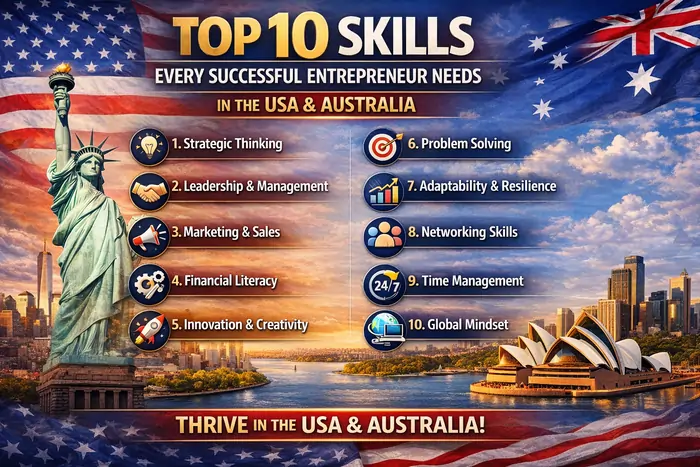
Entrepreneur skills are the foundation of building and growing a successful business, especially in competitive markets like the USA and Australia. From strategic thinking and financial management to leadership and digital expertise, these skills help entrepreneurs adapt to challenges, make informed decisions, and stay ahead in fast-changing industries. Developing strong entrepreneur skills not only improves business performance but also increases the chances of long-term success in today’s global economy.
Launching and growing a business in the USA and Australia demands more than a big idea; it requires a specific toolkit of entrepreneurial skills that help you navigate two highly competitive, yet opportunity-rich markets. Both countries offer strong startup ecosystems, access to funding, and support programs, but they also differ in regulations, market size, and customer expectations, so your skill set needs to flex to both contexts. In this guide, we will unpack the top 10 skills every successful entrepreneur needs in the USA and Australia, show you how they play out in real-world scenarios, and share resources you can use to develop each skill.
What Makes a “Successful” Entrepreneur Today?
Before listing specific skills, it is important to clarify what “success” actually means for modern entrepreneurs in both the US and Australian landscapes. Success is not just about revenue; it includes building a sustainable business model, creating value for customers, managing risk, and maintaining personal resilience over the long term. In the USA, entrepreneurs often measure success through scale, rapid growth, and investor returns, while in Australia, there is typically more emphasis on stability, lifestyle balance, and long‑term viability, especially among small and micro-businesses. These differences influence how you prioritize skills like funding know-how, regulatory understanding, and local networking.
Entrepreneur Skills #1 – Leadership and Vision
Leadership and vision sit at the core of every successful entrepreneurial journey, because they determine how you set direction, rally people behind your mission, and adapt when markets shift. In the USA, founders are often expected to articulate an ambitious vision that can attract investors and top talent, while in Australia, leadership often centers on building trust, clarity, and long-term relationships with employees, partners, and local communities. Strong entrepreneurial leadership means communicating where the business is going, why it matters, and how each person contributes to that future, whether you are pitching to a US venture capital firm or leading a small Australian team through a new product launch.
Strong entrepreneurial leadership also rests on a set of core personal traits such as resilience, initiative, and a willingness to take calculated risks, which separate founders who merely start businesses from those who scale them successfully. For a deeper dive into these characteristics, you can explore this guide on key entrepreneur traits that breaks down the personality factors behind real CEO success stories.
To deepen your leadership skills more broadly, you can explore structured programs like the Entrepreneurship MBA at AIB, which focuses heavily on leadership, strategic growth, and innovative thinking for entrepreneurs in Australia. In the US, you might look at online resources such as Harvard Business School Online’s entrepreneurial skills guide, which covers leadership and innovation in a global context.
Entrepreneur skills #2 – Strategic Thinking and Planning
Strategic thinking and planning allow you to translate your vision into concrete objectives, roadmaps, and contingency plans that work in both the US and Australian business environments. A strategic entrepreneur constantly analyzes market trends, customer behavior, and competitive moves, then updates their business model and goals accordingly. In the USA, strategic planning might revolve around rapid market entry, scaling across states, and preparing for investor due diligence, whereas in Australia it often includes adapting to smaller markets, regional differences, and leveraging government-facilitated support programs.
If you want structured guidance on planning, the U.S. Small Business Administration and the U.S. Chamber of Commerce small business resource center provide free learning center courses, templates, and step‑by‑step guidance to create business plans and growth strategies. In Australia, the Self‑Employment Assistance Program offers mentoring, workshops, and accredited training focused on investigating business opportunities and developing realistic business plans for small and micro-businesses.
Entrepreneur skills #3 – Financial Literacy and Money Management
Financial literacy and money management are non‑negotiable, because even the best idea fails if you cannot manage cash flow, pricing, and funding properly. Entrepreneurs in both the USA and Australia must read basic financial statements, understand margins, forecast cash needs, and make informed decisions about debt and equity financing. In the US, you may have more access to venture capital and small business loans, but you also face more competition and pressure to show strong financial metrics quickly, while in Australia you may rely more on personal funds, smaller grants, or targeted government support to get started.
To build these skills, explore resources like the U.S. Chamber of Commerce’s free small business resources, which aggregate tools and guides on budgeting, funding, and financial management. In Australia, initiatives attached to the Self‑Employment Assistance Program and accredited training such as Certificate III in Entrepreneurship and New Business can help you understand financial management, compliance, and risk in a local context.
Entrepreneur skills #4 – Sales, Marketing, and Networking
Sales, marketing, and networking skills turn your idea into revenue and relationships, which is why they are essential entrepreneurial skills in both countries. You need to define your ideal customer, craft compelling offers, communicate your value, and close deals consistently, whether you are marketing to US consumers or Australian small businesses. Beyond direct sales, networking helps you connect with mentors, partners, investors, and peers in startup communities, which is particularly important in ecosystems like Silicon Valley, New York, Sydney, and Melbourne.
In the US, you can tap into mentoring and workshops through organizations highlighted by the U.S. Chamber’s small business resources, which often link to local programs such as SCORE and Small Business Development Centers. In Australia, state-level business hubs, industry associations, and funded entrepreneurship programs provide networking events, coaching, and community spaces where you can refine your marketing strategies and relationship-building skills; examples include providers under the Self‑Employment Assistance framework and organizations like Sarina Russo Entrepreneurs.
Entrepreneur skills #5 – Communication and Negotiation
Effective communication and negotiation skills ensure that your message is clear and your deals are fair, which directly affects your reputation and profitability in both the US and Australian markets. Strong communicators can convey complex ideas simply, actively listen to stakeholders, and tailor their message for investors, customers, or team members across different cultural contexts. Negotiation skills help you secure better terms with suppliers, partners, and clients, which is particularly important when managing tight startup budgets or expanding into new regions.
To develop these capabilities, look for online training in communication and negotiation, or join entrepreneurial education programs that build these skills through role plays and real‑world projects. Platforms like Teaching Entrepreneurship and VentureLab provide entrepreneurship-focused curricula and resources that emphasize both hard and soft skills, making them useful for founders who want structured practice in communication, pitching, and negotiation.
Entrepreneur skills #6 – Problem-Solving and Decision-Making
Entrepreneurs face constant uncertainty, so strong problem-solving and decision-making skills are essential for navigating setbacks, regulation changes, and shifting customer needs in both countries. Effective problem-solving means diagnosing the root cause of an issue, brainstorming options, weighing trade-offs, and taking action quickly, rather than getting stuck in analysis paralysis. Decision-making for entrepreneurs also requires balancing data-driven insights with judgment and intuition, especially when you are entering a new market or launching an innovative product with limited historical data.
Many entrepreneurship courses now embed decision-making frameworks and practical exercises to help you practice under realistic constraints. For example, Online Courses Australia offers an Entrepreneurship Skills course that includes scenario-based learning, while broader overviews like Harvard Business School Online’s entrepreneurial skills article introduce key concepts and frameworks you can apply when making tough choices.
Entrepreneur skills #7 – Time Management and Productivity
Time management and productivity skills help entrepreneurs avoid burnout and maintain momentum in fast-moving markets like the USA and Australia. You need to prioritize high-impact tasks, delegate effectively, and build systems that keep you focused on strategic work rather than constant firefighting. For founders working with remote or distributed teams across US–AU time zones, the ability to schedule, communicate asynchronously, and manage your own energy becomes even more important.
Resources such as small business training programs often include modules on project management, digital tools, and workflow optimization that directly support entrepreneurs. In the US, the U.S. Chamber of Commerce’s small business resource center highlights free tools and guides on productivity and digital skills. In Australia, providers delivering Certificate III in Entrepreneurship and New Business and similar qualifications integrate time management and planning into their curricula, helping new founders organize their workload effectively.
Entrepreneur skills #8 – Digital and Technical Savviness
Digital and technical savviness is now a core entrepreneurial skill, because customers in both the USA and Australia expect seamless online experiences, data security, and accessible digital services. Entrepreneurs must understand basic digital marketing, ecommerce platforms, data analytics, and common productivity tools, even if they work with developers or agencies for more complex tasks. In the US, there is a large ecosystem of online tools and platforms designed for rapid growth, while in Australia, digital adoption is also high, but you may need to adapt to specific local platforms, payment preferences, and regulatory requirements around data and consumer protection.
Online entrepreneurship courses in Australia and the US frequently include digital modules that cover topics such as online branding, social media advertising, and digital sales funnels. Programs like the Entrepreneurship Skills course at Online Courses Australia and options listed via GetCourse’s entrepreneurship overview are designed to help aspiring founders master key digital tools they need to research markets, build business plans, and implement marketing strategies.
Entrepreneur skills #9 – Resilience, Adaptability, and Growth Mindset
Resilience, adaptability, and a growth mindset determine how you respond when things go wrong, which is inevitable in entrepreneurship. Entrepreneurs in both the US and Australia must cope with failed experiments, changing regulations, funding challenges, and unexpected competition, yet still continue learning and moving forward. A growth mindset helps you see setbacks as feedback, seek out coaching or mentoring, and continuously invest in your own development rather than assuming success is fixed or purely luck.
Many government-funded and nonprofit entrepreneurship programs focus on building resilience by pairing founders with mentors, offering long-term coaching, and creating communities where entrepreneurs can share experiences and lessons learned. In Australia, the Australian Government Self-Employment Assistance Program and service providers like BUSY At Work offer structured coaching over extended periods. In the US, you can access ongoing mentorship and peer support through initiatives highlighted on the U.S. Chamber small business resources and through education-focused organizations such as VentureLab.
Entrepreneur skills #10 – Team Building and People Management
Team building and people management skills become critical as soon as you work with freelancers, partners, or employees, which is often earlier than many founders expect. Effective entrepreneurs know how to recruit the right people, set clear expectations, give constructive feedback, and design a culture where team members can perform at their best, whether they are based in the US, Australia, or remotely. In the United States, competitive labor markets mean you may need to focus on employer branding and career growth opportunities, while in Australia, founders often invest heavily in trust and flexibility to attract and retain talent in smaller ecosystems.
Entrepreneurship education programs and government-funded initiatives sometimes include training in leadership, HR basics, and people management to support new business owners. In Australia, this can be integrated into Self-Employment Assistance Program training and qualifications like Certificate III in Entrepreneurship and New Business. Combining formal training with on-the-job learning and mentorship from providers such as BUSY At Work can help you avoid common hiring mistakes and build a team that truly supports your long-term goals.
How to Develop These Skills in the USA and Australia
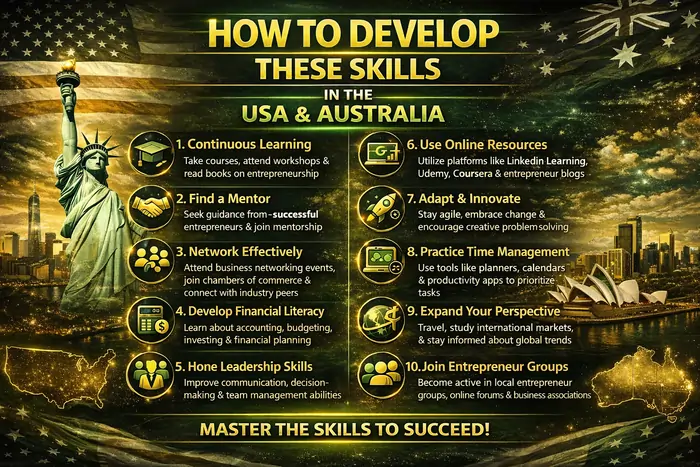
The good news is that every skill in this list can be learned and strengthened over time if you commit to structured learning and real-world practice. In the USA, you can combine free resources such as the U.S. Chamber of Commerce’s small business resource center, university-affiliated guides like Wilson College’s entrepreneur resources, and local mentoring networks with paid courses from business schools and online platforms. In Australia, federal and state-funded initiatives like the Self‑Employment Assistance Program, accredited qualifications such as Certificate III in Entrepreneurship and New Business, and online entrepreneurship courses like Entrepreneurship Skills at Online Courses Australia provide multiple routes to acquire both foundational and advanced skills.
You can also supplement formal training with global resources such as Teaching Entrepreneurship, VentureLab’s entrepreneurship education programs, and similar nonprofit organizations that publish curricula, lesson plans, and self-paced modules for aspiring entrepreneurs. Whichever country you are in, the key is to deliberately map each of the top 10 skills to at least one concrete action, such as enrolling in a course, joining a mentoring program, or setting a weekly practice routine.
Final Thoughts
When you look across the USA and Australia, the most successful entrepreneurs share a common foundation: leadership and vision, strategic thinking and planning, financial literacy, sales and marketing skills, strong communication and negotiation, problem-solving and decision-making, disciplined time management, digital savviness, resilience and adaptability, and the ability to build and manage teams. By intentionally developing these top 10 skills every successful entrepreneur needs in the USA and Australia, and by taking advantage of the rich mix of government programs, mentorship, and online learning resources available in both countries, you dramatically increase your chances of building a sustainable and impactful business.