

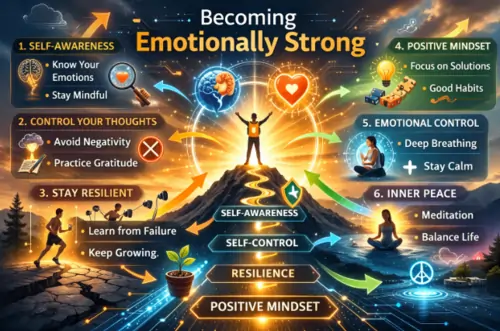
Becoming emotionally strong means you can feel emotions without being controlled by them. You still get stressed, hurt, angry, or disappointed—but you recover faster, think clearer, and make better choices even when life is heavy.
For many Filipinos, emotional strength matters because life often comes with real pressure: family responsibilities, school or work deadlines, money stress, relationship drama, and nonstop social media noise. Becoming emotionally strong is not about pretending you’re okay. It’s about building skills that help you stay steady, even when things are not.
This guide explains emotional strength in simple, realistic steps that you can practice daily.
What emotional strength really means
Many people confuse emotional strength with being “tough.”
But becoming emotionally strong is not about suppressing feelings or acting like nothing hurts. Emotional strength is about:
Emotional regulation
You can calm yourself down instead of exploding or shutting down.
Resilience
You can bounce back after setbacks instead of staying stuck for months.
Mental flexibility
You can adjust when plans change and handle uncertainty without panic.
Self-respect
You can protect your peace and set boundaries, even if people don’t like it.
If you’re becoming emotionally strong, your emotions don’t disappear—you simply learn how to manage them.
Signs you’re becoming emotionally strong
You may not notice it at first, but these are clear signs of growth:
- You pause before reacting
- You can handle criticism without falling apart
- You don’t chase approval as much
- You recover faster after disappointment
- You set boundaries with less guilt
- You stop over-explaining your choices
- You can feel sad without feeling hopeless
Becoming emotionally strong often looks like “quiet control,” not loud confidence.
Why people feel emotionally weak sometimes
Feeling emotionally weak doesn’t mean you’re broken. It often means you’re overloaded.
Common causes:
Chronic stress and burnout
Your brain and body are tired, so small problems feel huge.
Unresolved pain
Past trauma, grief, or betrayal can make you more reactive.
Lack of sleep and poor habits
When your body is unstable, emotions become harder to manage.
Toxic environments
Constant negativity drains your emotional energy.
Financial pressure
When money is tight, your nervous system stays on “alert mode.”
In Filipino households, emotional stress can also come from “hiya,” obligation, and people-pleasing habits. Becoming emotionally strong includes unlearning patterns that don’t protect you.
The foundation: the 3 basics that make you stronger
Before techniques, start with basics. Emotional strength is difficult if your body is always running low.
Sleep
Even one week of poor sleep can make you more sensitive and reactive. Aim for consistent sleep hours, even if it’s not perfect.
Simple tip:
Sleep and wake at the same time for 5 days straight. Consistency matters more than perfection.
Food and hydration
Low blood sugar can mimic anxiety. Dehydration can increase irritability. You don’t need a diet plan—just don’t skip meals.
Movement
A 10–20 minute walk helps regulate stress hormones. Becoming emotionally strong is easier when stress has a physical outlet.
Skill 1: Emotional awareness (name it to tame it)
Emotions get stronger when they are unclear.
Try this simple practice:
Ask yourself, “What am I feeling right now?”
Not “I’m stressed.”
More specific, like:
- disappointed
- embarrassed
- jealous
- rejected
- overwhelmed
- unsafe
Becoming emotionally strong starts with accuracy. When you can name what you feel, you can choose the right response.
A simple journaling prompt
Write one sentence:
“I feel ___ because ___.”
Example:
“I feel anxious because I’m afraid I’ll disappoint my family.”
This is not drama. This is clarity.
Skill 2: Emotional regulation tools (for real life situations)
When emotions spike, you need tools you can use anywhere.
Box breathing (30 seconds)
- Inhale 4 seconds
- Hold 4 seconds
- Exhale 4 seconds
- Hold 4 seconds
Repeat 2–3 times.
This calms your body so your brain can think again.
The “delay response” habit
If you feel triggered, do this:
- Drink water
- Walk to the bathroom
- Count slowly to 20
- Reply later, not now
Becoming emotionally strong is often just learning to delay reactions.
Grounding (5–4–3–2–1)
Name:
- 5 things you can see
- 4 things you can feel
- 3 things you can hear
- 2 things you can smell
- 1 thing you can taste
This pulls you out of panic mode.
Skill 3: Cognitive reframing (change the story, not the facts)
Your thoughts can make pain heavier.
Reframing is not lying to yourself. It’s choosing a more helpful perspective.
Example:
“This is hopeless.”
Reframe: “This is hard, but I can take one step.”
“They hate me.”
Reframe: “I don’t know what they think. I can ask or move on.”
Becoming emotionally strong includes separating:
Facts
from
Assumptions.
Facts: “They didn’t reply.”
Assumption: “They don’t respect me.”
This one change reduces unnecessary suffering.
Skill 4: Self-compassion (not self-pity)
Self-compassion means you speak to yourself like a friend.
Self-pity says: “Poor me, life is unfair.”
Self-compassion says: “This hurts, and I’m still going to take care of myself.”
Try this script:
“This is difficult. Many people struggle with this. I can support myself through it.”
Becoming emotionally strong requires kindness, not bullying yourself into growth.
Boundaries: a major sign of emotional strength
Many Filipinos struggle with boundaries because of family expectations. But boundaries are not disrespect. They are protection.
A boundary is simply a rule for your time, energy, and peace.
Simple boundary lines you can use
- “I can’t commit to that right now.”
- “I need time to think.”
- “I’m not comfortable with that.”
- “I can help, but not today.”
You do not need a long explanation.
Becoming emotionally strong often means tolerating the discomfort of someone being unhappy with your “no.”
Emotional strength in relationships
Being emotionally strong doesn’t mean avoiding conflict. It means handling it calmly.
A healthy communication structure
- Describe the behavior
- Share how it affects you
- Say what you need
Example:
“When plans change last minute, I feel stressed. Next time, can you tell me earlier?”
This reduces shouting and guessing.
Also, emotional strength includes recognizing manipulation:
- guilt-tripping
- silent treatment
- threats
- constant blame
Becoming emotionally strong sometimes means choosing distance from unsafe people.
Handling failure, shame, and rejection
Failure hurts more when you think it defines you.
If you fail at something, it means:
- your plan didn’t work
- your timing wasn’t right
- you need a different approach
It does not mean you are a failure.
In Filipino culture, “hiya” (shame) can feel heavy. Becoming emotionally strong includes learning that embarrassment is temporary, but quitting can become permanent.
The “small wins” method
After a setback, your confidence is low. Don’t aim big first.
Aim small:
- clean your room
- apply to one job
- send one message
- finish one task
Small wins create evidence that you can move forward.
Daily habits that build emotional strength
Becoming emotionally strong is built through small routines, not motivation.
Try these:
Two-minute morning check-in
“What do I feel today? What do I need today?”
Daily movement
Walk, stretch, or home workout for 10–20 minutes.
One difficult conversation per week
Practice direct communication with kindness.
Digital boundaries
Set a time window when you don’t scroll (example: first hour after waking).
Night reflection (2 minutes)
“What did I handle well today?”
“What will I improve tomorrow?”
A simple 30-day plan
Week 1: Awareness
- Name your emotions daily
- Journal: “I feel ___ because ___”
- Notice your triggers
Week 2: Regulation
- Practice box breathing daily
- Use the “delay response” rule
- Fix sleep schedule by 30 minutes
Week 3: Boundaries
- Say one respectful “no”
- Reduce one draining commitment
- Use a simple boundary script
Week 4: Resilience
- Choose one goal and take small steps daily
- Track small wins
- Review what’s improved
By day 30, becoming emotionally strong won’t feel perfect—but you’ll feel more stable.
When professional help is a smart choice
Becoming emotionally strong also means knowing when you need support.
Consider professional help if you experience:
- panic attacks
- constant hopelessness
- inability to function at work/school
- trauma symptoms (nightmares, flashbacks)
- thoughts of self-harm
Therapy is not for “crazy” people. It’s for people who want tools and support.
If you are in immediate danger or crisis, please contact local emergency services or a trusted adult right away.
FAQs
Is the fastest way to become emotionally strong to “think positive”?
No. The fastest way is to learn regulation skills and build consistent habits.
Are people born emotionally strong?
Some people grow up with safer environments, but emotional strength is a skill anyone can build.
How do I stop being “too sensitive”?
Focus on regulation and boundaries. Sensitivity can be a strength when managed well.
How do I set boundaries with family without disrespect?
Use respectful scripts, be consistent, and avoid over-explaining.
Can I become emotionally strong after trauma?
Yes, and many people do. Professional support can make the process safer and faster.