

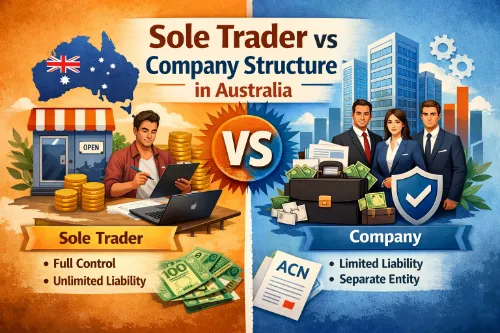
Sole trader vs company are the two most common structures for small businesses in Australia, and they differ mainly on liability, tax, costs, and growth potential. A sole trader is cheap and simple but exposes your personal assets, while a company (Pty Ltd) costs more and has more admin but offers limited liability and more flexibility for tax and investment.
A sole trader is an individual running a business in their own name or under a registered business name, using their own ABN. It’s the simplest structure with low setup and compliance, but legally you and the business are the same entity. If you need a refresher on what a sole trader is and how it works, ASIC’s overview of sole trader business structures is a useful starting point.
A company (usually a proprietary limited – Pty Ltd) is a separate legal entity that can own assets, incur debts, and enter contracts in its own name. It requires at least one director and one shareholder and has more formal governance, reporting, and cost. For the official tax view on different structures, the ATO’s guide to business structures and key tax obligations is worth bookmarking.
If you want a concise side‑by‑side comparison, the ATO and its partners provide a business structures comparison table aimed at small businesses.
Key Differences at a Glance
Major banks, software providers, and small‑business specialists all highlight the same core contrasts.
Liability and Risk
- Sole trader
- Unlimited personal liability: business debts and legal claims can be enforced against your personal assets (home, car, savings).
- Higher personal risk: you are personally on the hook for everything the business does.
- Company (Pty Ltd)
- Limited liability: shareholders are generally only liable up to the amount they’ve paid for their shares.
- The company, not you personally, owns assets and owes most debts, although directors can still be personally liable for some obligations (e.g., personal guarantees, unpaid GST/PAYG/super).
NAB’s guide on sole trader vs company structures clearly labels sole traders as having “unlimited liability” versus companies with “limited liability,” and notes that lenders may still ask directors to sign personal guarantees. For a deeper dive into the pros and cons of a company structure vs sole trader, Scalesuite’s breakdown of company structure vs sole trader in Australia is helpful.
Tax Treatment
- Sole trader
- All business profit is taxed at your individual marginal tax rates, up to the top rate.
- No separate business tax return – you lodge one individual tax return including a business schedule.
- Company
- Pays company tax on profits at the corporate rate (small business companies generally 25%).
- Profits then can be distributed as dividends to shareholders, often with franking credits.
- Separate company tax return is required each year, plus your own individual return if you draw salary/dividends.
For a simple worked example, AccountantBusiness compares tax outcomes for a sole trader and a company at around AUD 120,000 of profit in its article on sole trader or company in Australia. They show how a company can sometimes produce a lower overall tax bill and more tax planning flexibility as profits increase.
Sleek’s up‑to‑date 2026 guide on sole trader vs company business structures reinforces that if your personal tax bracket is high and you intend to retain profits in the business, a company may offer more tax‑efficient options.
Setup and Ongoing Costs
- Sole trader
- ABN is free; business name registration is relatively cheap.
- Very low setup cost, no ASIC company registration fee, and fewer professional fees needed.
- Ongoing: one individual tax return, basic bookkeeping, and minimal formal reporting.
- Company
- ASIC registration fee (hundreds of dollars) plus possible legal and accounting setup costs.
- Annual ASIC review fee and more extensive bookkeeping and accounting requirements.
- Must lodge a separate company tax return and maintain company registers and records.
NAB’s sole trader vs company summary puts it simply: sole trader = minimal setup and compliance; company = higher setup and ongoing costs. MYOB’s article on sole trader vs company key differences and Sleek’s comparison both point out that companies almost always need professional accounting support, while very simple sole traders sometimes handle their own admin in the early days.
If you’re a tradie thinking about structure choice, Mira’s piece on sole trader vs company for tradies gives a trade‑specific cost and compliance view.
Control and Decision-Making
- Sole trader
- You have complete control and make all decisions yourself.
- Easy to pivot and change direction quickly as the market changes.
- Company
- Directors manage the company; shareholders own it and may influence major decisions.
- Even if you’re sole director/shareholder, you still have formal director duties under the Corporations Act and must follow governance rules.
NAB’s structure comparison notes that company structures introduce shared decision‑making once you add more directors or shareholders. Scalesuite’s company vs sole trader pros, cons and costs emphasises that directors have legal duties (e.g., acting in the company’s best interests and preventing insolvent trading), which is a key difference from sole traders.
Growth and Capital Raising
- Sole trader
- You can hire staff but cannot bring in other “owners” without changing structure.
- Raising capital generally limited to savings, loans, or personal guarantees; investors usually prefer company structures.
- Company
- Easier to add shareholders or directors, and to bring in partners or investors.
- You can issue new shares, run employee equity plans, and separate ownership from day‑to‑day management.
NAB and Scalesuite both flag scalability and capital raising as major advantages of a company structure, especially if you plan to grow, open more locations, or attract outside investors.
Pros and Cons: Sole Trader vs Company in Australia
Drawing on NAB, MYOB, Sleek, and specialist accountants, here are the main pros and cons for each structure.
Sole Trader – Advantages
- Simple and cheap to set up – ABN is free, and you only register a business name if you need one.
- Low compliance burden – Single tax return, no ASIC company filings, fewer formal records.
- Full control and flexibility – Easy to make quick decisions and pivot your business model.
- Ideal for testing ideas and low‑risk activities – Suits freelancers, consultants, early‑stage side businesses, and many tradies starting out.
If you’re not sure whether to start as a sole trader or company, Sleek’s 2026 guide to sole trader business structure vs company walks through scenarios where a sole trader setup makes sense initially.
Sole Trader – Disadvantages
- Unlimited personal liability – Your personal assets are exposed to business debts and claims.
- Tax can become less efficient at higher profits – All profit is taxed at your marginal rate, which can exceed the 25% company rate.
- Harder to scale and raise capital – Investors and partners typically prefer owning shares in a company.
- Perception and credibility – Some larger clients, corporates, and banks perceive companies as more established.
Sprintlaw’s article on sole trader vs company structures in Australia highlights that legal risk and scalability are the main reasons many founders eventually move away from sole trader status as they grow.
Company – Advantages
- Limited liability – Better protection for personal assets, subject to director obligations and guarantees.
- Potential tax advantages – Company tax rate can be lower than your top personal rate and allows profit retention and longer‑term tax planning.
- Better for growth and investment – Easier to bring in co‑founders, investors, and employee shareholders.
- Continuity and succession – The company continues even if ownership or management changes.
Bentleys’ high‑level guide to choosing the right business structure in Australia and In‑depth pieces like Scalesuite’s company vs sole trader analysis both highlight these advantages, especially for businesses with higher risk profiles and growth plans.
Company – Disadvantages
- Higher setup and running costs – ASIC registration and annual review fees, plus legal and accounting costs.
- More complex governance – Director duties, company registers, shareholder agreements, and solvency responsibilities.
- More admin – Separate company tax return, ASIC reporting, and payroll obligations for directors and staff (including compulsory super).
AccountantBusiness’s article on sole trader or company in Australia neatly summarises it as: “Sole trader: quick, simple, cheap, but you carry all the risk. Company: more admin and costs, but stronger protection, lower tax rates, and credibility.”
Official and Practical Comparison Resources
To help your readers go deeper or double‑check details, you can naturally reference these external resources in your post:
- A high‑level bank perspective via NAB’s sole trader vs company comparison.
- ASIC’s formal explanation of sole trader, partnership, company, and trust structures.
- The ATO’s explanation of business structures and tax obligations.
- The ATO/Tax Super & You business structures comparison for a visual, table‑based overview.
- Sleek’s up‑to‑date 2026 guide on whether a company or sole trader structure is best.
You can also point tradies and solo contractors to Mira’s article on sole trader vs company for tradies for a practical trade‑specific angle.
Which Structure Is Right for You?
Most Australian accountants and small‑business advisors outline a similar decision pattern.
- Sole trader often makes sense when:
- You’re just starting, testing a concept, or running a lower‑risk side business.
- Initial profit is modest and you want to minimise setup cost and admin.
- You want full control and don’t plan to bring in investors or partners soon.
- Company usually becomes more attractive when:
- You expect profits to grow and want more tax‑planning options and profit retention.
- Your business has material risk (employees, leases, bigger contracts) and you want limited liability.
- You plan to scale, bring in partners or investors, or build a brand that larger clients will trust.
The Queensland Government’s guide on choosing a business structure and Bentleys’ accountant‑written structure selection guide both suggest starting simple (often as a sole trader) when risk and revenue are low, then moving to a company as complexity and profit grow.
When you reach that stage, Liston Newton’s step‑by‑step article on how to change from a sole trader to a company structure walks through the legal, tax, and practical steps to transition. Sprintlaw’s sole trader vs company guide also outlines what to consider before making the switch.