

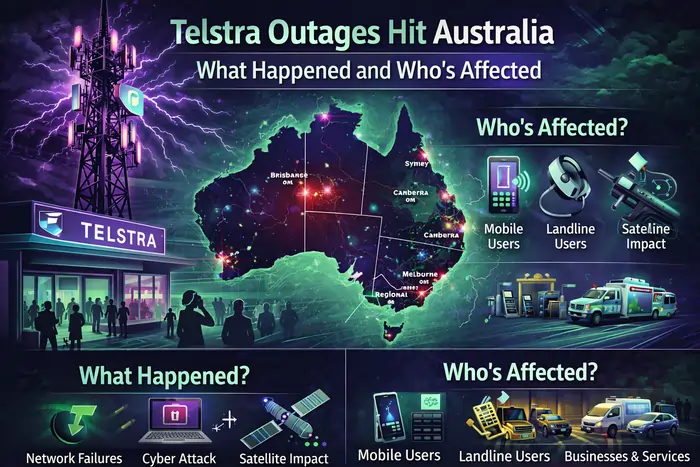
A series of Telstra outages and network failures over the last couple of years has highlighted just how dependent Australia has become on a single carrier for mobile, internet and even emergency calls. From Triple Zero issues to regional blackouts and planned upgrade disruptions, Telstra outages have affected households, businesses and critical services across the country.
Overview of the Latest Telstra Outages
In recent months, Australians have faced a mix of unplanned Telstra outages and planned disruptions tied to network upgrades. In southern NSW, for example, a Telstra fault in 2025 wiped out phone and internet for entire towns, while in early 2026 multiple regional communities were warned of days of intermittent service due to mobile base station works.
At the same time, Telstra has dealt with high‑profile incidents affecting emergency services, including a Triple Zero (000) outage and broader debates about mobile reliability in bushfires and severe weather. This combination of headline‑grabbing failures and background planned outages is why “Telstra outages” and their impact are trending in national discussion.
The best place to see Telstra’s own view of recent incidents is its Exchange blog post, “Our Triple Zero outage: the facts, the cause, and what’s next”, which sets out one major outage in detail.
What Exactly Happened to Telstra’s Network?
Telstra’s network problems have arisen from a mix of technical faults, process failures and external conditions. In a comprehensive post‑incident report on a March Triple Zero outage, Telstra says the problem was caused by “a combination of a technical fault, an issue in our backup process and a communication problem,” which together disrupted emergency call routing for about 90 minutes.
Other incidents have stemmed from power failures at exchange sites and software or configuration problems in the mobile network. In one earlier series of outages, Telstra executives explained that a flawed node restart and a mass re‑registration of mobile devices overloaded signalling nodes, preventing customers from making calls or using data until traffic was throttled and configuration changes were made.
It’s important to distinguish between planned maintenance and unplanned outages. Telstra regularly schedules planned outages to upgrade base stations and backhaul, publishing local notices such as the Telstra Network Disruption Advice for Hay Shire and similar regional updates. Unplanned outages, by contrast, are sudden failures caused by faults, storms, fires, or misconfigured upgrades, and these are the ones that leave customers unexpectedly offline.
Which Services Went Down?
Depending on the incident, Telstra outages have affected different parts of the network. Some disruptions have hit mobile calls, SMS and data services, particularly where a mobile site or a core signalling node has failed or been overloaded. Others have impacted fixed‑line voice, BigPond email, webmail and NBN voice services, as in an April 2025 power outage that left thousands of customers unable to access BigPond and webmail for extended periods.
Regional events in southern NSW and Western Australia have taken entire towns off the grid, cutting both landline and mobile connections for residents and businesses. Where mobile and fixed services go down together, the impact on everyday life is severe, with everything from EFTPOS and online banking to cloud‑based business tools and remote work grinding to a halt.
Telstra’s own outage status page lets customers check current faults for mobile, NBN and fixed services in their area, and is updated during major incidents.
Who Was Most Affected Across Australia?
While big city outages make headlines, many of the most disruptive Telstra failures have occurred in regional and rural areas where Telstra is often the only realistic option. In southern NSW, an outage knocked out both phone and internet across multiple communities, affecting households, farms and small businesses that rely on Telstra for everything from EFTPOS to remote monitoring.
Local councils and regional news outlets have issued repeated advisories about planned and unplanned Telstra disruptions, such as Hay Shire’s network disruption notices and South Burnett’s warnings about upgrade‑related outages. In coastal areas like Torquay on Victoria’s Surf Coast, conflicting information about mobile service outages has led to confusion for residents trying to work out whether the problem was their phone, the tower, or a wider network issue.
Because many regional communities lack robust alternative providers, a Telstra outage can mean no working mobile service at all, with knock‑on effects on local health services, emergency response, and day‑to‑day business operations.
Telstra Outages and Triple Zero (000) Safety Concerns
Perhaps the most alarming aspect of Telstra’s recent problems has been the impact on access to Triple Zero (000). On 1 March 2026, a technical failure combined with a backup process issue caused a 90‑minute disruption to Triple Zero call handling on the Telstra network, prompting a detailed internal investigation and public explanation.
Telstra’s report, “Our Triple Zero outage: the facts, the cause, and what’s next”, says that while many calls eventually got through via alternative routing, the incident exposed weaknesses in redundancy and highlighted the need for improved alarm handling, backup processes and communications. The event comes on top of broader concerns about Triple Zero resilience, including a four‑day power outage in WA where residents could not reach emergency services due to combined electricity and telecoms failures.
The Australian Communications and Media Authority (ACMA) and the federal government have already tightened rules around emergency call obligations and are now pursuing a “root‑to‑branch” review of Triple Zero, alongside a parliamentary inquiry into service outages. ACMA’s guidance on mobile outages and network interference stresses that major outages affecting Triple Zero can attract regulatory action and require carriers to strengthen safeguards.
How Telstra Responded to the Outages
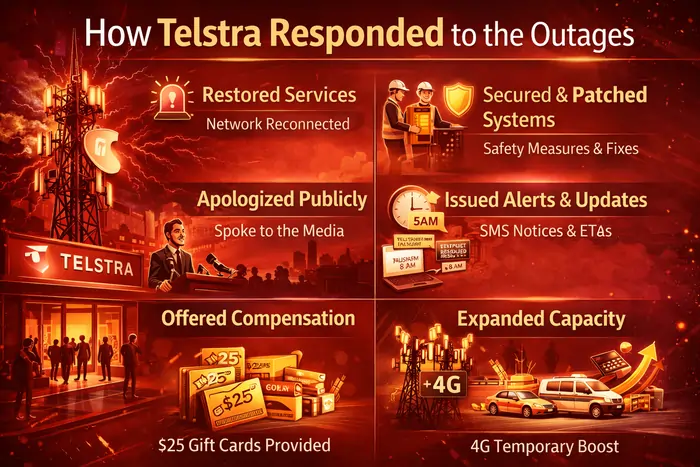
In the wake of major outages, Telstra has adopted a more open communications strategy, publishing detailed post‑mortems and committing to technical and procedural fixes. Following the 000 incident, Telstra says it has upgraded network monitoring, refined backup processes for emergency call routing, and improved its incident management and stakeholder communications plans.
Past outages have seen Telstra offer “free data days” or credits as a form of goodwill compensation when mobile customers were left without service for extended periods. In regional cases, spokespeople have explained that power issues, hardware faults or 4G/5G upgrade works were behind disruptions, and that upgrades would ultimately improve capacity and performance even though they caused short‑term pain.
At the same time, Telstra has faced criticism for sometimes suggesting affected customers should “buy more services” or additional backup links to improve their resilience—comments that have gone down poorly with rural users who feel they have few alternatives.
Customer Frustration, Compensation and Your Rights
Every major Telstra outage triggers a wave of customer frustration on social media, in talkback radio and in local news. Small businesses complain about lost sales when EFTPOS and internet go down; remote workers find themselves suddenly offline; and families in bushfire‑prone regions worry about what would happen if they needed emergency help.
Under Australian telecommunications rules, customers may be entitled to compensation or refunds when outages are significant and prolonged. The ACMA page on mobile outages and network interference notes that telcos must keep customers informed about major outages and, where appropriate, provide compensation for service failures. In practice, Telstra sometimes offers bill credits, free data or other gestures, but these are not automatic and often require affected customers to contact the provider or respond to specific eligibility messages.
Community posts like “Telstra outage compensation process” shared on Facebook show people comparing experiences and tips on how to pursue refunds or credits after serious disruptions. Nonetheless, many customers argue that compensation rarely matches the real economic impact of downtime, especially for businesses.
Why Telstra Outages Keep Happening
Telstra’s repeated issues are not just bad luck; they reflect the complexity and pressure of running a national network under increasing demand. Several factors contribute:
- Ageing infrastructure and technical debt: Legacy systems can be brittle, with small misconfigurations or hardware failures causing cascading outages if backups and monitoring aren’t up to scratch.
- Rising data and device load: More devices, 5G rollouts and direct‑to‑device services increase the volume and complexity of signalling and traffic, making it harder to test every scenario before changes go live.
- Major upgrade programs: Telstra’s 4G/5G upgrades and base station modernisation projects, such as those in Wondai and Hay, bring long‑term improvements but can cause localised outages while work is underway.
- Extreme weather and power issues: Storms, bushfires and grid failures can simultaneously knock out power and telecoms infrastructure, as seen in WA’s Midwest and other regions.
Technical deep‑dives such as iTnews’ “Inside Telstra’s network woes: what happened” show how mis‑executed restarts, overloaded signalling nodes and international cable faults have all played roles in past mass outages.
How to Check and Manage Future Telstra Outages
Given the likelihood of future disruptions, it pays to know how to check Telstra’s status and build some redundancy into your own setup.
To check current outages:
- Use Telstra’s official outage checker for mobile, NBN and fixed‑line services in your area.
- Follow local council or emergency service updates, which often re‑share Telstra notices for planned works and major faults.
- In longer or more severe incidents, check news sites and radio bulletins for broader context and expected restoration times.
To reduce your own risk:
- Enable Wi‑Fi calling on your device where available, so you can place calls over a broadband connection if mobile coverage drops.
- Consider a backup connection, such as a SIM from a different carrier, especially for critical business or remote‑area use.
- For businesses, plan for offline contingencies—manual payment options, local data backups and alternative communication routes.
Articles like Digital8’s “What the Telstra Outage Teaches About Digital Resilience” outline practical steps organisations can take to cope better with sudden connectivity loss.
What Telstra Outages Tell Us About Australia’s Digital Dependence
Telstra outages are more than just technical glitches; they expose how deeply digital connectivity is woven into Australian daily life. When a single carrier goes down, the effects ripple across emergency services, financial systems, logistics, healthcare, education and remote work.
Consumer advocates and industry experts warn that Australia’s reliance on a handful of major networks—with limited redundancy in some regions—creates systemic risk. Debates around Triple Zero resilience, new rules on direct‑to‑device connectivity and strengthened ACMA oversight all point to a future where regulators expect higher standards of resilience, transparency and backup planning from carriers.
For individuals and businesses, these outages underline the importance of building personal resilience: having backup connectivity options, offline workflows for critical operations, and a clear understanding of what to do if 000 can’t be reached on the first attempt.
Final Thoughts on Telstra’s Outages and What Comes Next
Telstra outages have hit Australia in waves—some local and planned, others sudden and national in impact—but together they show that network resilience can no longer be treated as an afterthought. The Triple Zero incident in particular has forced Telstra, regulators and government to confront the consequences of failures in an era where mobile networks are lifelines, not luxuries.
Looking ahead, Australians should expect more scrutiny of telco outage handling, stricter emergency‑call obligations and continued investment in upgrades that aim to prevent the same kind of failures from recurring. At the same time, customers—especially in regional and high‑risk areas—will need to stay proactive about checking outage information, seeking compensation where eligible, and building their own backup plans.
The same structural forces putting pressure on Telstra’s network resilience—digital dependence, changing customer expectations and tight margins—are transforming other sectors too. In aviation, Qantas is recalibrating loyalty through Qantas Frequent Flyer Status Credits: What’s Changing and Why It’s Trending, while in retail, the shutdown analysed in Glue Store to Close All Australian Doors: The End of a Streetwear Icon shows how even long‑standing brands can struggle to adapt to a more connected, always‑online economy.
In a country as vast and disaster‑prone as Australia, the story of Telstra outages is really a story about how we manage digital dependence: balancing efficiency with redundancy, pushing carriers to lift their game, and making sure that when the next outage hits, fewer people are left completely in the dark.