

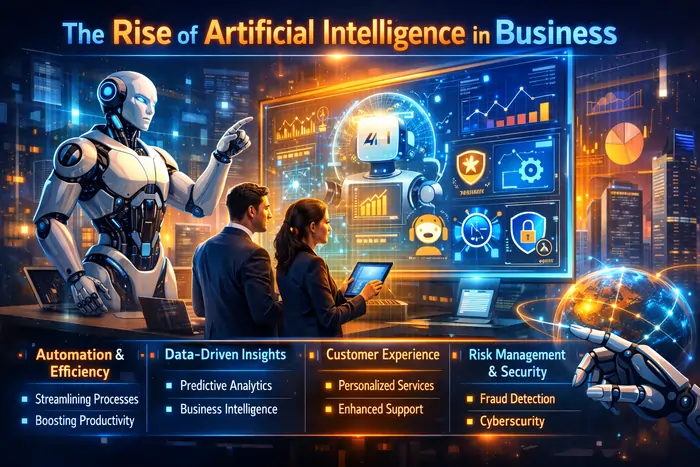
Rise of AI in Business is transforming the way companies operate, compete, and grow in today’s fast-changing digital economy. What was once seen as a futuristic technology is now a practical tool that businesses use every day to automate tasks, analyze data, improve customer experiences, and make smarter decisions. From small startups to global corporations, organizations are embracing artificial intelligence to increase efficiency, reduce costs, and unlock new opportunities for innovation. As AI continues to evolve, its role in shaping the future of business is becoming more powerful and impossible to ignore.
Artificial intelligence has moved from theory to the center of how modern companies compete, scale, and innovate, reshaping everything from operations and customer experience to business models and the future of work. As AI systems become more powerful and accessible, the Rise of AI in Business is less about “if” you will use AI and more about “how strategically” you will apply it.
What Is Artificial Intelligence in Business Today?
In a business context, artificial intelligence refers to systems that can learn from data, detect patterns, and make or support decisions with minimal human intervention, going far beyond the static rules of traditional software. Classic business software follows predefined instructions, while AI‑driven systems adjust their behavior over time as they ingest more information, which makes them especially powerful in environments with high data volume and complexity.
Several forces explain why AI is suddenly everywhere in business:
- Massive growth in data from digital channels, sensors, and enterprise systems.
- Cheaper cloud computing and specialized hardware that make training and running models economical.
- Breakthroughs in machine learning, especially deep learning and generative AI, that unlock new use cases such as content creation and code generation.
Today, AI is woven into everyday tools—recommendation systems, fraud detection, demand forecasting, chatbots, and copilots—so even small and mid‑sized businesses can access capabilities once reserved for big tech. For leaders who want a structured overview of AI in a strategic context, Harvard Business School’s guide on the role of AI in digital transformation is a good starting point: The Role of Artificial Intelligence in Digital Transformation.
How AI Is Transforming Business Operations
Across industries, AI is transforming business operations by automating repetitive work, surfacing insights from data, and enabling faster, more accurate decisions.
AI‑driven efficiency and automation show up in scenarios like invoice processing, claims handling, scheduling, and IT support, where machine learning models classify documents, route requests, and trigger workflows that once needed manual intervention. Predictive analytics allows organizations to anticipate demand, identify churn risks, and optimize inventory levels, which improves planning and reduces waste. When AI is embedded into dashboards and decision‑support tools, managers can move from backward‑looking reporting to proactive, data‑driven decision‑making.
Reports on AI business trends indicate that high‑performing organizations are shifting from experiments to scaled deployments, using AI to drive both cost optimization and revenue growth. Google’s recent AI trends overview for enterprises highlights that companies that operationalize AI across workflows see measurable gains in productivity and responsiveness: AI Business Trends 2025.
Key AI Technologies Powering Modern Enterprises
Behind the Rise of AI in Business are several foundational technologies.
- Machine learning (ML): Models learn patterns from historical data to make predictions—such as which customers are likely to churn or which transactions are likely fraudulent—without being explicitly programmed for each scenario.
- Deep learning: Multi‑layer neural networks excel at tasks like image recognition, speech recognition, and complex pattern detection, powering applications such as quality inspection in manufacturing and medical image analysis.
- Natural language processing (NLP): NLP enables systems to understand and generate human language, driving chatbots, search relevance, document summarization, and AI assistants embedded in business tools.
- Computer vision: AI interprets visual information from cameras, photos, and video, allowing for automated inspection, safety monitoring, and visual search in retail.
- Generative AI: Newer models can generate text, images, code, and other content, which is already being used for marketing copy, customer support responses, software development, and data exploration.
Business‑oriented glossaries, such as Hushly’s overview of AI terms, help non‑technical leaders get fluent in these concepts so they can participate meaningfully in AI strategy discussions: 25 Terms for Artificial Intelligence in Business Explained.
Real‑World Applications of AI Across Departments
The rise of AI in business is visible in concrete, department‑level use cases rather than abstract hype.
In marketing and sales, AI powers audience segmentation, predictive lead scoring, dynamic pricing, and personalized recommendations that respond to customer behavior in real time. Generative AI tools can produce draft ad copy, emails, and landing‑page variants, speeding up experimentation while human marketers focus on strategy and refinement.
Customer service and customer experience are being transformed by AI‑powered chatbots and virtual assistants that handle routine queries 24/7, route complex issues to agents, and surface suggested responses based on historical ticket data. Many companies report that AI‑enabled support improves response quality and reduces handling times when implemented with clear escalation paths to humans.
Operations and supply‑chain teams use AI for demand forecasting, inventory optimization, routing and logistics planning, and anomaly detection in production lines. In HR and recruitment, AI supports candidate screening, resume parsing, and talent analytics, helping organizations identify skill gaps and forecast workforce needs. In finance and risk functions, AI models flag suspicious transactions, score credit risk, and automate reconciliation tasks, improving both accuracy and speed.
Business‑focused guides like Business News Daily’s overview of AI in organizations showcase many of these cross‑department use cases in accessible language: How Artificial Intelligence Will Transform Businesses.
Benefits of Adopting AI in Business
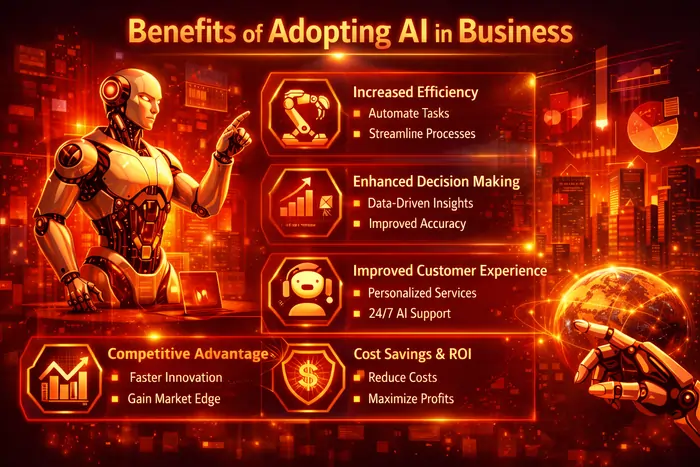
Organizations that successfully integrate AI into their operations report several recurring benefits.
First, AI boosts operational efficiency by taking on repetitive, rules‑based tasks and high‑volume workflows, freeing employees to focus on higher‑value work such as problem‑solving and relationship‑building. McKinsey’s latest global AI survey notes that high‑performing companies use AI to both reduce costs and generate new revenue, with many seeing substantial savings in functions like supply chain and customer operations.
Second, AI improves decision‑making by surfacing patterns in data that humans would struggle to detect at scale, enabling more precise forecasting, risk assessment, and performance monitoring. Third, AI can create competitive advantage and fuel innovation by enabling new products, services, and business models, such as usage‑based offerings, hyper‑personalized experiences, and AI‑enhanced platforms. Finally, AI allows businesses to scale without growing headcount linearly, because automation and decision‑support increase the output per employee.
IBM’s analysis of AI‑driven transformation emphasizes that organizations integrating AI into their broader change programs tend to outperform peers on productivity and growth, not just cost: AI for Digital Transformation.
Challenges and Risks of Enterprise AI Adoption
Despite the upside, the Rise of AI in Business comes with meaningful challenges and risks that leaders must manage.
On the technical side, poor data quality, fragmented systems, and legacy infrastructure can limit AI impact and make projects harder to scale. Many organizations struggle with AI adoption because they underestimate the effort needed for data integration, MLOps, and change management, treating AI as a plug‑and‑play tool instead of a capability that needs ongoing investment.
Ethical and governance issues are equally critical. AI systems can reflect and amplify biases present in training data, leading to unfair outcomes in areas such as hiring, lending, or policing if not carefully designed and monitored. Businesses must also navigate privacy regulations and emerging AI‑specific rules, which require transparency, explainability, and accountability for automated decisions. Without clear AI governance frameworks, organizations risk reputational damage, regulatory penalties, or loss of customer trust.
Business‑focused resources, such as glossaries and primers from firms like FullStack Labs and Innosight, underscore the importance of responsible AI practices and governance in enterprise settings: The Essential AI Glossary for Business Leaders and A Glossary of Common AI Terms for Business Leaders.
Building an AI Strategy for Your Organization
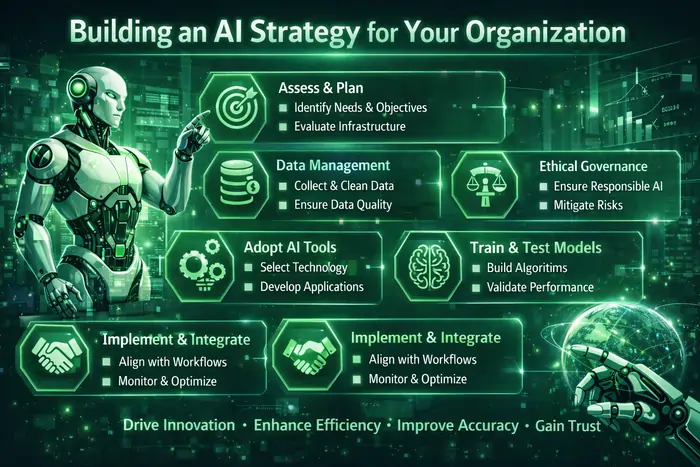
Given the stakes, the rise of AI in business demands an intentional strategy rather than ad‑hoc pilots.
An effective AI strategy starts with business objectives: what outcomes you want, such as reducing churn, increasing conversion, speeding up fulfillment, or improving forecasting accuracy. Leaders then assess AI readiness by looking at data assets, technology stack, talent, and existing processes to identify gaps and opportunities. From there, prioritizing a small number of high‑value, high‑feasibility use cases as quick‑win pilots builds confidence and momentum before scaling.
Organizations also face build‑versus‑buy decisions: whether to develop custom models in‑house, use cloud‑based AI services and platforms, or partner with vendors and consultants. Many enterprises adopt a hybrid approach, building proprietary models where they have unique data and differentiation while leveraging external platforms for generic capabilities like document analysis or customer support.
For many executives, committing to AI at a strategic level means rethinking long‑held assumptions about how their business operates, which can feel risky compared to the status quo. If you are wrestling with whether to stay in a comfortable but outdated operating model or make a bolder shift toward AI‑enabled ways of working, you may connect with this story on finding The Courage to Quit what no longer fits in order to pursue more aligned growth.
Crucially, AI strategy must include governance: policies, roles, and processes that define how AI systems are designed, tested, deployed, monitored, and updated in line with ethical and regulatory expectations. Programs like Harvard’s “Leading Your Organization’s AI and Digital Transformation” are designed specifically to help executives develop these strategic and governance capabilities: Leading Your Organization’s AI and Digital Transformation.
The Role of AI in Digital Transformation
AI is increasingly seen not just as a tool but as a core engine of digital transformation.
Digital transformation involves rethinking how an organization operates, delivers value, and competes in a digital economy, often requiring changes in processes, culture, and business models. Harvard’s analysis of AI in digital transformation emphasizes that AI helps companies move from static, one‑off projects to dynamic, data‑driven systems and strategies that continuously adapt to new information. AI can reshape strategy, operations, and customer engagement by enabling real‑time optimization, personalization, and experimentation at scale.
AI‑enabled transformation also changes the nature of work, leading to “human–AI collaboration” where machines handle pattern‑heavy tasks and humans focus on judgment, creativity, and relationship‑building. This shift requires reskilling and upskilling employees, redesigning roles, and fostering a culture that embraces experimentation with AI tools rather than fearing replacement.
Major technology providers like IBM show this in practice through “Client Zero” initiatives, where they use their own AI platforms internally to transform functions such as HR, IT, and operations before offering them to customers: Business Transformation Consulting Services. An accessible overview of AI’s role in broader transformation is here: AI for Digital Transformation.
Ultimately, leading your company through AI‑driven change is less about perfect technology and more about mindset—being willing to choose growth over comfort, experiment, and learn in public as the landscape evolves. If you are drawn to that kind of leadership, you will likely resonate with the reflections in Choosing Growth Over Comfort, which explore what it looks like to prioritize development over familiarity.
Generative AI and the Next Wave of Business Innovation
Generative AI represents a particularly visible wave in the Rise of AI in Business, creating new possibilities across content, code, design, and knowledge work.
Marketing teams use generative AI to draft emails, social posts, ads, and landing pages, then refine them with human insight, accelerating testing cycles and personalization. Developers rely on AI coding assistants to suggest functions, generate boilerplate, and catch potential bugs, which speeds up shipping and frees engineers for higher‑level design decisions. Knowledge workers increasingly interact with AI copilots embedded in productivity tools, using natural language to query data, generate reports, or summarize long documents.
For small and medium‑sized businesses, generative AI lowers the barrier to sophisticated capabilities like design, analytics, and customer support content, which were previously expensive or required specialized staff. Trend analyses for 2025 highlight agentic AI—autonomous AI agents that can perform multi‑step tasks and make low‑risk decisions—as a major frontier, with expectations that such systems will handle a significant share of routine decisions in the near future.
If you want a concise overview of the most important generative and broader AI trends shaping business, these resources are useful: Top 5 AI Trends for Businesses in 2025 and 10 AI Trends Transforming Business in 2025.
How to Get Started with AI in Your Business (Action Plan)
For many organizations, the biggest question is not “why AI?” but “where do we start?”
For small and mid‑sized businesses, a pragmatic path is to:
- Identify 1–3 pain points where automation or better predictions would clearly save time or money (for example, repetitive customer queries or inventory issues).
- Pilot off‑the‑shelf AI tools—such as AI customer support platforms or analytics copilots—on a small scale with clear metrics like response‑time reduction or forecast accuracy.
- Train staff on how to use these tools effectively and safely, including guidelines for reviewing AI outputs and protecting sensitive data.
- Iterate based on results, scaling what works and dropping what does not.
Larger enterprises might run a more formal process:
- Establish an AI and digital transformation office or cross‑functional team.
- Conduct an AI readiness assessment across data, technology, and talent.
- Build an AI roadmap aligned with business strategy, including transformation priorities and reskilling programs.
Executive education and consulting can help accelerate this journey; for example, Harvard’s online and professional programs focus on equipping leaders to navigate AI and digital disruption strategically: Digital Transformation & AI – HBS Online. Consulting practices such as IBM’s business transformation services also help enterprises design AI‑aligned roadmaps and move from pilots to scaled deployments: Business Transformation Consulting Services.
As AI continues to reshape business, the leaders who thrive will be those who consistently choose growth over comfort, pairing bold experimentation with responsible governance and building the kind of organizations that can adapt as quickly as the technology itself.