

Big data and predictive analytics are two sides of the same coin: massive, diverse data feeds advanced models that forecast what’s likely to happen next, helping organizations move from reacting to anticipating. This guide follows the outline we created and includes natural external resources you can keep or swap in your content.
What Are Big Data and Predictive Analytics?
Big data refers to extremely large and complex data sets—high in volume, velocity, and variety—that traditional tools struggle to store, process, and analyze. These data come from many sources: transactions, web and app logs, IoT devices, sensors, social media, CRM systems, and more. Hurree’s big data terminology list and SmartDataCollective’s 22 key big data terms are helpful glossaries of foundational concepts.
Predictive analytics is a branch of advanced analytics that uses historical data, statistical modeling, and machine learning to predict future outcomes. IBM’s What is Predictive Analytics? defines it as analyzing data to identify patterns and relationships, then using those patterns to forecast risks, opportunities, and likely behaviors. HBS Online’s overview of predictive analytics shows how organizations apply it to problems like equipment failure prediction, customer retention, and credit risk.
When you combine big data and predictive analytics, you get the ability to turn massive, messy data streams into foresight—reducing uncertainty and enabling smarter decisions across the business.
How Big Data and Predictive Analytics Work Together
Big data provides the raw material, while predictive analytics provides the engine that converts that material into predictions and recommended actions.
From raw data to predictive insight
A typical pipeline looks like this:
- Data collection and storage
Organizations ingest data from internal systems (ERP, CRM, POS), external sources (market data, weather, social media), and IoT devices. These data often land in data lakes or cloud data warehouses, which are built to handle large volumes and diverse formats. - Data processing and preparation
ETL/ELT processes clean, transform, and integrate data—handling missing values, resolving duplicates, standardizing formats, and creating features suitable for modeling. Google Cloud’s guide to predictive analytics stresses that data preparation typically consumes a large share of project effort. - Model building and training
Data scientists and analysts build predictive models (classification, regression, time series, etc.) using historical data to learn relationships between inputs (features) and outputs (targets). Qlik’s “What is Predictive Modeling?” and IBM’s business analytics overview explain how models are selected, trained, and validated. - Deployment and scoring
Once validated, models are deployed into production systems—either batch (e.g., nightly churn scores) or real-time (e.g., fraud detection on live transactions). Codewave’s “Predictive Analytics and Big Data: How They Work Together” walks through this end-to-end flow with concrete examples. - Decisioning and action
Predictions feed dashboards, alerts, and automated workflows, influencing marketing campaigns, inventory decisions, maintenance schedules, and more. KPMG’s “The benefits of big data and predictive analytics” emphasizes that the real value comes when insights are embedded into everyday business processes.
At a broader level, this is part of a larger AI wave reshaping how companies operate; stories like The Rise of Artificial Intelligence in Business show how organizations are using AI-powered analytics—from prediction to automation—to reinvent strategy, operations, and customer experiences.
Digital Squad’s big data and predictive analytics driving smart business calls this combination the “engine” of smart business transformation, enabling proactive decisions instead of reactive ones.
Core Techniques and Models in Predictive Analytics
Predictive analytics isn’t a single method; it’s a toolkit of models and algorithms suited to different problem types.
Common predictive modeling tasks
- Regression (forecasting numeric values)
Used for predicting sales, demand, prices, or customer lifetime value. - Classification (categorizing into classes)
Used for churn prediction (will a customer leave?), credit default (likely to default?), or lead scoring (high/medium/low quality). - Clustering/segmentation
Groups similar customers, products, or behaviors without pre-labeled classes, often used for market segmentation and anomaly detection. - Time series forecasting
Models like ARIMA, exponential smoothing, and LSTM networks forecast trends and seasonality for metrics such as demand, traffic, or sensor readings.
Insightsoftware’s “Top Predictive Analytics Models and Algorithms to Know” gives clear, business-friendly explanations of these model categories and when to use each.
Typical algorithms
- Linear and logistic regression for straightforward relationships.
- Decision trees and random forests for interpretability and handling complex interactions.
- Gradient boosting (e.g., XGBoost, LightGBM) for highly accurate models on structured data.
- Neural networks and deep learning when you have large, complex data (e.g., images, text, sensor streams).
Qlik, Splunk, and Appinio all stress the importance of data quality, feature engineering, and model evaluation (using metrics like accuracy, ROC-AUC, RMSE) in building robust predictive models. Without good inputs and rigorous validation, even sophisticated algorithms can mislead.
Key Business Uses of Big Data and Predictive Analytics
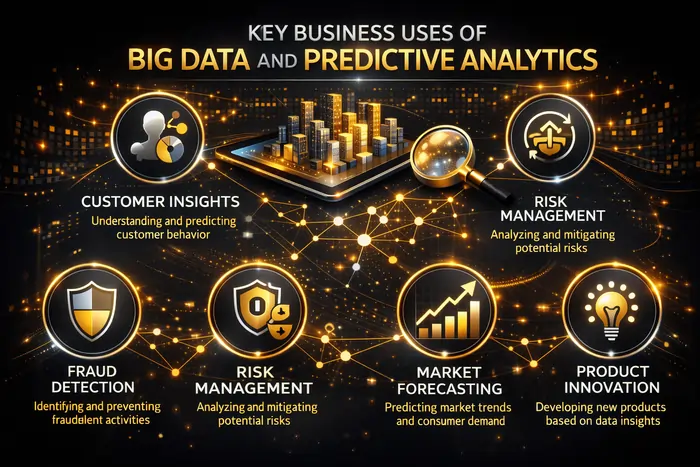
Big data and predictive analytics are used across functions and industries, often in recurring patterns.
Customer and Marketing Analytics
Predictive analytics is widely used to understand and influence customer behavior.
Key use cases include:
- Customer churn prediction
Models identify customers likely to leave based on behavior, engagement, support interactions, and product usage. This allows targeted retention offers and proactive outreach. - Personalized recommendations and next-best action
Retailers and streaming platforms use big data on browsing, purchases, and viewing history to recommend products or content. Netflix-style personalization is a classic example, as highlighted in LinkedIn’s article on big data & predictive analytics driving operational efficiency. - Campaign optimization and lead scoring
Predictive models score leads and forecast campaign performance, enabling marketers to focus on high-probability prospects and allocate budgets more effectively.
HBS Online and Marymount University both showcase marketing and customer analytics as core predictive analytics applications in their explanations and use case lists and “5 Use Cases For Predictive Analytics in BI”.
Operations, Supply Chain, and Maintenance
Predictive analytics is central to operations and supply chain optimization.
- Demand forecasting and inventory optimization
Models use historical sales, seasonality, promotions, and external data (like weather or macroeconomic indicators) to forecast demand and recommend inventory levels. This reduces stockouts and overstock. - Predictive maintenance
In manufacturing and utilities, sensor data and event logs are used to predict when machines are likely to fail. HBS provides a clear example of algorithms that monitor machine conditions and alert staff before catastrophic failures occur, saving substantial repair and loss costs. - Supply chain risk and logistics optimization
Big data feeds models that anticipate delays, identify bottlenecks, and optimize routing and sourcing strategies. A SageScience paper on big data and predictive analytics for optimized supply chain outlines these opportunities in depth.
In manufacturing, predictive analytics supports quality prediction, yield optimization, and predictive maintenance initiatives, often alongside advanced automation and robotics. As factories become more data‑driven and instrumented, combining big data, predictive models, and industrial automation (including robotics) is key to staying competitive. For a deeper dive into how robotics is transforming production lines, see Manufacturing Robotics | Benefits, Uses & Future Trends, which explores how robots, sensors, and analytics work together on the shop floor.
Risk, Finance, and Fraud Detection
In finance and risk management, predictive analytics is used to assess probabilities of default, fraud, and other adverse events.
- Credit risk scoring
Models predict the likelihood of borrowers defaulting based on credit histories, income, and behavioral data. - Fraud detection and anomaly detection
Transaction and behavioral data are analyzed to detect unusual patterns that suggest fraud, often in real time. Splunk’s introduction to predictive modeling explains how anomaly detection is used across security and operations. - Pricing and profitability analysis
Big data and prediction models help financial institutions optimize pricing for loans, insurance, and products, balancing risk and return.
IBM’s business analytics overview describes predictive analytics as part of a broader descriptive–predictive–prescriptive analytics continuum for finance and risk.
Industry-Specific Examples
Predictive analytics is applied in many sectors:
- Healthcare: risk scores for hospital readmission, disease progression, and patient outcomes. An NCBI paper on predictive analytics in the era of big data reviews opportunities and ethical concerns in health contexts.
- Manufacturing: quality prediction, yield optimization, predictive maintenance, and energy efficiency.
- Retail & e‑commerce: assortment planning, markdown timing, promotional effectiveness, and customer LTV prediction.
GoodData’s industry examples of leveraging predictive analytics provides four detailed vertical case studies.
Benefits of Big Data and Predictive Analytics
When implemented well, big data and predictive analytics deliver several strategic and operational benefits.
- Reduced uncertainty and better planning
Predictive models turn raw data into probabilities and scenarios, supporting more informed long-term planning and budgeting. - Faster, more informed decision making
Instead of relying solely on past reports or intuition, teams can consult live dashboards and predictive scores to guide decisions in near real time. Codewave emphasizes how this shortens decision cycles and enables faster reactions to market changes. - Cost reduction and operational efficiency
Accurate forecasts minimize overproduction and excess inventory, while predictive maintenance reduces downtime and repair costs. Digital Squad’s smart business article lists improved efficiency and cost savings as central outcomes. - Improved customer experience and personalization
Big data analytics enables tailored recommendations, personalized offers, and proactive service, strengthening loyalty and lifetime value. - Competitive advantage and new business models
KPMG and Giraffe Studio both describe big data and predictive analytics as catalysts for data-driven business model innovation, enabling new services, revenue streams, and more agile digital transformation.
In short, predictive analytics transforms data into foresight, allowing organizations to identify risks, opportunities, and trends earlier than competitors.
Challenges and Risks to Consider
The journey isn’t frictionless; big data and predictive analytics introduce several challenges.
- Data integration and quality
Combining data from many sources often reveals inconsistencies, missing values, and errors. Poor data quality can severely degrade model performance, so governance and cleansing are critical. - Skills and talent
Effective predictive analytics requires data engineering, data science, and domain expertise—skills that are often scarce. Many organizations struggle to hire or upskill for these roles. - Model bias and ethics
Predictive models can inadvertently encode historical bias, leading to unfair decisions (e.g., in lending, hiring, or policing). The NCBI article and IBM’s guides emphasize the need for fairness assessments, explainability, and ethical oversight. - Privacy, security, and regulation
Big data often includes sensitive personal information, raising compliance requirements under GDPR, HIPAA, and other regulations. Robust security and clear consent mechanisms are essential. - Overreliance on models
Predictive analytics should inform decisions, not completely replace human judgment. IBM notes that combining analytics with domain expertise yields the best results.
Recognizing these challenges upfront helps teams build more responsible, trustworthy analytics programs.
Getting Started With Big Data and Predictive Analytics
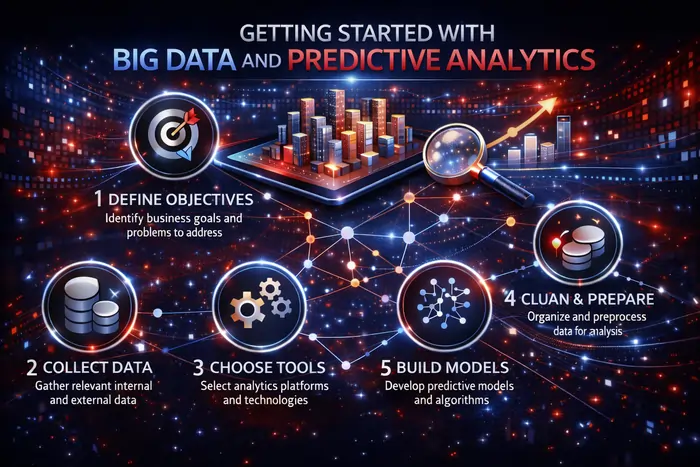
A practical, phased approach can reduce risk and increase the odds of success.
- Clarify business objectives
Start with questions like: “What decisions do we want to improve?” or “Which problems, if predicted earlier, would create the most value?” IBM and HBS both stress starting from business goals rather than technology for its own sake. - Audit existing data
Identify what data you already have (internal systems, logs, external subscriptions), its quality, and how accessible it is. - Choose tools and platforms
Depending on scale and maturity, you might use cloud-native analytics platforms (AWS, Azure, Google Cloud), specialized BI tools, or existing data science stacks. Google Cloud’s predictive analytics guide outlines common architecture patterns. - Start with a pilot use case
Select a focused, high-impact use case (e.g., churn prediction, a particular product’s demand forecast, or a high-cost failure mode in equipment). HBS and Marymount University both recommend pilots that are tightly scoped but measurable. - Build cross-functional teams
Combine business stakeholders, data engineers, data scientists, and IT/ops to ensure models are useful, deployable, and maintainable. - Iterate and scale
Evaluate performance, refine models, and integrate them into business workflows. Then replicate the approach for new use cases and departments.
KPMG, IBM, and 180ops’ future of data-driven decision making and predictive analytics all highlight that organizations succeed when they treat analytics as an ongoing capability, not a one-off project.
Future Trends in Big Data and Predictive Analytics
The field continues to evolve quickly, with several key trends reshaping what’s possible.
- Real-time and streaming analytics, edge analytics, and IoT
Instead of batch processing, more companies are analyzing streaming data for real-time predictions—critical for fraud detection, dynamic pricing, and IoT applications. This increasingly intersects with edge analytics and IoT, where data is processed near the source (on devices or gateways) to reduce latency and bandwidth usage. Telecom and industrial experts note that advanced connectivity—especially ultra‑reliable low latency communication—is critical here; perspectives like The Future of 5G and 6G Connectivity outline how next‑gen networks will support massive device density and real-time analytics for vehicles, factories, and smart cities, amplifying what big data and predictive models can do in the field. - AutoML and democratization
Automated machine learning tools are lowering barriers for non-experts, allowing analysts and domain experts to build models with less coding. - Integration with AI and decision intelligence
Predictive analytics is increasingly paired with prescriptive analytics, optimization, and generative AI to recommend actions, not just predict outcomes. IBM’s prescriptive analytics article describes how predictive and prescriptive models work together to suggest optimal decisions. - Explainable and responsible AI
There is growing emphasis on transparency, interpretability, and governance to ensure predictive models are fair, understandable, and compliant.
Together, these trends suggest a future where big data and predictive analytics are embedded into everyday tools and workflows, making data-driven decisions the norm rather than the exception.