

Manufacturing robotics is rapidly becoming the backbone of modern production, combining precision, speed, and intelligence to reshape how factories operate. This guide explains what manufacturing robotics is, its benefits and uses, and where the technology is headed—with external resources and real-world perspectives you can explore further.
What Is Manufacturing Robotics?
Manufacturing robotics refers to the use of programmable machines—industrial robots, collaborative robots (cobots), and autonomous systems—to perform tasks in production environments such as assembly, welding, material handling, and inspection. These robots are designed to execute repeatable, often physically demanding or high-precision operations with minimal human intervention.
The first industrial robots appeared in the 1960s, initially handling basic pick-and-place and welding tasks in automotive plants. Over the decades, advances in sensors, control systems, and computing have enabled robots to perform complex, multi-axis motions, respond to feedback, and integrate tightly with other automation equipment. Today, manufacturing robotics is a core pillar of Industry 4.0, alongside the Industrial Internet of Things (IIoT), cloud computing, and advanced analytics.
If you want a broad overview, NetSuite’s How Robotics Is Changing Manufacturing explains how robots are reshaping production lines, labor needs, and business models.
Key Benefits of Robotics in Manufacturing
Robots bring multiple advantages that go beyond simple labor replacement.
Higher productivity and throughput
Robots can significantly increase efficiency and throughput by working faster and more consistently than humans on repetitive tasks. They can operate 24/7 with only short breaks for maintenance, which boosts output and reduces lead times.
Goodwin University’s article on the importance of robotics in manufacturing notes that continuous, fatigue-free operation is one reason robots help manufacturers keep up with demand and tight delivery windows. Automate UK’s guide to the benefits of robots in manufacturing likewise highlights reduced cycle times and higher throughput as key outcomes.
NetSuite points out that robots often take over labor-intensive, repetitive activities so human workers can focus on higher-value tasks such as problem-solving, optimization, and oversight. This combination increases overall plant productivity.
Improved quality and precision
Robots are extremely precise and repeatable, which leads to consistent quality and fewer defects. RobotsDoneRight’s benefits of robots in manufacturing article notes that robots can hold tight tolerances and perform identical motions thousands of times without variation.
Automate UK emphasizes that robots eliminate quality issues caused by fatigue, distraction, or inconsistent technique, which improves product reliability and reduces rework. NetSuite echoes this, explaining that robotic automation improves accuracy and repeatability, directly impacting brand reputation and customer satisfaction.
Enhanced worker safety
Robots excel at taking on dangerous, dirty, and dull tasks—everything from heavy lifting and high-temperature processes to exposure to fumes and repetitive motions. Goodwin University highlights that robots can perform welding, painting, and handling of hazardous materials, substantially reducing workplace injuries and long-term strain issues.
RobotsDoneRight notes that by automating high-risk operations, manufacturers can prevent accidents and lower costs associated with health care, insurance, and lost time. Universal Robots’ overview of industrial robots often used in manufacturing shows how both traditional robots and cobots can be deployed to improve safety while maintaining or increasing output.
Cost savings and ROI over time
Robotics requires upfront investment, but the long-term return on investment (ROI) can be substantial. TulipTech’s “8 reasons shows the importance of robots” notes that robots reduce defect rates, cycle times, and material waste, all of which directly cut operating costs.
RobotsDoneRight explains that robots lower per-unit costs by increasing throughput, reducing scrap, and minimizing unplanned downtime. Motion Solutions’ guide on benefits of robotics in manufacturing points out that robots can be particularly cost-effective in high-volume or labor-intensive processes, and that careful planning of ROI is essential.
NetSuite adds that robotics supports broader Industry 4.0 initiatives, allowing manufacturers to remain globally competitive through flexible, data-driven automation. Some vendors also offer Robots-as-a-Service (RaaS) or leasing, lowering entry barriers for small and mid-sized manufacturers.
Flexibility and scalability
Modern robotics is increasingly about flexibility—not just rigid high-volume lines. GrayMatter Robotics’ “Future of Manufacturing: Trends in Industrial Robotics” explains how AI-powered robots and smarter tooling enable quick changeovers, making small-batch and customized production more viable.
Dassault Systèmes’ future of robotics in manufacturing overview highlights modular, reconfigurable robot cells and simulation tools that allow manufacturers to scale up or pivot faster than with traditional automation. This agility is especially important in markets with short product lifecycles and high mix, low volume demand.
Common Uses and Applications of Manufacturing Robotics
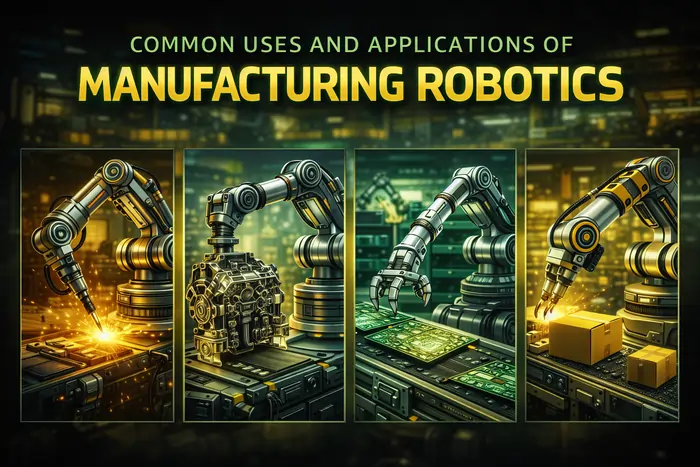
Robotics now touches nearly every stage of manufacturing, from raw material handling to final inspection.
Material Handling and Logistics
Material handling is one of the most common applications:
- Palletizing and depalletizing
- Picking, packing, and sorting
- Conveying parts between processes
- Machine tending—loading/unloading CNCs, presses, and other equipment
NetSuite notes that robots frequently perform picking, packing, palletizing, and part transfer to relieve workers from monotonous and physically taxing tasks. Autonomous mobile robots (AMRs) and automated guided vehicles (AGVs) are also used for intralogistics, moving materials around the plant.
Assembly, Welding, and Fabrication
Robots are heavily used in assembly and fabrication, especially in automotive and electronics.
Common tasks include:
- Arc and spot welding
- Painting and coating
- Component insertion, fastening, and screwdriving
- Cutting, trimming, and bending in metals and plastics.
AZoRobotics’ article on Robotics and the Future of Smart Manufacturing explains that combining robots with sensors and AI enables more complex assembly tasks and tighter quality control—particularly important in high-precision industries.
Inspection, Testing, and Quality Control
Vision-guided robots and fixed inspection systems play a growing role in quality control. Use cases include:
- Surface and cosmetic inspection using cameras and AI
- Dimensional checks and measurement
- Automated functional testing and sorting of passed/failed parts.
WhalesBot’s “What Are Industrial Robots and Why Are They the Backbone of Smart Manufacturing” describes how integrated vision allows robots to detect defects early, reducing scrap and rework. Prelaunch’s “Robotics in Manufacturing: Applications and Current Trends” highlights AI-enabled quality control as one of the most impactful current trends.
Sector-Specific Use Cases
Robotic adoption is spreading across industries:
- Food and beverage: packaging, labeling, palletizing, and sometimes direct food handling with hygienic designs.
- Pharmaceuticals and medical devices: sterile packaging, precise dosing, and high accuracy assembly and inspection.
- Consumer goods and e-commerce: high-speed picking, packing, and order fulfillment.
- Small and medium manufacturers: cobots used for flexible assembly, light machine tending, and small-batch operations without massive retooling costs.
Goodwin and NetSuite both note that, thanks to easier programming and safer designs, SMEs are increasingly using robots to remain competitive, not just large enterprises.
Types of Robots Used in Manufacturing
Different tasks and environments call for different robot designs and interaction models.
Traditional Industrial Robots
Key categories include:
- Articulated robots: multi-joint arms with high flexibility.
- SCARA robots: ideal for high-speed assembly and pick-and-place in a horizontal plane.
- Cartesian/gantry robots: operate on linear axes, often used for machine tending, pick-and-place, and large work envelopes.
- Delta/parallel robots: extremely fast pick-and-place for light items.
These robots are typically separated from workers via cages or safety systems and excel in high-speed, high-precision and high-payload operations. Wikipedia’s industrial robot entry provides a detailed look at the main architectures and their pros and cons.
Collaborative Robots (Cobots)
Cobots are designed to safely work alongside humans, using force-limiting joints, sensors, and advanced safety functions. They’re often smaller, easier to program, and ideal for:
- Light assembly and screwdriving
- Simple machine tending
- Packaging and kitting
- Tasks where variation or human judgment is still important.
StandardBots’ “Future of robotics in manufacturing: from ideas to action” notes that cobots are central to bringing automation into high‑mix, low‑volume environments where traditional robots were too rigid. The IFR Top 5 Global Robotics Trends 2026 report lists collaborative robots as a key growth area and stresses careful risk assessment to ensure safety.
Autonomous Mobile Robots (AMRs)
AMRs navigate the factory floor independently using lidar, cameras, and mapping algorithms. They’re used for:
- Moving components between workstations
- Delivering material to assembly cells
- Handling finished goods to storage or shipping.
Prelaunch notes that AMRs and AGVs are crucial for smart intralogistics, making material flow more responsive and data-driven.
AI-Enabled and Vision-Guided Systems
Robots enhanced with AI and machine learning can adapt to variability and learn from data rather than relying solely on rigid programming. Examples include:
- Robots that identify and pick randomly oriented parts using 3D vision.
- Systems that adapt to minor changes in parts or workspaces.
- Real-time defect detection and anomaly alerts through AI vision.
The review AI-enhanced manufacturing robotics outlines how these techniques enable more flexible automation, especially in high-mix environments.
Challenges and Considerations in Adopting Robotics

Robotics is powerful, but adoption comes with challenges.
Cost and integration complexity
Robots, peripherals, integration engineering, and training represent significant upfront investment, especially for smaller firms. PlantAutomation-Technology’s “Robotics in Manufacturing: Benefits and Future Outlook” stresses that careful ROI analysis and phased deployment are critical to avoid overextending capital.
Integration into legacy production lines can also be complex: manufacturers must consider cycle times, upstream/downstream processes, and how robots will interact with existing equipment. Motion Solutions recommends starting with a well‑scoped pilot project before a full rollout.
Skills gap and workforce reskilling
Automation changes the skills needed on the factory floor. Goodwin University underscores the growing demand for technicians and engineers trained in robotics, mechatronics, and controls. The ScienceDirect article “Working with robots: trends and future directions” highlights the importance of human–robot collaboration skills, ergonomics, and trust.
Manufacturers must invest in training and education so existing employees can transition into roles such as robot operators, maintenance technicians, and automation specialists. Done well, robotics can upskill the workforce rather than simply displace it.
Safety, compliance, and standards
Safety standards like ISO 10218 and ISO/TS 15066 govern industrial robots and cobots. Even collaborative robots must be evaluated in context, since payload, end effectors, and workpieces can introduce additional hazards.
Universal Robots and IFR both stress conducting thorough risk assessments, implementing proper guarding or safety scanners, and training workers in safe operation. Motion Solutions adds that involving safety experts early avoids costly redesigns later.
Change management and organizational resistance
Robotics also requires cultural change. Plex/Rockwell Automation’s article on the future of robotics and automation in manufacturing notes that employees may fear job loss or feel overwhelmed by new technology.
Successful adopters often:
- Communicate clearly about why robots are being introduced.
- Involve shop-floor employees in design and testing.
- Show quick wins that improve safety and reduce drudgery.
This approach helps build buy‑in and ensures robotics supports people rather than alienating them.
Future Trends in Manufacturing Robotics
Robotics is evolving from isolated, pre-programmed machines into intelligent, connected, adaptive systems.
Smarter, More Connected Factories
In smart factories, robots are integrated with the Industrial Internet of Things (IIoT), cloud, and edge computing. Data from robots, sensors, and machines feeds into analytics platforms to optimize production in real time, enable predictive maintenance, and support digital twins and simulation.
Synox’s article on AI and robotics at the heart of Factory 4.0 describes how AI, IoT, and robotics act as the “brains and arms” of highly flexible, data-driven plants. Underneath all of this is connectivity: telecom and industrial experts highlight how the future of 5G and 6G connectivity will enable ultra‑low latency, massive device density, and real-time video/telemetry for industrial robots, taking concepts like remote control, digital twins, and holographic collaboration from pilot to everyday reality.
Human–Robot Collaboration and Workforce Evolution
The International Federation of Robotics’ Top 5 Global Robotics Trends 2026 report highlights human–robot collaboration as a major trend. StandardBots notes that cobots will increasingly handle tasks side by side with humans, especially in SME and high‑mix environments. These shifts imply:
- More shared workspaces with dynamic safety systems.
- A growing need for operators who can program and troubleshoot robots.
- A transition from purely manual labor to tech‑enabled, problem‑solving roles.
As IBM’s Industry 4.0 overview explains, the future factory is not about replacing humans but augmenting them with intelligent automation.
AI, Machine Learning, and Adaptive Robotics
AI is driving the next leap—robots that learn and adapt instead of just repeating fixed programs. Prelaunch describes AI-driven predictive maintenance, AI-optimized production planning, and smarter quality control as current trends. A detailed review on AI-enhanced manufacturing robotics explains how machine learning, computer vision, and advanced analytics are transforming robots from static tools into intelligent systems.
At the business level, stories like The Rise of Artificial Intelligence in Business show how AI is reshaping strategy, operations, and decision-making across industries, including manufacturing, making it clear that AI‑driven robotics is part of a much larger digital transformation. AZoRobotics and Synox both point to future scenarios where robots collaborate autonomously, adjust to upstream changes, and support mass customization at scale.
Sustainability and Global Competitiveness
Robotics contributes to sustainability by reducing waste, optimizing energy use, and enabling right‑sized production. WAM Saudi’s article on the future of robotics in manufacturing notes that smarter robots and better process control support greener, more resource‑efficient operations.
On a strategic level, robotics helps companies respond to labor shortages, wage pressures, and supply chain shifts. Automation can support reshoring and nearshoring efforts by making local, high‑quality production economically viable.
Is Manufacturing Robotics Right for Your Operation?
Robotics is not a one-size-fits-all solution. Deciding if it’s right for your operation means assessing your processes, constraints, and goals.
Key questions:
- Do you have repetitive, high-volume, or ergonomically challenging tasks?
- Are quality issues, labor shortages, or safety risks hurting performance?
- Is there a clear use case where a robot could add value (cycle time, quality, safety)?
- Do you have, or can you access, integration and maintenance expertise?
- Can you start with a small pilot to validate ROI before scaling?
Motion Solutions and Automate UK both recommend starting small: automate one cell or task, measure results, iterate, then expand gradually. For many manufacturers—especially SMEs—cobots or modular robot cells are a practical entry point that can later grow into more integrated systems.
NetSuite’s “How Robotics Is Changing Manufacturing” and UTI’s “Role of Robotics in Manufacturing” provide accessible checklists of benefits and considerations to help you evaluate readiness and plan your first projects.
Final Thoughts
Manufacturing robotics is no longer experimental; it’s a core enabler of productivity, quality, safety, and flexibility in factories of all sizes. As robots become smarter, more connected, and easier to deploy, they’re evolving from isolated automation cells into integral partners across the entire value chain.
The most successful manufacturers aren’t asking whether robots will replace humans; they’re asking how humans and robots can work together to build stronger, more resilient, and more innovative operations. If you approach robotics as a staged, strategic investment—start with clear use cases, learn from pilots, reskill your workforce, and leverage complementary technologies like AI and advanced connectivity—you’ll be well positioned to harness the next wave of industrial transformation.