

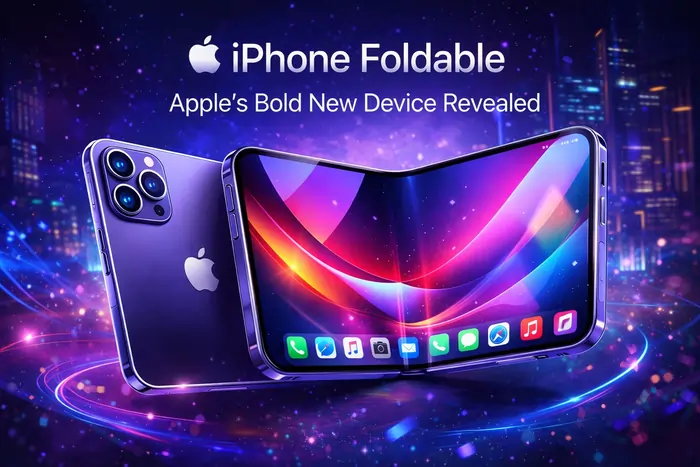
Apple iPhone Foldable is shaping up to be Apple’s boldest hardware move since the original iPhone, with multiple credible reports now pointing to a 2026 launch window and a radically different form factor that blurs the line between phone and tablet. In this guide, we’ll break down what we know so far about Apple’s first foldable iPhone, how it compares to existing foldables, who it’s really for, and why it could redefine premium smartphones over the next few years.
What Is the Apple iPhone Foldable?
When people talk about the Apple iPhone Foldable, they’re referring to Apple’s long‑rumored first folding iPhone, often nicknamed “iPhone Fold.” Apple hasn’t officially confirmed the device yet, but a dense trail of patents, supply‑chain leaks, and analyst reports now paints a fairly consistent picture of what’s coming.
Recent coverage from outlets like International Business Times on the foldable iPhone launch rumors and CNET’s “iPhone Fold: Launch Date, Price and Everything We Know” suggests that Apple is preparing a premium foldable device with a book‑style design, a large inner display, and a smaller outer screen for quick tasks. Think of it as an iPhone that opens into a mini‑iPad—without losing the pocketability of a phone.
Apple has been quietly laying the groundwork for years, filing patents on flexible displays, novel hinge systems, and multi‑angle folding mechanisms. Those efforts now appear to be converging into a single, ambitious product line that aims to leapfrog current foldables on durability, crease visibility, and software polish.
For a running, rumor‑focused overview, MacRumors’ foldable iPhone guide remains one of the most thorough rumor round‑ups currently available.
Expected Design: How Will the Apple iPhone Foldable Look?
Most sources agree that the first Apple iPhone Foldable will adopt a book‑style design, similar to the Galaxy Z Fold line rather than a small clamshell “flip” phone. According to reports compiled by PhoneArena’s foldable iPhone explainer, Apple is targeting an inner display of about 7.8 inches and an outer cover display around 5.5 inches.
Key design expectations include:
- Book‑style fold: Opens like a small tablet, closes like a regular phone.
- Large inner OLED screen (≈ 7.8″): Optimized for multitasking and media.
- Smaller outer display (≈ 5.5″): For quick interactions, notifications, calls, maps.
- Premium frame materials: A mix of titanium and aluminum is rumored to balance strength and weight.
- Minimal‑crease display tech: Apple is reportedly obsessed with reducing or nearly eliminating the center crease.
The International Business Times report on Apple’s foldable iPhone notes that Apple’s internal goal has been a nearly crease‑free display and a hinge that feels smoother and more robust than existing competitors. Meanwhile, an earlier CNET piece on Apple’s foldable screen patent points out how Apple has explored panels that can bend in multiple directions, hinting at future flexibility beyond a single book fold.
Apple is also advancing its hinge engineering, with a recent patent on “hinges for folding display devices” describing a multi‑link system designed to move the rotation axis outside the hinge for a gentler bend on the display. You can see this hinge thinking unpacked in GSMArena’s coverage of Apple’s new hinge patent.
Display and Hardware Specs: What’s Inside the Apple iPhone Foldable?
While specs can still shift before launch, several reports have converged on a plausible hardware profile for the Apple iPhone Foldable.
According to rumor round‑ups like CNET’s iPhone Fold explainer and Mashable’s deep dive on iPhone Fold specs and price, here’s what the device is expected to offer:
- Displays:
- Inner display: ~7.8‑inch OLED, 120 Hz, designed for tablet‑like use.
- Outer display: ~5.5‑inch OLED, 120 Hz, for phone‑first interactions.
- Battery:
- Roughly 5,000–5,500 mAh total capacity, larger than any current iPhone, to support the big inner screen.
- Performance:
- Expected next‑gen Apple Silicon (likely an A‑series chip tuned for iOS 27), 12 GB RAM, up to 1 TB storage.
- Cameras:
- Biometrics:
- Touch ID integrated in the side button rather than Face ID, according to several leaks compiled by MacRumors and PhoneArena.
Analysts quoted in IBTimes’ coverage and Engadget’s rumor roundup expect Apple to prioritize battery life and structural rigidity to address long‑standing concerns around foldable durability. That likely explains the focus on a beefy battery pack and robust hinge engineering described in the patent literature.
For a concise, spec‑style overview that will be easy to update as details firm up, PhoneArena’s foldable iPhone hub is a solid reference.,
iOS 27 and Software: How Will Apple Optimize the Foldable Experience?
Hardware alone won’t make the Apple iPhone Foldable stand out; the software experience is where Apple typically pulls ahead. Reports suggest that the foldable will run a version of iOS 27 customized for larger, flexible displays.
Based on leaks aggregated by PhoneArena and Mashable’s coverage of iPhone Fold features, we can expect:
- Seamless transitions between folded and unfolded modes, with apps resizing smoothly.
- Expanded multitasking, including side‑by‑side apps, floating windows, and possibly new Split View variants.
- Optimized home screen layouts for the tablet‑like inner display.
- Continuity features, such as resuming an app exactly where you left it when switching screen states.
Bloomberg and other outlets, summarized in Mashable’s “Apple’s iPhone Fold will let you run apps side by side” report, claim Apple is taking an iPad‑style approach: keep the OS familiar, but layer in advanced multitasking and layout controls. That strategy aims to avoid overwhelming users while still making the larger display feel genuinely useful rather than just a bigger screen.
Engadget’s analysis of iPhone Fold rumors stresses that Apple wants to avoid the early awkwardness seen in some first‑gen foldables, where software lagged behind the hardware. If Apple nails the software experience on day one, the Apple iPhone Foldable could immediately feel more polished than rivals that took several generations to refine.
Launch Date, Price, and Lineup Strategy

Perhaps the most common question around the Apple iPhone Foldable is: when is it actually coming, and how much will it cost?
Launch Timing
The majority of recent reports now point to late 2026 as the target launch window.
- International Business Times cites analysts such as Ming‑Chi Kuo and Jeff Pu, who expect a second‑half 2026 debut, with mass production ramping in the summer and a September unveiling.
- CNET’s launch date explainer also points to 2026, aligning the foldable with the iPhone 18 series.
- Mashable’s iPhone Fold report and Engadget’s rumor roundup echo the same timeframe.
There are even suggestions that Apple may delay or stagger the standard iPhone 18 base model, instead prioritizing iPhone 18 Pro, iPhone 18 Pro Max, and the foldable at launch, with the entry‑level iPhone 18 arriving later. This strategy, highlighted by IBTimes and other analyst notes, would underline how central the foldable is to Apple’s 2026 lineup story.
Price Expectations
On pricing, most rumors agree: the Apple iPhone Foldable will be very expensive, even by Pro Max standards.
- CNET and Mashable both mention estimates around or above 2,000 USD for the entry configuration.
- PhoneArena similarly expects a price that comfortably surpasses current iPhone Pro Max models, reflecting the cost of flexible displays and advanced hinges.
This would position the Apple iPhone Foldable as a halo device: designed to showcase Apple’s engineering and capture the most dedicated, high‑spending segment of the market, rather than becoming the mainstream default overnight.
How the Apple iPhone Foldable Compares to Rival Foldables
Apple is late to the foldable party compared to Samsung, Google, and others, but that delay is partly strategic. Competitors have already gone through multiple generations of iteration, ironing out hinge failures, display creases, and software bugs.
When the Apple iPhone Foldable arrives, it will enter a market shaped by:
- Samsung Galaxy Z Fold and Z Flip lines: Now in their fifth or sixth generation, refining water resistance and crease reduction.
- Google Pixel Fold and successor models: Focused on camera quality and deep Android multitasking.
- OnePlus Open and other book‑style foldables: Competing aggressively on thinness and crease performance.
Apple’s bet, as framed in Engadget’s iPhone Fold rumors breakdown and CNET’s comparison‑oriented coverage, is that it can deliver:
- A cleaner, closer‑to‑crease‑free display.
- A more reliable hinge for long‑term durability.
- Better‑integrated software via iOS 27, tuned around the foldable form factor.
If Apple succeeds, the Apple iPhone Foldable could become the aspirational foldable, even for users who currently don’t see a folding phone as necessary.
For speculative comparisons and community discussion, the Reddit thread “2026 Foldable iPhone: All the Leaks So Far” pulls together how Apple’s rumored specs stack up against current foldables.
Who Is the Apple iPhone Foldable For?
Given the expected price and feature set, the Apple iPhone Foldable is not aimed at every iPhone user. Instead, it’s likely targeting:
- Power users and early adopters who want the most cutting‑edge Apple hardware each cycle.
- Productivity‑focused users who want a device that can double as a small tablet for split‑screen work, reading, or note‑taking.
- Tech enthusiasts who already considered switching to Android foldables but held out for an Apple version.
Analyst commentary cited by IBTimes suggests that Apple sees the foldable as a catalyst for a new upgrade supercycle, encouraging existing Pro‑tier iPhone owners to step up to an even higher‑end device. Some estimates predict a 10% boost in overall iPhone sales in 2026 if the foldable resonates with its target demographic.
What Apple’s Foldable Strategy Tells Us About Its Future
The Apple iPhone Foldable isn’t just another iPhone; it signals how Apple is thinking about hardware in a maturing smartphone market. Alongside rumors of an ultra‑thin “iPhone Air” and experiments with AR devices, the foldable suggests Apple is moving toward a multi‑form‑factor ecosystem instead of one slab phone for everyone.
Commentary from AppleInsider’s piece on iPhone Fold leaks and Engadget’s analysis argues that if the 2026 foldable is successful, Apple could spin the concept into:
- Larger book‑style foldables that blur into iPad territory.
- Compact clamshell “flip” iPhones for audiences who want smaller, fashion‑oriented devices.
- Foldable iPads or Mac devices that experiment with new input and display paradigms.
Apple’s patent activity, summarized in resources like CNET’s coverage of multi‑way folding displays and GSMArena’s hinge patent breakdown, reinforces the idea that this first foldable iPhone is just the start.
Staying Up to Date on Apple iPhone Foldable News
Because the Apple iPhone Foldable is still unannounced, details will keep changing—and leaks will intensify as Apple moves into mass production. If you want to track the latest credible updates, it helps to follow a few trusted hubs:
- MacRumors’ foldable iPhone guide for aggregated leaks and analysis.
- CNET’s iPhone Fold explainer for consumer‑friendly summaries.
- PhoneArena’s foldable iPhone page for specs, release windows, and price rumors.
- Engadget’s iPhone Fold rumors roundup for broader context across the foldable market.
As more concrete information emerges, especially closer to the rumored late‑2026 unveiling, these sources will be the fastest way to verify what’s real versus hype about the Apple iPhone Foldable.
The Apple iPhone Foldable is more than just another iPhone rumor; it’s Apple’s clearest signal yet that the future of the iPhone won’t be limited to flat slabs of glass. Drawing on years of patents, supply‑chain leaks, and increasingly consistent analyst reports, the picture that’s emerging is of a premium, book‑style device that aims to combine iPhone portability with iPad‑like screen real estate and iOS multitasking refinements. If Apple can deliver on a near‑crease‑free display, robust hinge design, and polished iOS 27 software tuned for folding, its first foldable could immediately leapfrog many of today’s Android rivals on overall experience and aspirational appeal.
For now, the Apple iPhone Foldable looks set to be a halo product aimed at power users, early adopters, and productivity‑focused fans who are willing to pay a significant premium for cutting‑edge design. But as Apple iterates and potentially spins the concept into clamshell “flip” models or larger foldable iPads, this first device could mark the beginning of an entirely new category within the Apple ecosystem. Whether you’re an iPhone Pro owner wondering if you should wait, or a curious observer watching the high‑end phone market evolve, keeping an eye on Apple’s foldable plans is one of the best ways to understand where smartphones are headed next.
As Apple experiments with bold new hardware like the Apple iPhone Foldable, the broader consumer tech world is also being driven forward by subscription ecosystems and content updates. For a snapshot of how the gaming side is evolving in parallel, take a look at PlayStation Plus Games: New Titles You Can’t Miss, which shows how software and services are becoming just as important as the devices we use.