

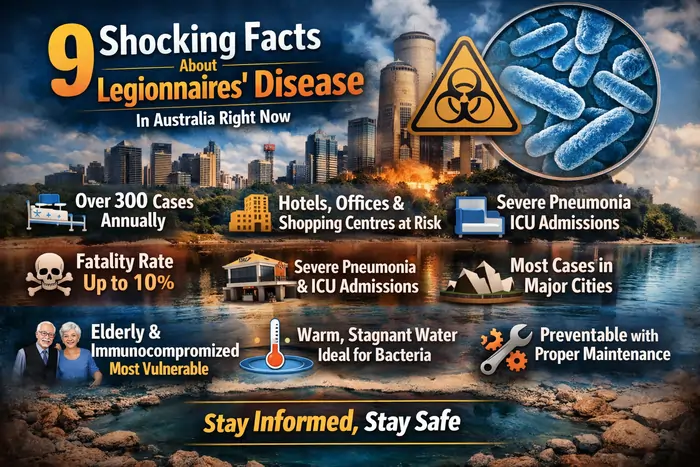
Legionnaires’ disease is a severe form of pneumonia caused by Legionella bacteria, which thrive in warm water systems such as cooling towers, plumbing, and air-conditioning units. In Australia, the disease remains officially uncommon, but recent outbreaks in major cities like Sydney show a concerning upward trend, particularly among older adults and people with underlying health conditions.
Unlike many respiratory illnesses, Legionnaires’ disease is not spread from person to person. Instead, infection occurs when people inhale contaminated water droplets from everyday environments, making outbreaks harder to detect and control. Early symptoms often resemble common pneumonia, which can delay diagnosis and increase the risk of severe complications such as respiratory failure.
Health authorities across Australia emphasise that prevention is possible through proper maintenance of water systems, strict public health monitoring, and increased awareness among high-risk groups. As urban infrastructure ages and climate conditions favour bacterial growth, Legionnaires’ disease is becoming a growing public health concern rather than a rare infection.
1. Officially “uncommon” – but the trend is rising
On paper, legionellosis (the broader term that includes Legionnaires’ disease) is still classified as an uncommon disease in Australia, with only a few hundred cases reported each year nationwide. The Australian Centre for Disease Control describes Legionellosis (Legionnaires’ disease) as a serious but relatively rare infection, however state data show notifications have been rising over time, especially among older adults.
New South Wales surveillance reports have highlighted an upward trend over more than a decade, with more cases being identified thanks to better awareness and testing. Most infections occur in people aged over 50, and many patients are men with underlying conditions, which concentrates the burden of disease in a specific segment of the population rather than spreading evenly across all age groups.
From an SEO perspective, this is a powerful angle: Legionnaires’ disease is still seen as “rare”, but the real‑world risk is growing, particularly for older Australians and those with chronic illnesses. Linking early in your article to national guidance such as the Australian CDC’s page on Legionellosis (Legionnaires’ disease) and Victoria’s Legionellosis (Legionnaires’ disease) – health.vic helps anchor this claim in credible sources while reinforcing your target keyword.
2. Outbreaks are hitting CBDs and high‑traffic areas
One of the most shocking realities is that recent Legionnaires’ disease outbreaks in Australia have not been confined to hospitals or industrial facilities; they’ve been linked to busy central business districts and public areas. In New South Wales, health authorities issued a Legionnaires’ disease alert for Sydney CBD after multiple people who had been in the city centre developed severe pneumonia.
Media reports such as this ABC News health alert for Sydney CBD have described clusters of cases in people who only had one thing in common: spending time in the same city blocks in the days before they became ill. Additional communications from South Eastern Sydney Local Health District, including a media release about extra Legionnaires’ cases linked to Clarence Street near Wynyard, show how cooling towers and other water systems in dense CBD settings can expose large numbers of people very quickly.
For readers, this underscores that simply being in the wrong place at the wrong time can be enough exposure, especially if multiple cooling towers are affected. By naturally integrating links like Legionnaires’ disease control guideline – NSW Health when you discuss outbreak management, you give users a path to official advice and strengthen topical authority around “Legionnaires disease Australia” and “Legionnaires disease outbreak Sydney CBD”.
3. The bacteria thrive in ordinary warm water systems
Another disturbing fact is how common the environmental conditions for Legionnaires disease really are. Legionella bacteria are found naturally in rivers, lakes and soil, but they become a serious human health threat when they colonise man‑made water systems.
Guidance from the Australian Government and the Australian Drinking Water Guidelines – Legionella section highlights that these bacteria thrive in warm, stagnant water, especially at temperatures between roughly 20°C and 45°C. They are also protected by biofilms, scale and sediment inside pipes and tanks, which means poor maintenance or low disinfectant levels can allow Legionella to multiply.
Victoria’s Legionella and water delivery systems guidance explains that high‑risk environments include hot‑water systems, showers, spa pools, decorative fountains, and complex hospital or aged‑care plumbing. Similar messages appear in national and environmental health documents like the enHealth Guidelines for Legionella control and the Legionnaires’ Disease – Environmental Health Guide, making it clear that something as everyday as a warm shower or a poorly maintained cooling tower can be a source of infection.
4. It’s not contagious between people – which makes it harder to catch early
Unlike many respiratory illnesses that have made headlines in recent years, Legionnaires disease is not usually spread from person to person. The World Health Organization’s legionellosis fact sheet emphasises that people typically become infected when they inhale tiny droplets (aerosols) containing Legionella from contaminated water systems, such as cooling towers, showers or spas.
NSW Health reiterates this in its Legionnaires’ disease control guideline: the disease is acquired from the environment, not from close contact with sick individuals. The US CDC general fact sheet on Legionella also notes that person‑to‑person transmission is extremely rare, with only isolated cases reported worldwide.
Paradoxically, this environmental pattern makes outbreak detection more challenging. Because there is no classic “household spread”, clusters can appear scattered and unconnected until public health investigators realise that people who became ill were all exposed to the same area or building. This is one reason state health departments monitor pneumonia notifications closely and publish alerts like the Legionnaires’ disease alert for Sydney CBD when patterns emerge.
5. It often looks like “just pneumonia” until it’s severe
Early symptoms of Legionnaires disease are notoriously difficult to distinguish from other forms of pneumonia or even a rough bout of the flu. Healthdirect’s Legionnaires’ disease information page lists common symptoms such as high fever, chills, cough, shortness of breath, muscle aches and headaches, which are similar to many respiratory infections.
However, Legionnaires’ disease can also include gastrointestinal symptoms like diarrhoea, nausea and abdominal pain, along with confusion or disorientation, especially in older adults. Resources like the Cleveland Clinic’s overview of Legionnaires’ Disease and Healthline’s Legionnaires’ disease guide explain that doctors often rely on specific diagnostic tests—such as urinary antigen tests and respiratory cultures—to confirm Legionella infection.
Because the signs are non‑specific, it’s easy for early cases to be misdiagnosed as generic community‑acquired pneumonia, particularly if the clinician isn’t aware of a current outbreak or environmental exposure. The StatPearls medical review of Legionnaires’ Disease notes that delayed recognition can contribute to more severe disease, especially in patients who do not initially receive antibiotics active against Legionella.
6. Complications can be rapidly life‑threatening
One of the most alarming aspects of Legionnaires disease is how quickly it can progress in vulnerable patients. The WHO’s legionellosis fact sheet and clinical sources like the Cleveland Clinic describe Legionnaires’ disease as a severe form of pneumonia that can lead to respiratory failure, septic shock and multi‑organ failure if not treated promptly.
The StatPearls article on Legionnaires’ Disease details complications including acute respiratory distress syndrome (ARDS), acute kidney injury, neurological involvement (such as confusion and encephalopathy) and cardiac complications like myocarditis or pericarditis. Mortality rates vary depending on the setting and the health of the patient but can be high in older adults, immunocompromised people and those infected in hospital or aged‑care settings.
Even survivors may face a lengthy recovery. Healthdirect’s Legionnaires’ disease page notes that recovery can take weeks and some people continue to experience fatigue, breathlessness or neurological symptoms long after leaving hospital. This reality makes early recognition and treatment critical, and it’s why authoritative sites such as the CDC Legionella fact sheet emphasise the importance of rapid diagnosis and appropriate antibiotics.
7. Certain Australians face much higher risk
Another shocking truth is that the burden of Legionnaires disease in Australia falls disproportionately on specific high‑risk groups. According to the Australian CDC’s Legionellosis (Legionnaires’ disease) overview and state health guidance, older adults (especially over 50), current or former smokers, and people with chronic lung disease, diabetes, kidney disease or weakened immune systems are much more likely to develop severe disease.
The WHO’s legionellosis Q&A and consumer resources like Healthline’s Legionnaires’ disease guide echo this pattern, describing how underlying conditions and immunosuppression significantly increase risk. Hospital patients and aged‑care residents are especially vulnerable because they are often frail, have multiple conditions and are exposed to large, complex water systems that must be carefully managed to prevent Legionella growth.
Victoria’s Legionella and water delivery systems guidance specifically targets hospitals and residential aged‑care facilities, outlining how they must assess and control water‑system risks. SA Health’s Legionnaires’ disease and reducing the risks provides advice for households, noting that hot‑water systems in homes with elderly or chronically ill occupants need to be properly maintained and set at safe temperatures.
8. Climate, ageing infrastructure and maintenance all play a role
The recent rise in Legionnaires disease notifications and recurrent outbreaks in cities like Sydney and Melbourne are not random events; they are shaped by climate, building design and maintenance practices. Warmer ambient temperatures, especially during late summer and early autumn, create ideal conditions for Legionella to grow in warm water systems and cooling towers if they are not properly managed.
The enHealth Guidelines for Legionella control and Queensland’s Guide to Legionella control in cooling water systems underline how ageing infrastructure, complex pipe networks, dead‑legs and poorly maintained tanks all increase the likelihood of Legionella colonisation. Once Legionella is established in a cooling tower or warm‑water system, aerosols can disperse over surrounding streets or into buildings through air intakes, potentially exposing many people.
Environmental health references like the Legionnaires’ Disease – Environmental Health Guide explain that devices such as evaporative air‑conditioning units, spa pools and decorative fountains can also contribute to Legionella risk if they are not cleaned and disinfected according to manufacturer and regulatory requirements. For Australian readers, these technical details highlight that prevention isn’t just about hospitals and super‑bugs; it’s about everyday infrastructure, building maintenance and regulatory enforcement.
The same climate and urbanisation pressures that favour Legionella also fuel other mosquito‑ and water‑related outbreaks across the region. For example, 9 Alarming Facts About the Samoa Dengue Outbreak You Need to Know explores how a severe dengue outbreak in Samoa escalated rapidly and shows how climate‑sensitive diseases can strain health systems in the Pacific.
9. Prevention is possible – but depends on both institutions and individuals
The most important—and in some ways most shocking—fact is that a significant share of Legionnaires disease cases could be prevented through robust water‑system management, better building maintenance and heightened awareness among at‑risk individuals.
What institutions and building owners must do
Australian guidance makes it clear that owners and managers of high‑risk systems are legally and ethically responsible for controlling Legionella. Documents such as the enHealth Guidelines for Legionella control, the NSW Legionnaires’ disease control guideline and Queensland’s Guide to Legionella control in cooling water systems all set out practical steps, including:
- Developing and regularly reviewing Legionella risk management plans.
- Keeping hot‑water storage above set temperatures (with safe mixing at the tap) and ensuring cold water stays cold.
- Maintaining adequate levels of disinfectant such as chlorine.
- Flushing low‑use outlets and removing dead‑legs in plumbing.
- Scheduling routine inspections, sampling and, where needed, shock disinfection.
Victoria’s Legionella and water delivery systems and SA Health’s Legionnaires’ disease and reducing the risks add further state‑specific advice that hospitals, aged‑care facilities, businesses and even private landlords can follow.
What individuals can do
Individuals, especially those in high‑risk categories, also have an important role to play in preventing Legionnaires disease and reducing their personal risk. Consumer‑friendly resources like Healthdirect’s Legionnaires’ disease page and Healthline’s Legionnaires’ disease guide recommend that people over 50, smokers, and those with chronic health conditions seek prompt medical care if they develop severe flu‑like symptoms, persistent cough, breathing difficulties or confusion—especially after visiting areas with known outbreaks or staying in hospitals, hotels or aged‑care facilities.
The WHO’s legionellosis fact sheet and the CDC Legionella fact sheet also advise reducing general pneumonia risk by quitting smoking and keeping chronic conditions under good control. While there is currently no widely used vaccine for Legionnaires’ disease, routine vaccines against influenza and pneumococcal disease can help lower overall respiratory morbidity, which is especially important in older and vulnerable populations.