

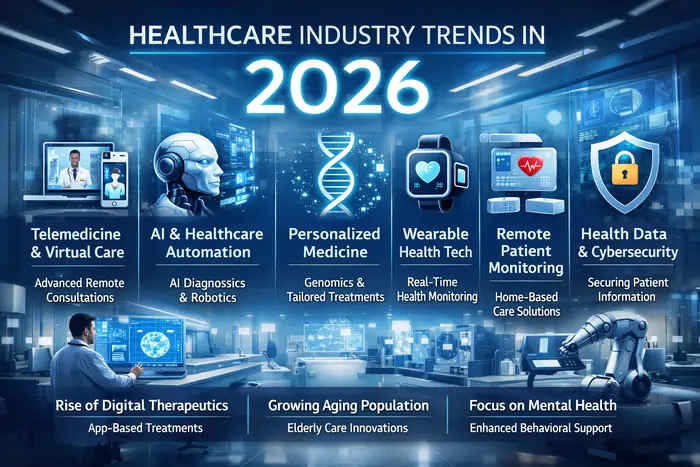
Healthcare Trends 2026 is being reshaped by converging pressures: aging populations, chronic disease, workforce shortages, rising costs, and an accelerated shift toward digital, AI‑enabled care. These forces are pushing providers, payers, and health‑tech companies to rethink how care is delivered, financed, and experienced, with several clear trends defining the year.
The State of Healthcare in 2026
By 2026, health systems in many countries are dealing with a heavier burden of chronic disease, an older patient population, and lingering operational strain from the pandemic years. In the US, McKinsey projects that healthcare demand and complexity continue to rise while financial and workforce pressures squeeze margins, forcing organizations to look for new efficiency and care‑delivery models.
At the same time, investment and innovation in digital health remain strong, with reports highlighting robust funding and M&A activity around virtual care, AI tools, and data platforms. Analysts describe 2026 as an inflection point where technology‑enabled care shifts from pilot projects to scaled, integrated capabilities across health systems. A good macro view of this landscape comes from McKinsey’s outlook on what to expect in US healthcare in 2026 and beyond: What to Expect in US Healthcare in 2026 and Beyond.
Technology‑Enabled Care Delivery and Digital Health
One of the most visible healthcare industry trends in 2026 is the normalization of technology‑enabled care delivery, with digital health woven into standard practice rather than treated as an exception.
Telehealth and virtual care, which surged during the pandemic, have now settled into hybrid models where patients seamlessly move between in‑person and virtual encounters depending on clinical need and preference. Remote patient monitoring (RPM) programs track vital signs and symptoms for chronic conditions like heart failure, diabetes, and COPD, allowing earlier intervention and more care at home. Hospital‑at‑home and virtual hospital programs use RPM devices, in‑home visits, and virtual rounds to shift appropriate inpatient‑level care into the home environment, improving patient comfort and reducing hospital congestion.
In Asia, regional reports highlight rapid growth in mobile health apps, wearable adoption, and virtual‑first clinics, particularly in urban centers, making digital health one of the top trends for 2026 across the region. For an overview of these developments, see: Top Digital Health Trends in Asia for 2026 and Beyond.
AI and Automation in Healthcare Trends 2026
Artificial intelligence and automation are moving from experimental tools to core infrastructure in healthcare organizations.
On the clinical side, AI‑powered diagnostics support radiology, pathology, and cardiology by flagging suspicious findings, prioritizing worklists, and providing decision support that complements clinician judgment. AI‑driven clinical decision support tools help identify high‑risk patients, recommend evidence‑based interventions, and coordinate care across teams, especially for complex chronic conditions. Ambient clinical documentation and AI scribe tools automatically generate visit notes from consultations, reducing documentation burden and giving clinicians more time with patients.
On the operational side, AI agents are beginning to automate administrative tasks such as prior authorization, coding, and patient outreach, which can reduce delays and administrative costs. A recent BCG analysis argues that AI agents and automation will transform health care operations by 2026, particularly in scheduling, coordination, and administrative workflows: How AI Agents and Tech Will Transform Health Care in 2026.
The American Association of Nurse Practitioners also highlights AI documentation and smart triage as key technology trends improving patient care and clinician experience in 2026: Top Five Health Care Trends for 2026: How New Technology Is Transforming Patient Care.
Many of the AI capabilities now transforming diagnostics, documentation, and care coordination mirror broader enterprise trends, as organizations in every sector adapt to the rise of artificial intelligence in business and look for ways to operationalize AI at scale.
Patient‑Centered, Consumer‑Driven Healthcare
Patients in 2026 behave more like informed consumers, expecting convenient access, transparency, and personalization. Health plans and providers are investing in “digital front doors”—integrated portals and apps that let patients schedule visits, access records, view costs, and communicate with care teams from a single interface.
Care models are becoming more patient‑centered and personalized, with precision medicine, genomics, and data‑driven risk stratification informing tailored treatment plans. There is also growing emphasis on healthspan—how long people live in good health—leading to more proactive, preventive, and lifestyle‑oriented services, sometimes enabled by wearables and remote coaching.
Digital navigation tools help patients move through complex systems by recommending appropriate care settings, managing referrals, and surfacing benefits they may not realize they have. Cigna’s 2026 trend piece, for example, highlights personalized navigation and consumer‑centric design as key to improving outcomes and affordability: Top Health Care Trends for 2026.
Value‑Based Care, Costs, and New Payment Models
Financial pressure remains a defining theme for healthcare in 2026, with payers and providers accelerating the shift from volume‑based to value‑based care. Value‑based models tie reimbursement to outcomes, quality, and total cost of care, encouraging investments in prevention, care coordination, and data analytics.
At the same time, margin pressure is acute: Vizient’s 2026 outlook emphasizes “new margin math” as hospitals face rising labor and supply costs, changing reimbursement rates, and more care shifting to outpatient and home settings. Drug costs, including the rapid uptake of GLP‑1 and other metabolic therapies for obesity and diabetes, are reshaping pharmacy and benefit strategies as plans try to balance clinical benefits with affordability.
Policy‑wise, US analyses highlight ongoing recalibration in Medicare Advantage, Medicaid redeterminations, and changes in site‑of‑care reimbursement, all of which influence where and how care is delivered. For context on these shifts, ATI Advisory’s brief on 2025 industry trends and what to watch in 2026 offers a policy‑focused view: 2025 Healthcare Industry Trends and What to Watch in 2026.
Workforce Pressures and the Future Healthcare Workforce
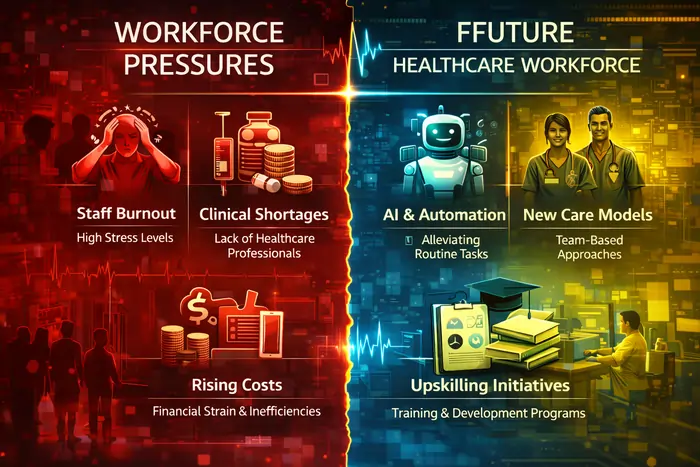
Workforce shortages and burnout remain critical challenges for the healthcare industry in 2026. Many systems are grappling with aging clinicians, high turnover in nursing and frontline roles, and growing demand that outpaces traditional staffing models.
Technology is playing a dual role: it can either add to burden (through clunky systems and extra clicks) or reduce it by streamlining work. Emerging tools like ambient documentation, AI‑driven triage, and automated scheduling are designed to free clinicians from repetitive administrative tasks and focus them on direct patient care. Some organizations are experimenting with new care‑team models that blend physicians, nurse practitioners, physician assistants, pharmacists, and virtual care teams to extend capacity.
Reports from Definitive Healthcare and others point out that solving workforce strain will require not only technology but also redesigned workflows, culture changes, and new training pipelines. A concise snapshot of these staffing dynamics is available in: 7 Healthcare Trends to Watch in 2026.
Data, Interoperability, and Cybersecurity
Data is the fuel for many of these trends, but interoperability and security remain persistent challenges. Health systems are investing in platforms that aggregate data from EHRs, claims, devices, and patient‑reported sources to support analytics, AI, and value‑based care. However, gaps in data integration and standards continue to hinder seamless information flow across providers, payers, and regions.
The World Health Organization’s global strategy on digital health underscores interoperability as a core pillar for safe, effective digital health at scale. Cybersecurity has also risen to the top of C‑suite agendas, as healthcare remains a prime target for ransomware and data breaches, with significant financial and patient‑safety implications. Organizations are boosting investments in security operations, identity management, and zero‑trust architectures to protect sensitive health data as more services move online.
For an overview of current digital applications and challenges, including interoperability and security, see: Digital Health: Current Applications, Challenges, and Future Perspectives.
Global and Regional Perspectives on Healthcare Trends
While many themes are global, healthcare industry trends in 2026 play out differently by region.
In the US, key focuses include value‑based care, Medicare Advantage dynamics, care‑delivery redesign, and managing GLP‑1‑related costs, as highlighted in McKinsey and other consulting analyses. In Europe, there is strong attention on health‑system resilience, primary‑care strengthening, and digital‑health regulation, including AI governance. Asia‑Pacific stands out for rapid consumer adoption of digital health, telehealth platforms, and retail‑health hybrids, often leapfrogging legacy models.
Global digital health strategies, like WHO’s framework, emphasize equity, access, and capacity‑building so that digital tools do not widen existing health gaps between and within countries. For a broad view on the future of healthcare and technology, including global trends, this article offers useful context: The Future of Healthcare and Technology: What’s Next.
Breakthrough Technologies and Clinical Innovations
Technology trends in 2026 go beyond telehealth and basic digitization, with several clinical innovations advancing quickly.
Medical‑technology trend reports highlight growth in robotics‑assisted surgery, smart infusion pumps, AI‑enhanced imaging devices, and advanced monitoring tools. Genomics and next‑generation therapies are moving further into mainstream care, supporting more precise oncology treatments, rare disease diagnostics, and pharmacogenomics‑informed prescribing.
Metabolic and obesity treatments, including GLP‑1 drugs, are reshaping care pathways and prompting new models for long‑term weight management and chronic‑disease risk reduction. Longevity and healthspan‑focused services—ranging from advanced screening to personalized prevention programs—are gaining traction, especially in private and concierge markets.
Articles like Bernard Marr’s overview of healthcare technology trends synthesize many of these breakthroughs into an accessible summary: 8 Healthcare Technology Trends to Watch in 2026.
How Healthcare Organizations Can Prepare for 2026 and Beyond
To navigate these trends, healthcare organizations need clear strategic priorities and realistic execution plans.
For providers, key moves include:
- Investing in digital front doors, virtual care, and remote monitoring that integrate with core clinical workflows.
- Building or partnering for AI capabilities in documentation, decision support, and operations, with strong governance.
- Redesigning care models and workforce roles to address shortages and burnout while maintaining quality.
- Strengthening data platforms, interoperability, and cybersecurity to support analytics and protect trust.
For payers and health plans, priorities often center on:
- Aligning benefits and reimbursement with value‑based care and tech‑enabled services.
- Managing the financial impact of high‑cost therapies and rising chronic‑disease burden.
- Using data and AI to identify high‑risk members, personalize engagement, and support navigation.
Consulting and industry reports stress that the execution gap—not technology availability—is now the main barrier; organizations that succeed are those that align leadership, culture, incentives, and capabilities around a coherent vision of tech‑enabled, patient‑centered care. Slalom’s “Healthcare Industry Trends 2026” piece, for example, frames this as moving from isolated tools to adaptive care models and system‑level transformation: Healthcare Industry Trends 2026.
For a more finance‑ and innovation‑focused perspective, you can also explore Silicon Valley Bank’s 2026 healthcare trends report, which examines investment flows and emerging segments: 2026 Healthcare Industry Trends Report.
Healthcare industry trends in 2026 point toward a system that is more digital, data‑driven, home‑centered, and consumer‑oriented, but also under significant financial and workforce strain. Organizations that treat trends like AI, telehealth, and value‑based care as components of a unified transformation strategy—rather than isolated projects—will be best positioned to deliver better outcomes, experiences, and sustainability in the years ahead.