

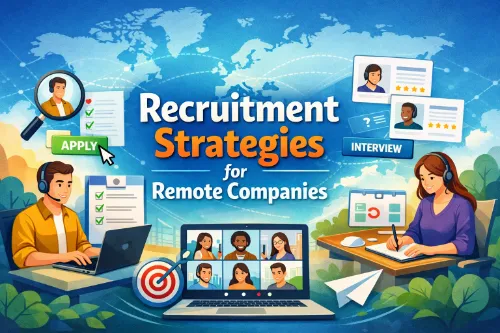
Recruiting for a remote company requires more than moving your traditional hiring process onto Zoom. It means rethinking how you attract, evaluate, and onboard talent across borders, time zones, and cultures. Remote‑first employers that get this right benefit from wider talent pools, lower overhead costs, and stronger diversity—but only if their recruitment strategies are intentionally designed for distributed work.
In this guide, you’ll learn proven recruitment strategies for remote companies, supported by real‑world examples and expert resources you can reference as you build or refine your own remote hiring playbook.
1. Start With a Remote‑Ready Hiring Mindset
The first step in designing effective recruitment strategies for remote companies is shifting your mindset from “remote allowed” to “remote designed.” Articles like Remote Recruitment: Adapting to the New Normal stress that remote hiring requires deliberate systems for role clarity, communication, and assessment rather than ad‑hoc adaptations.
Guides such as 8 Helpful Tips for Hiring Successful Remote Employees recommend defining your ideal remote candidate profile, including communication skills, self‑management, and comfort with asynchronous work—not just technical skill sets. When your hiring team understands what remote success looks like, you can design job descriptions, interview questions, and assessments that target the right people from day one.
2. Clarify Roles and Expectations in Your Job Descriptions
In remote companies, the job description often acts as a candidate’s first “tour” of your culture and expectations. That’s why experts like Forbes Advisor in 11 Effective Recruitment Strategies emphasize clear, detailed job descriptions as a cornerstone of any modern hiring strategy.
Remote‑specific resources such as Top Strategies for Successful Remote Hiring recommend that remote companies explicitly outline:
- Time‑zone expectations and whether work is fully async or has core hours
- Tools candidates will use daily (Slack, Zoom, Asana, GitLab, etc.)
- Performance metrics and how success will be evaluated in a distributed context
Similarly, Kenjo’s guide to hiring and managing remote employees highlights transparency during hiring as essential for setting the right expectations and attracting people who can thrive without in‑person oversight.
3. Build a Strong Employer Brand for Remote Talent
Remote talent can apply to companies anywhere in the world, which means your employer brand must stand out. Articles like Employer Branding for Remote Companies | Best Practices explain that employer branding for remote companies is now a core strategic lever to compete for high‑quality candidates globally.
Specialized resources such as Employer Branding for Remote Companies to Attract Talent show that remote brands win when they clearly communicate their remote employee value proposition (EVP), culture, and candidate experience across digital channels. Practical steps include:
- Publishing remote work policies and handbooks openly, as GitLab and Buffer do
- Showcasing stories and testimonials from distributed team members
- Highlighting remote‑friendly perks, growth paths, and work‑life balance
When candidates see that your remote setup is intentional and mature, they’re more likely to prioritize your company in their search.
4. Use the Right Channels and Platforms to Source Remote Talent
An effective remote recruitment strategy leverages platforms and tools built for distributed talent. Guides like How to Attract and Hire the Best Remote Talent for Your Company recommend using niche remote job boards, freelance marketplaces, and remote‑friendly networks alongside traditional channels.
If you want an end‑to‑end hiring stack, Workana’s breakdown of 5 Top Talent Acquisition Platforms for End‑to‑End Hiring 2025 highlights platforms like Workana, Greenhouse, Jobvite, and Zoho Recruit that support sourcing‑to‑onboarding workflows and global compliance. These platforms can help you:
- Automate candidate sourcing with AI filters and matching
- Manage international hiring workflows, contracts, and compliance
- Integrate with HRIS and collaboration tools for smoother handoffs
Combined with a strong employer brand, these channels ensure your remote roles reach the right candidates at scale.
5. Design a Remote‑Friendly Application and Screening Process
Once candidates land on your roles, the application and screening process should demonstrate how your remote company operates. Remote hiring experts at Hubstaff advise using structured, predictable steps so candidates always know what comes next, which they outline in their remote hiring best practices guide.
Articles like Remote Operations at Distributed Companies: Automattic, Buffer & GitLab show how top all‑remote companies use asynchronous written communication and trial projects in their hiring. For example:
- Buffer has candidates produce Loom videos and async written responses to evaluate communication and cultural fit.
- Automattic runs multi‑week paid trials so candidates and teams can test collaboration in a real remote context.
By incorporating async tasks, written prompts, and realistic work samples, you can better assess how candidates will perform day‑to‑day in your distributed environment.
6. Implement Structured, Remote‑Optimized Interviews
Structured interviews are especially important in remote recruitment because they reduce bias and help you compare candidates consistently across geographies. Hubstaff’s guide on remote hiring best practices and Hoops HR’s Top Strategies for Successful Remote Hiring both recommend:
- Using a standardized set of interview questions mapped to competencies
- Including scenario‑based questions specifically around remote collaboration
- Incorporating practical skills assessments or take‑home tasks
Many of these suggestions are echoed in broader recruitment guides like 11 Effective Recruitment Strategies, which emphasizes structured interviews and clear evaluation rubrics to make hiring fairer and more efficient. When you combine structure with remote‑specific questions, you get far better signal about who will actually thrive on your team.
7. Screen for Remote‑Ready Skills and Mindsets
For remote roles, soft skills and work habits often matter as much as technical expertise. In 8 Helpful Tips for Hiring Successful Remote Employees, Indeed advises employers to prioritize:
- Self‑motivation and time management
- Written and asynchronous communication skills
- Comfort with digital tools and independent problem‑solving
Guides like Recruiting for Remote Work: Key Strategies for Building a High‑Performing Distributed Workforce reinforce the importance of evaluating candidates on their ability to work autonomously, navigate ambiguity, and collaborate across time zones. Screening for these traits during interviews and trial tasks dramatically reduces the risk of mis‑hires in remote roles.
8. Prioritize Culture Fit and Values Alignment (Not Just “Likeability”)
Culture fit in remote companies is less about personality and more about alignment with values and working norms. Hoops HR’s Top Strategies for Successful Remote Hiring recommends making cultural alignment a formal part of your recruitment process, including evaluating core values in interviews and encouraging transparency about how your team operates.
Arc’s case study on Remote Operations at Distributed Companies: Automattic, Buffer & GitLab describes how Automattic uses job trials to assess cultural and collaboration fit in real work situations, rather than relying on gut feel from a single call. Similarly, remote employer branding resources from We Work Remotely encourage highlighting inclusive language, cultural learning opportunities, and stories from global team members to attract candidates who align with your culture.
By focusing on values and working styles, you build remote teams that feel cohesive despite never sharing an office.
9. Be Transparent About Challenges, Expectations, and Performance
The best recruitment strategies for remote companies treat candidates like future partners, not just applicants. Hoops HR advises teams to be transparent about challenges such as time‑zone coordination, self‑management, and limited face‑to‑face time, which they outline in their remote hiring article. This honesty filters out candidates who aren’t prepared for distributed work and builds trust with those who are.
Hubstaff’s remote hiring guide recommends setting clear expectations around workflows, communication tools, and goals during the recruitment process. Likewise, Kenjo’s tips for hiring and managing remote employees highlight transparency and expectation‑setting as two of the most important best practices when hiring remotely.
When candidates know how they’ll be evaluated and what success looks like in your company, your offers are more likely to be accepted by the right people—and new hires ramp up faster.
10. Invest in Remote‑First Onboarding as Part of Recruitment
Effective recruitment for remote companies doesn’t stop at the signed offer; it includes how you onboard and integrate new hires. GitLab’s complete guide to remote onboarding for new hires demonstrates how a well‑documented, asynchronous onboarding process can teach new team members to self‑serve information, adopt remote‑first practices, and feel supported from day one.
Hoops HR also emphasizes onboarding in its Top Strategies for Successful Remote Hiring, recommending structured onboarding plans, digital resource hubs, and training on remote work tools. GitLab’s handbook‑first approach, detailed in its onboarding guide, shows how using issues, templates, and self‑driven tasks can scale onboarding across hundreds or thousands of remote employees globally.
When candidates see that your onboarding is robust and remote‑friendly, it becomes a selling point in your recruitment messaging.
11. Leverage Technology, Automation, and Data in Your Hiring Funnel
Remote recruitment is inherently digital, which makes it a perfect fit for automation and data‑driven optimization. Remote recruiting practices: The expert guide from Remote.com explains how to build cost‑effective hiring plans using calculators, strategies, and tools that reduce manual work while maintaining candidate quality.
Similarly, Workana’s overview of top talent acquisition platforms points out that modern platforms use AI‑driven sourcing, workflow automation, and analytics to save up to 70% of sourcing time. Key actions include:
- Automating initial screening and scheduling
- Tracking time‑to‑hire, source effectiveness, and quality‑of‑hire
- Ensuring compliance for cross‑border hiring and data protection
For remote companies, optimization based on data is essential because you’re often hiring across multiple countries, roles, and seniority levels simultaneously.
12. Create a Consistent Candidate Experience Across Borders
One underrated recruitment strategy for remote companies is designing a globally consistent candidate experience. Articles such as Recruiting for Remote Work: Key Strategies for Building a High‑Performing Distributed Workforce stress that candidates should receive clear, timely communication and fair evaluation regardless of their location.
Resources on employer branding for remote companies from We Work Remotely and Allianze HR both highlight the importance of using inclusive language, being mindful of cultural nuances, and telling stories from multiple regions so that candidates feel seen and represented. By aligning messaging, timelines, and expectations across markets, you build trust and protect your brand reputation with global talent.
13. Use Feedback Loops to Continuously Improve Your Remote Hiring
Finally, great recruitment strategies for remote companies are never “set and forget.” Hubstaff, Remote.com, and other remote hiring experts all encourage teams to gather feedback from candidates and new hires to refine job descriptions, interviews, and onboarding.
You can adapt ideas from employer branding guides like Employer Branding for Remote Companies To Attract Talent by auditing your candidate communications regularly, tracking drop‑off points, and updating processes to stay competitive as remote work evolves. Even small changes—like shortening your interview process, clarifying salary ranges earlier, or providing better pre‑interview materials—can significantly improve your remote hiring outcomes over time.