

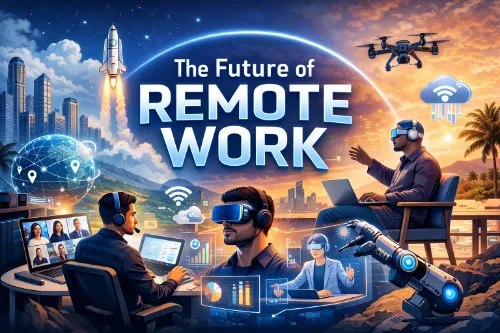
The future of remote work isn’t about “everyone stays home forever”—it’s about a more flexible, digital, and global labor market where hybrid and remote‑first models become the norm, powered by AI and outcome‑based management. Here’s how that future is taking shape and what it means for workers and leaders.
Remote and Hybrid: The New Normal
Recent data shows that fully on‑site work is no longer the default. Yomly’s remote work statistics for 2025 note that by 2026, remote work has reached about 52% of the global workforce, almost doubling its pre‑pandemic level. At the same time, Amply’s hybrid working statistics report that the share of workers with a hybrid schedule rose from around 20% in 2019 to roughly 53% in 2025.
This aligns with research highlighted by HybridHero’s Future of Hybrid Work: New Trends and Predictions for 2025, which cites a McKinsey study suggesting that about 90% of businesses plan to adopt some form of hybrid work due to its productivity and satisfaction benefits. In other words, the future isn’t purely remote or purely office—it’s a spectrum of hybrid and remote‑first setups.
Key Trends Shaping Remote Work in 2026 and Beyond
1. Hybrid as Default, Not Exception
Splashtop’s Top 10 Trends That Will Redefine Remote Work in 2026 argues that hybrid work is becoming the default operating model. Their analysis notes that aggressive return‑to‑office (RTO) mandates are reshaping corporate culture, but many organizations are settling into flexible patterns rather than reversing remote entirely.
Amply’s data suggests hybrid workforces are about 5% more productive than fully remote or fully on‑site teams, with 66% of managers seeing productivity improvements and 36% of hybrid employees reporting higher engagement than fully on‑site peers. By the end of 2025, they predict less than 55% of the workforce will be bound to a traditional office, with a “3‑2” schedule (three days in office, two remote) emerging as a common pattern.
2. Remote‑First Outperforms Remote‑Friendly
A LinkedIn analysis, The Future of Remote Work in Tech: Trends to Watch in 2026 and Beyond, argues that “remote‑first” will replace “remote‑friendly.” Remote‑friendly companies still center offices and treat remote workers as exceptions, whereas remote‑first teams design processes assuming people are distributed by default and avoid office‑centric decision‑making.
GitLab’s own experience, summarized in talks like “Phases of remote adaptation, GitLab’s handbook process, and the future of remote work” and case studies such as The GitLab Remote Work Experiment, illustrates this shift. They moved from emergency remote work (stabilization) to intentional, handbook‑first, asynchronous operations, demonstrating how a remote‑first approach can scale to thousands of employees across 60+ countries.
3. Outcome‑Based Work Replaces “Hours Online”
Both Splashtop’s trend list and the LinkedIn tech trends article highlight the rise of outcome‑based performance models. Splashtop notes that outcome‑based contracts will increasingly define what success looks like, focusing on deliverables instead of days swiped into an office. LinkedIn’s analysis similarly argues that “the days of measuring productivity by hours online are numbered,” with high‑performing companies shifting toward trusting teams and measuring results rather than screen time.
Toolshero’s Future of Remote Work in 2026 adds that compensation frameworks and governance will evolve alongside this shift, with more refined pay bands, flexibility stipends, and transparency around monitoring to maintain trust.
4. AI‑Powered Workflows and Digital Collaboration
AI is set to permeate remote and hybrid work. Splashtop’s trends list points out that AI‑powered productivity tools will transform remote workflows, helping with automation, summarization, and collaboration—but also raising concerns about work intensification if not managed well.
HybridHero’s hybrid work trends article cites the rise of tools like KUDO (real‑time translation), VirBELA (virtual worlds for collaboration), and Agora (AI noise cancellation, sentiment analysis, interactive features), plus the impact of 5G on more reliable, immersive remote experiences. Buffer’s State of Remote Work report and commentary suggest we’ll see more tools designed from first principles for remote‑first teams, challenging the status quo of chat‑heavy, always‑on communication.
Globalization of Talent and the Rise of Digital Jobs
The World Economic Forum, in partnership with Capgemini, estimates that remote jobs will continue to grow significantly. A WEF‑linked analysis, World Economic Forum Estimates 92 Million Jobs Will Go Remote by 2030, forecasts that fully remote roles will rise from around 73 million to 92 million by 2030.
- Emerging technologies like cloud computing, video conferencing, and AI have accelerated global collaboration.
- There is a surplus of skilled, educated workers in lower‑middle‑income countries who can help fill labor shortages in higher‑income regions through digital remote jobs.
- Key sectors ripe for remote roles include accounting, legal, finance, IT services, healthcare, marketing, communications, and cybersecurity.
At the same time, the WEF highlights risks: technology failures and cybersecurity, performance management for global digital workers, and ensuring fair work conditions and wages. They emphasize the need for fair wage practices and inclusive culture to prevent exploitation and maintain well‑being as remote work globalizes.
Skills You’ll Need to Thrive in the Future of Remote Work
As remote work matures, the skills bar is rising. Forbes’ 7 Remote Work Skills You Need To Keep From Falling Behind In 2026 notes that basic digital skills are no longer enough. The article highlights advanced communication, emotional intelligence, adaptability, self‑management, and proficiency with digital collaboration tools as key.
Splashtop’s trends list and the LinkedIn tech trends piece add:
- Async communication as a core leadership capability—teams that excel remotely design for asynchronous work and minimize unnecessary meetings.
- Continuous learning and upskilling around AI, cybersecurity, and digital tools to stay relevant.
- Resilience and self‑discipline to handle blurred boundaries and changing policies.
These insights align with broader reskilling initiatives covered by the World Economic Forum’s Reskilling Revolution, which aims to prepare hundreds of millions of people for a digital, remote‑heavy economy.
Productivity, Well‑Being, and Culture in a Hybrid Future
Amply’s hybrid stats suggest that concerns about lost productivity are largely unfounded when remote and hybrid work are done well. They report:
- Hybrid workforces are ~5% more productive than fully remote or fully on‑site.
- 66% of managers see increased productivity with hybrid work, and 90% say hybrid worker productivity is the same or higher than pre‑pandemic.
- 77% of workers report improved productivity when working remotely, and 72% of hybrid/remote workers are less likely to take sick days.
However, Splashtop and Toolshero both point out that aggressive RTO mandates, monitoring tools, and poorly designed hybrid arrangements can harm culture and trust. Splashtop notes that mental health and employee well‑being are becoming non‑negotiable, with employers under pressure to address isolation, burnout, and work‑life boundaries.
GitLab’s remote experiment and Buffer’s long‑running remote culture both emphasize intentional practices—documentation, async communication, virtual social events, and periodic in‑person gatherings—to maintain cohesion and fight “out of sight, out of mind” dynamics. Tidaro’s GitLab remote work case study describes how GitLab uses group conversations, local coworking days, and in‑person events to break down silos and maintain connection.
What This Means for Companies
For organizations, the future of remote work brings both opportunities and responsibilities.
- Designing hybrid intentionally: HybridHero and MIT Sloan‑linked resources stress that hybrid models require deliberate design around schedule patterns, meeting norms, technology, and office space—not ad hoc flexibility.
- Investing in leadership training: Toolshero’s 2026 analysis predicts that training managers for hybrid and remote leadership will become a strategic priority, with programs focused on outcome‑based management, digital tools, and privacy‑respecting monitoring policies.
- Balancing flexibility and fairness: The WEF/Capgemini paper flags wage suppression risks and urges companies to adopt fair wage practices and inclusive support for remote hires in lower‑cost regions.
- Strengthening cybersecurity and data governance: Splashtop’s trends list highlights cybersecurity as a top concern for distributed teams, calling for robust security practices and clear policies.
Companies that treat remote work as a strategic capability—not just a perk or a cost‑cutting move—are more likely to attract global talent, maintain engagement, and stay competitive.
What This Means for You
For individuals, the future of remote work means:
- More options: WEF estimates show millions more fully remote roles by 2030, across professional services, tech, healthcare, and creative fields.
- Higher expectations: Employers will expect advanced digital fluency, async communication skills, and self‑management—not just the ability to join a Zoom call.
- Continuous reskilling: AI, automation, and global competition will keep changing the skills in demand, making ongoing learning a necessity.
- Agency over location and schedule: With hybrid and remote‑first models expanding, more people will be able to choose where they live and how they structure their weeks—if they can demonstrate the skills and reliability remote work demands.
To prepare, you can:
- Audit your current remote skills and gaps using insights from Forbes’ remote skills list.
- Study remote‑first playbooks from GitLab and Buffer to understand how mature distributed teams operate.
- Invest in async communication, digital collaboration tools, and AI‑assisted workflows that are rapidly becoming standard.