

Seasonal planning for US and Australian businesses means reading your demand patterns, then deliberately aligning cash, marketing, inventory and staffing with those patterns in two very different seasonal calendars. Done well, it turns predictable peaks and troughs into planned opportunities instead of annual crises.
Introduction: Why Seasonal Planning Matters in the US and Australia
Seasonal planning is the practice of building your financial, marketing and operational calendar around expected peaks and dips in demand rather than reacting when it is already too late. In the US, many businesses live or die by the Q4 holiday season, summer travel and events like Black Friday and Cyber Monday; in Australia, seasonality flips, with retail and tourism spikes clustered around a hot Christmas, long summer holidays and school break periods.
Because the seasons are reversed between the Northern and Southern Hemispheres, multi‑market businesses cannot just “copy‑paste” a calendar and call it a day—your US customers might be shopping for winter jackets while your Australian audience is searching for beach umbrellas. Guides like Business Victoria’s 6 seasonal strategies for small businesses and Digital Agency Network’s Seasonal Marketing: 5 Strategies for Year‑Round Business Success both stress that small businesses need a proactive, data‑driven approach to seasonal planning.
Understanding Seasonal Patterns in Each Market
US Business Seasonality
In the US, many sectors see a pronounced spike in Q4, supported by Thanksgiving, Black Friday, Cyber Monday and Christmas, with smaller peaks around back‑to‑school, Memorial Day and summer holidays. Seasonal cash‑flow guides like Airwallex’s seasonal cash flow management for holiday demand recommend mapping sales, margin and payments data for previous years to understand how these events actually play out in your own numbers.
Planning resources emphasise that your “seasonal curve” is unique: a US ecommerce retailer might peak in November–December, while a B2B software provider peaks around fiscal‑year budgeting cycles. The key is to overlay your revenue with holidays, marketing campaigns and weather data to see what truly drives demand.
Australian Business Seasonality
In Australia, seasonality is shaped by the opposite climate, school holidays and tourism flows. Business Victoria notes that many small businesses peak in the warm months around Christmas and summer holidays, with additional bumps around events like EOFY and local festivals. Beany’s strategic cashflow management for seasonal businesses shows how BAS, PAYG and superannuation payments add their own rhythm to the year, regardless of how sales fluctuate.
Accru Melbourne’s 9 tips to managing a seasonal business encourages owners to look at at least two to three years of data to identify recurring peaks and troughs, and then forecast these into the coming year rather than “starting from zero” every season. For retailers, Stylematrix’s seasonal inventory strategies for Australian retailers highlights how seasonality affects stock levels, product mix and lead times.
Identifying Your Peak and Off‑Peak Periods
Whether you are in the US or Australia, three steps are central to understanding your pattern:
- Plot monthly (or weekly) revenue and gross margin across multiple years.
- Mark major holidays, campaigns and external events (weather shocks, lockdowns).
- Analyse where demand pulls forward, where it drops, and how long cash collections lag behind.
Airwallex’s seasonal cash‑flow guide and Business Victoria’s seasonal strategies both emphasise combining historical data with forward‑looking assumptions, then adjusting for macro changes (such as e‑commerce penetration or shifting tourism patterns). That forms the foundation for the financial and marketing tactics that follow.
Financial Planning for Seasonal Businesses
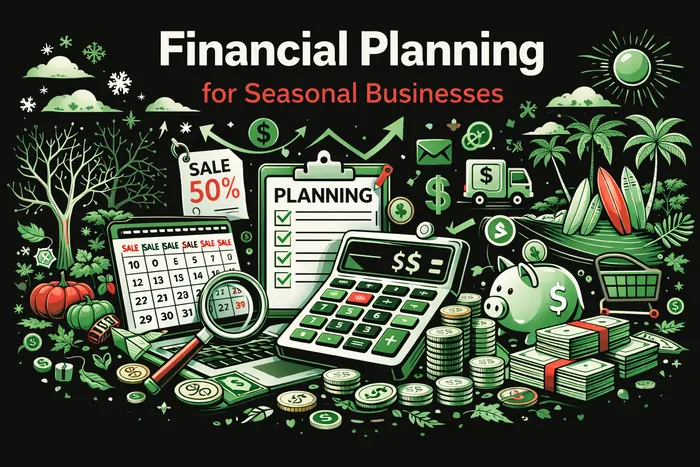
Cash‑Flow Management for Seasonal Businesses
Cash‑flow management is the number‑one seasonal planning priority. Fundtap’s strategies for year‑round stability in seasonal businesses argues that you should think in terms of a 12‑month cash cycle, not just the high season. That means:
- Building a rolling 12‑month cash‑flow forecast that captures seasonal swings.
- Anticipating when big costs like tax, insurance and loan repayments hit.
- Managing receivables aggressively during peak to avoid slow‑pay problems in off‑season.
Beany’s strategic cashflow management for seasonal businesses recommends modelling three scenarios—optimistic, expected and conservative—and ensuring you can still meet obligations under the conservative case. Bentleys’ bookkeeping tips for a seasonal business emphasise accurate, timely bookkeeping as the basis for any realistic cash‑flow forecast.
Beyond seasonal projections, owners should also master the day‑to‑day basics of managing cash flow in a small business; this practical guide on managing cash flow in a small business explains forecasting, smoothing inflows and outflows, and building habits that keep cash healthy all year.
Budgeting for Peak vs Off‑Peak Seasons
Instead of one flat annual budget, most experts recommend two perspectives: a peak‑season budget and an off‑season budget. Fundtap suggests clearly separating peak‑season investments (extra inventory, staff, marketing) from off‑season base costs and treating them as different “mini‑budgets” inside your year.
BizCover’s 13 tips for managing a seasonal business year-round advises classifying costs as fixed or variable and planning how to flex the variable portion in quiet months. Pacific Finance’s financing tips for seasonal business stability likewise recommends building seasonal budgets that tie into funding options, so you are not forced into expensive last‑minute finance.
Building Reserves and Securing Finance
Most seasonal‑business guides agree you should build a cash buffer from peak‑season profits. Beany explicitly suggests earmarking a portion of peak‑season surplus for tax, superannuation, insurance and major supplier costs that arrive regardless of revenue. That buffer buys you time to adjust if an upcoming season underperforms.
Carbon Group’s financial tips to get your business holiday‑ready and Pacific Finance’s financing tips both recommend lining up finance ahead of time—overdrafts, lines of credit, invoice finance—when your financials look strong and lenders are more receptive. Fundtap’s stability guide stresses matching the type of finance to the underlying need (e.g., short‑term working‑capital facilities for inventory vs longer‑term loans for equipment).
If your current model is heavily tied to one season, consider adding new revenue streams or experiments that are cheaper to test; this list of low‑cost business ideas shows examples of lean, complementary offers you could pilot in your off‑season to smooth income.
Seasonal Marketing Strategies for US and Australian Businesses
Mapping a Seasonal Marketing Calendar
Seasonal marketing performs best when it is planned months in advance. Digital Agency Network’s Seasonal Marketing: 5 Strategies for Year‑Round Business Success recommends creating a calendar that covers all four seasons, key holidays and industry‑specific events. WSI’s article on how to properly plan your seasonal marketing efforts adds that you should layer timing, channels and budgets into that calendar well before execution.
In practice, that might mean:
- US track: back‑to‑school, Halloween, Thanksgiving, Black Friday/Cyber Monday, Christmas, New Year.
- Australian track: EOFY, spring racing, summer/Christmas, Australia Day, local festivals and school holidays.
Business Victoria’s seasonal strategies encourage small businesses to map out these events visually and align promotions, partnerships and stock accordingly.
Seasonal Marketing Campaigns and Content
Seasonal campaigns work best when they are specific, timely and genuinely relevant. Infobip’s strategic guide to seasonal marketing suggests segmenting customers by geography, climate and past behaviour, then tailoring seasonal offers to each group rather than blasting generic “Holiday Sale!” messages.
Thryv’s What is Seasonal Marketing? explains how to build campaigns around themes such as weather (heatwaves, storms), life events (weddings, school returns) or specific holidays, then choose channels and offers that match that theme. Digital Agency Network’s seasonal‑marketing piece reinforces this with examples, highlighting limited‑time bundles, gift guides and service packages as effective seasonal tactics.
For bricks‑and‑mortar operators, seasonal planning should also include local SEO for small businesses so you show up when local customers search for “near me” terms at peak times; this guide on local SEO for small businesses walks through optimising Google Business Profiles, local keywords and reviews to capture that demand.
Using Seasonal Keywords and SEO
From an SEO perspective, seasonal planning means identifying and targeting seasonal keywords early enough that your content can rank when search demand spikes. Neil Patel’s guide on seasonal keywords for SEO shows how to use tools like Google Trends to spot when certain phrases ramp up and plan content accordingly. Yellow Pages’ article on what are seasonal keywords and how to use them emphasises that different regions (including Australia) can have very different seasonal keyword patterns.
OneUpWeb’s Seasonal SEO: Holiday and Time‑Based Keyword Research and SearchAtlas’ seasonal keywords guide both advocate:
- Creating evergreen seasonal landing pages you refresh each year.
- Internally linking to those pages from related content.
- Updating copy, offers and FAQs ahead of each season rather than starting from scratch.
This is especially important if you are targeting both US and Australian audiences, since query patterns and timing differ by hemisphere.
Inventory, Operations and Staffing Strategies
Seasonal Inventory Planning
Inventory planning is central to seasonal success, particularly in retail, hospitality and seasonal services. Stylematrix’s Seasonal Inventory Strategies for Australian Retailers highlights how Australian retailers must juggle long lead times, supplier constraints and rapidly changing trends between seasons.
In the US, ASD Market Week’s six ways to leverage seasonal buying strategies recommends using data from previous seasons to refine purchasing, negotiating terms with suppliers for flexible reorders, and planning aggressive end‑of‑season clearance strategies. Prospa’s retail and hospitality guide to planning for the holiday rush adds practical tips on how to balance stock levels with cash‑flow and staffing constraints ahead of major peaks.
Staffing Plans for Busy and Quiet Seasons
Seasonal businesses must plan recruitment, training and rostering in line with demand, not on gut feel. BizCover’s 13 tips for managing a seasonal business year-round recommends starting hiring early for peak seasons, building a pool of returning seasonal staff, and clearly communicating expectations and schedules.
Accru Melbourne’s 9 tips to managing a seasonal business stresses the importance of budgeting for recruitment, training and overtime costs and using flexible working arrangements where appropriate. Carbon Group’s holiday‑readiness guide also suggests cross‑training staff during off‑season so they can cover multiple roles when it gets busy.
Using Off‑Season Time Strategically
Quiet months are the ideal time to strengthen systems, refine strategy and experiment. Business Victoria encourages small businesses to use off‑season to review suppliers, renegotiate contracts, audit tech tools and tidy up processes. Accru suggests looking at a 12‑month horizon during off‑season, planning projected sales and costs, and testing new product or service ideas that could smooth revenue across the year.
Bentleys’ bookkeeping guide and Beany’s cash‑flow resource both underline that off‑season is also the right time to catch up on reconciliations, tighten controls and ensure your numbers are accurate before the next busy cycle.
Digital and Data‑Driven Seasonal Planning
Using Analytics and Forecasting
Data is the backbone of strong seasonal planning. Airwallex’s seasonal cash flow management guide recommends combining historical sales, margin and payment‑cycle data to forecast cash‑flow needs around holiday demand. Nero Financial’s financial forecasting for the festive season shows how to project staffing, marketing and inventory costs into that model.
SearchAtlas’ seasonal keywords guide and Neil Patel’s seasonal‑SEO article both show how to combine search data with your internal analytics to identify when content should be created or refreshed. That way, your site is ready when demand appears.
Tools and Processes for Seasonal Planning
Practical seasonal planning often relies on a handful of simple tools and recurring processes:
- A rolling 12‑month cash‑flow forecast maintained monthly.
- A shared seasonal marketing calendar covering US and Australian campaigns.
- Inventory dashboards that surface stock levels, lead times and sell‑through rate by category.
WSI’s seasonal marketing planning article suggests scheduling planning sessions several months before key periods, then locking in creative, copy and budgets early. Business Victoria’s seasonal strategies page similarly recommends seeing your year as a cycle, with planning, execution and review phases repeating across seasons.
Risk Management and Contingency Planning
Seasonal businesses face extra risk from weather, supply‑chain disruptions and demand shocks. Pacific Finance’s financing tips for seasonal business stability advises owners to build contingency plans that assume at least one weak season in every few years and to line up finance before it is urgently needed.
Fundtap’s year‑round stability piece and BizCover’s year‑round tips both emphasise diversifying revenue streams—adding off‑season products or services so your entire business is not tied to a single seasonal spike. Business Victoria and Accru encourage businesses to “stress test” their plan by modelling what happens if key assumptions (weather, tourism, consumer spending) are worse than expected, then pre‑defining actions like cutting discretionary spend or deploying specific promotions.
Case‑Style Examples and Practical Scenarios
A US ecommerce retailer preparing for Q4 might:
- Use OneUpWeb’s Seasonal SEO and Neil Patel’s seasonal keywords SEO guide to identify and update holiday landing pages months before peak search demand.
- Follow Airwallex’s and Carbon Group’s financial‑planning advice to forecast cash‑flow needs, secure a line of credit and budget for ad spend and extra stock.
- Apply Infobip’s strategic seasonal marketing to personalise offers by segment and channel.
- For local merchants, combine this with local SEO for small businesses to capture nearby intent during peak shopping days.
An Australian tourism or retail business planning for summer might:
- Use Beany’s cashflow management for seasonal businesses to model various booking and weather scenarios and ensure obligations are covered.
- Lean on Business Victoria’s seasonal strategies and BizCover’s year‑round tips to plan staffing, partnerships and promotions.
- Use Stylematrix’s inventory strategies for Australian retailers and Thryv’s seasonal marketing framework to align stock and campaigns with local demand and events.
- Explore new off‑season offers inspired by low‑cost business ideas to smooth revenue into quieter months.
If you are operating across both markets, your seasonal plan will likely have two parallel tracks: one for US seasonality and one for Australian seasonality, with shared processes but different timing.
Actionable Seasonal Planning Checklist
You can turn all of this into a practical checklist for your US and Australian operations:
- Analyse 2–3 years of sales and cash‑flow data to identify peaks, shoulders and troughs.
- Build a 12‑month rolling cash‑flow forecast with separate assumptions for peak and off‑peak periods.
- Construct a seasonal marketing calendar for each market (US and AU) including holidays, weather events and local festivals.
- Research seasonal keywords for each geography and refresh key pages several months before demand spikes.
- Plan inventory purchases, lead times and clearance strategies based on forecast demand.
- Prepare hiring and rostering plans, plus a returning seasonal staff pool.
- Use off‑season to fix systems, review suppliers and test new offers.
- Strengthen core financial skills with resources on managing cash flow in a small business.
- Stress‑test your plan with downside scenarios and pre‑define contingency actions (spend cuts, promos, finance options).
Treating seasonal planning as a structured, data‑driven process—rather than a last‑minute scramble—helps US and Australian businesses smooth cash flow, maximise peak‑season returns and turn the challenges of seasonality into a durable competitive advantage.
