


Low-cost business ideas aren’t just side hustles anymore—they’re one of the smartest ways to test entrepreneurship without betting your entire savings. With the right idea, lean execution, and smart use of free tools and resources, you can build a business that actually works and grows over time.
Introduction: Why Low-Cost Businesses Win Today
When people imagine starting a business, they often picture big capital, office space, and investors—but the reality today is very different. Many successful founders now start with Low-cost business ideas that rely more on skills, time, and strategy than on money. From freelancing and online services to home-based micro-brands, these lean models let you validate ideas, build real revenue, and pivot quickly when the market changes.
On RealCEOsStories.com, the focus is on how real founders build real companies—not “get rich quick” fantasies. By leaning into Low-cost business ideas that work in real life, you move from dreaming about entrepreneurship to actually executing, using the budget and skills you already have.
What Makes a Low-Cost Business Idea “Work”?
Not every cheap idea is a good idea. A Low-cost business ideas that truly works usually has four key traits:
- Low startup cost – You can launch with minimal cash, often a few hundred dollars or less.
- Fast path to first revenue – You can test and get your first paying customer in weeks, not years.
- Real, consistent demand – People are already paying for similar solutions or clearly searching for them.
- Simple operations – You don’t need a large team, warehouse, or complex infrastructure to deliver.
The traps appear when ideas look cheap on paper but require hidden expenses like licenses, specialized equipment, advanced software, or large ad budgets. Some models also demand long learning curves, which push your first revenue far into the future. Before committing, run every idea through a simple checklist:
- What will it realistically cost to start and run in the first 3–6 months?
- How quickly can you reach a paying customer?
- Which skills do you already have, and which will you need to learn?
- How complicated is delivery and customer support?
Once you can answer those questions clearly, you’re ready to explore specific low-cost small business ideas that work today.
Low-Cost Online Business Ideas That Actually Work
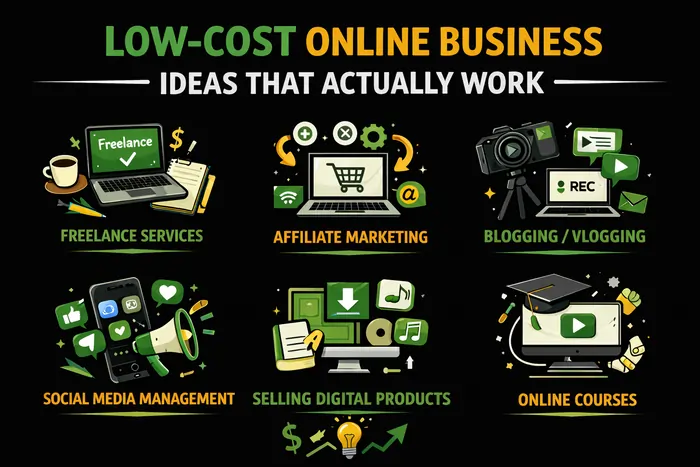
Online businesses are among the lowest-overhead options because you don’t need physical premises, and many tools are free or freemium. You can start from home, work part-time, and scale as income grows. Here are several online low-cost small business ideas that consistently prove themselves.
1. Freelance Services (Writing, Design, Marketing, VA Work)
Freelancing is one of the fastest paths from skill to income. Whether it’s copywriting, graphic design, social media management, SEO, or virtual assistant services, you monetize what you already know. Your core assets are:
- A simple portfolio or sample work.
- A professional profile (LinkedIn, portfolio site, or marketplace profile).
- The ability to communicate clearly and deliver on time.
To accelerate your learning curve and see how others package their services, browse real offers and positioning ideas on platforms like the official Upwork freelancer marketplace (link this on “Upwork freelancer marketplace”). You’ll quickly see which services are in demand and how top providers frame their value.
2. Content Creation and Blogging
Content creation—blogs, YouTube channels, newsletters, or podcasts—is a slower but powerful way to build an asset. You produce valuable content for a clear niche, attract an audience, then monetize through:
- Affiliate marketing.
- Sponsorships and brand partnerships.
- Digital products (ebooks, templates, courses).
- Your own services or consulting.
Startup costs are low: a domain, hosting, basic branding and design tools, and perhaps an email marketing platform. For big-picture inspiration and practical examples of lean content-based businesses, check out the long-form guides on Success.com’s low-cost business ideas page, which highlight real-world stories and models.
3. Affiliate Marketing and Niche Sites
Affiliate marketing means recommending other companies’ products and earning a commission when people buy through your links. Niche sites focus on specific topics—like productivity tools, fitness gear, or software for small businesses—and build trust through:
- In-depth reviews.
- Comparisons.
- How-to guides and tutorials.
This model rewards patience, consistency, and SEO. If you want a structured overview of Low-cost business ideas(including affiliate-focused setups), you can study breakdowns and examples in UpFlip’s low-cost business ideas guide.
4. Dropshipping and Print-on-Demand (POD)
With dropshipping and print-on-demand, you sell physical products without holding inventory. A supplier prints or ships products only after a customer orders. Your main work is:
- Choosing a niche and products.
- Setting up an online store.
- Driving traffic and optimizing conversions.
These models keep startup costs low but demand strong product research and marketing. For step-by-step ecommerce examples and startup cost expectations, you can explore Shopify’s guide to low-investment business ideas.
Comparison Table: Online Ideas – Cost vs Time
A quick way to compare online Low-cost business ideas that work is to look at startup costs and time demands side by side.
| Idea | Typical startup cost range | Time to first client/sale |
|---|---|---|
| Freelance services | Very low (often under a few hundred dollars) | 1–4 weeks with consistent outreach |
| Content creation / blogging | Low (domain, hosting, basic tools) | 3–6 months for meaningful traction |
| Affiliate niche site | Low–moderate (content + SEO tools) | 3–9 months, depending on traffic and SEO |
| Dropshipping / POD | Low–moderate (store + product testing) | About 4–8 weeks with solid offer testing |
Service-Based Small Business Ideas With Minimal Investment
Service businesses are often low-cost because your time and expertise are the product. Many require only basic tools, a simple website or profile, and a way to reach customers.
5. Local Home Services (Cleaning, Errands, Handyman Work)
Home cleaning, errand running, basic repairs, and similar services are always in demand, especially in busy urban and suburban areas. Typical startup needs include:
- Basic supplies or tools.
- Simple branding (a name, a number, possibly a logo).
- Local marketing (flyers, local Facebook groups, word of mouth).
You can validate quickly by offering your services to neighbors, friends, or local businesses and asking for referrals in exchange for great service. For additional cost-planning guidance for local businesses, the SBA’s guide on calculating startup costs is a useful reference.
6. Tutoring, Coaching, and Teaching
If you have strong skills—academic, language, music, or professional—tutoring and coaching are classic Low-cost business ideas that work both online and offline. You can:
- Start with one-on-one sessions via video or in-person.
- Offer packages (e.g., four-session programs).
- Later expand into group programs or digital resources.
This model is perfect if you enjoy teaching and want to validate your expertise before building anything complex.
7. Consulting and Digital Marketing Services
Small businesses frequently need help with strategy, marketing, systems, and operations but can’t afford full-time staff. If you have experience in areas like SEO, performance marketing, content strategy, operations, or sales, consulting can be highly profitable with low overhead.
You can:
- Start by solving one clear problem (“help local restaurants get more Google reviews”).
- Offer a simple package (audit + action plan + implementation support).
- Use early engagements as case studies for future clients.
When designing lean offers and pricing, it helps to understand typical startup costs and planning frameworks—resources like Xero’s guide on startup business costs can help you think through your numbers.
Home-Based & Part-Time Business Ideas for Beginners
If you’re building something alongside a job, studies, or family, home-based and part-time ideas are often the most realistic. They let you control your schedule, avoid commuting, and keep costs low while you test your concept.
8. Home Baking, Food Prep, and Specialty Foods
Home-based food businesses—baked goods, specialty snacks, meal prep, or celebration cakes—can begin with small batches and a tight niche. You’ll typically:
- Test recipes and pricing with your existing network.
- Package products simply but professionally.
- Sell through direct orders, social media, or local markets.
Be sure to check local regulations around food production and sales in your area, as requirements vary by region—anchor this advice to a keyword like “local food business regulations” and link to your government’s food safety or business licensing portal.
9. Handmade Products and Micro-Brands
If you’re crafty, handmade products (candles, accessories, home decor, digital prints) can become a micro-brand you grow over time. You can:
- Launch through marketplaces or social platforms.
- Start with very small production runs.
- Gather feedback fast and refine your best sellers.
This kind of business is especially friendly to part-time creators, since you can batch production and sales activity around your schedule.
10. Virtual Assistant (VA) Work
Virtual assistants support entrepreneurs and businesses with tasks like email management, scheduling, research, reporting, and social media. It’s a strong starting point for beginners because:
- You can learn and specialize over time (e.g., podcast VA, operations VA).
- You mainly need a laptop, reliable internet, and organizational skills.
- You can start general, then niche down as you learn which tasks you enjoy and which pay best.
For inspiration on how home-based and part-time founders structure their work, curated lists like BusinessNewsDaily’s low-cost business ideas roundup can give you additional angles and niches to consider.
Comparison Table: Local & Service Ideas – Cost vs Time
Here’s a quick comparison of service-based ideas to highlight differences in startup effort and lifestyle fit.
| Idea | Typical startup cost range | Time to first client |
|---|---|---|
| Local home services | Low (basic supplies/tools, simple local marketing) | 1–3 weeks with focused local outreach |
| Tutoring / coaching | Very low (internet, basic materials) | 1–4 weeks via network and platforms |
| Consulting / digital marketing | Very low (laptop, a few software tools) | 2–6 weeks depending on network and positioning |
| Virtual assistant | Very low (device, internet connection) | 1–4 weeks via platforms or referrals |
Low-Cost Small Business Ideas by Audience
The best Low-cost business ideas that work are those that match your real-life situation—time, responsibilities, and environment matter as much as the idea itself.
For Students
Students benefit from flexible, online-first models that can flex around semesters and exams. Strong options include:
- Freelance writing, design, or social media management.
- Tutoring in subjects you excel at.
- Online reselling or flipping products.
Choose ideas with short delivery cycles and clear outcomes to avoid overwhelming your schedule.
For Moms and Caregivers
Parents and caregivers often need schedule-friendly, home-based businesses. Ideas that fit include:
- Virtual assistant work during nap times or evenings.
- Home baking or small-batch food production.
- Handmade products or digital goods sold online.
- Coaching or consulting delivered via video calls.
Short, well-defined service “sprints” (e.g., a one-week setup service or a one-hour strategy call) make it easier to work in small, predictable blocks of time.
For Rural or Small-Town Areas
In rural or small-town contexts, blending online and offline can be powerful. Examples include:
- Local delivery, errands, or logistics services.
- Pet care, basic repairs, or micro-agricultural services.
- Selling local products online through a simple store.
You’re often competing less with big players locally, which gives you space to build deep relationships and word-of-mouth.
For Entrepreneurs in the Philippines
In the Philippines, many founders start with low-cost businesses in food, reselling, online services, and tourism-adjacent offerings. There’s a strong foundation of English proficiency and service-oriented skills thanks to the country’s long-time role in business process outsourcing (BPO). Over the last few years, the Philippines has been shifting from traditional voice-based BPO work into higher-value knowledge-process and IT-BPM roles, which means many professionals already have remote-ready skills they can turn into lean online businesses or consulting offers.
At the same time, remote-friendly infrastructure and global clients using Philippine talent for fully online projects make it easier than ever for local founders and digital nomads alike to base service or productized businesses in the country. For a more structured overview of context-specific opportunities, guides like QuickBooks’ small business ideas in the Philippines provide additional examples and categories you can adapt.
How to Choose the Right Low-Cost Business Idea
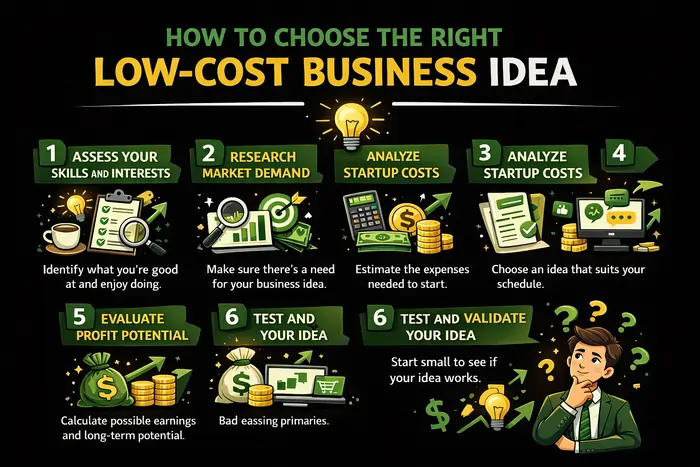
Choosing the right idea is less about chasing trends and more about aligning with who you are and what you want. Start with a quick self-audit:
- Skills: What do people already ask you for help with?
- Time: How many hours per week can you honestly commit?
- Capital: How much can you invest upfront without stress?
- Market access: Who can you reach easily right now (online communities, local groups, colleagues)?
Then validate demand with a simple three-step process:
- Research – Look up similar businesses, their pricing, positioning, and customer reviews to confirm people are already buying.
- Test – Offer a “minimum viable” version of your service or product to a small group and see if they’re willing to pay.
- Iterate – Adjust your offer, messaging, or target audience based on real feedback and results.
If you prefer a more formal structure, you can pair this with a step-by-step planning guide like ADP’s small business startup guide or the U.S. SBA’s 10-step roadmap for starting a business.
Action Plan: Launching in 30 Days With a Small Budget
You don’t need a perfect business plan to begin—just a clear 30-day action roadmap. Use this as a template for any of the Low-cost business ideas that work above.
Week 1: Niche and Offer Validation
- Decide on one specific problem you’ll solve and for whom.
- Talk to 5–10 people in your target audience about their needs and willingness to pay.
- Define a simple starter offer (e.g., a four-session coaching package, a starter website build, or a basic product bundle).
Week 2: Basic Branding and Presence
- Choose a straightforward brand name and tagline that clearly state what you do.
- Set up a lean online presence: a one-page site, landing page, or optimized profile where your audience already is.
- Prepare a short bio, one-page service description, and 1–3 samples or testimonials (even if they’re from beta clients).
If you’re not design-heavy, using ready-made layouts like Canva’s free blog templates helps you launch faster without getting stuck on visuals.
Week 3: First Marketing Push
- Reach out directly to potential clients via email, DMs, or local conversations with a clear, outcome-focused offer.
- Share your story and offer in 3–5 relevant online communities or groups.
- Test a small paid experiment only if you already have a clear offer and landing page.
For additional low-cost marketing ideas you can swipe, see curated lists like this LinkedIn article on low-cost marketing ideas for small businesses.
Week 4: Refine and Prepare to Scale
- Review what worked: channels that produced leads, messages that resonated, and offers people engaged with.
- Tighten your offer and messaging based on real data and customer feedback.
- Decide on your next 60–90 days: modest price increase, new package, or a clearer niche.
You can support your growth with free and subsidized training from organizations like the U.S. Chamber of Commerce’s roundup of free small business resources or your local Small Business Development Center via the SBA.
Technical Touch: Estimating Your Break-Even Point
Once you know roughly what you’ll charge and what your recurring costs are, it’s helpful to estimate your break-even point—the number of units or clients you need to cover your costs. A simple formula looks like this:Break-Even Units=Price per Unit−Variable Cost per UnitFixed Costs
For example, if your fixed monthly costs (software, internet, basic tools) are 100, your price per service package is 50, and your variable cost per package is 10, then your break-even units are 100/(50−10)=2.5, which means you’d need 3 packages per month to cover your costs. Anything beyond that is profit you can reinvest or pay yourself.
If you want a deeper dive into break-even concepts and cost structures, you can explore explainers like Wall Street Prep’s guide to the break-even point formula.
By focusing on low-cost small business ideas that work in the real world, using clear comparison tables, grounding your choices in simple numbers like break-even points, and curating external resources your readers can act on, you give yourself the best odds of building a story worthy of Real CEO Stories—starting right where you are, with what you already have.