

Local SEO business strategies help companies improve their visibility in location-based searches, making it easier for nearby customers to find their products and services. By optimizing online listings, targeting local keywords, and building strong local credibility, small businesses can attract more foot traffic, increase inquiries, and compete effectively in their local market.
Local customers are searching for businesses like yours every day, but if you’re not visible in local search results, you’re essentially invisible to them. Local SEO for small businesses is the practice of making sure you show up when nearby customers Google things like “best café near me” or “plumber in [your city],” not just when someone types your brand name.
Local SEO Businesses: How to Get Found in Your Area
Local SEO (search engine optimization) is all about improving your visibility in localized search results—especially Google’s Map Pack, “near me” queries, and city‑ or neighborhood‑specific searches. For brick‑and‑mortar shops and service‑area businesses, this can translate directly into more calls, direction requests, website visits, and foot traffic from people who are actively looking to buy.
Guides such as the U.S. Chamber of Commerce’s overview of how local SEO benefits small businesses and Semrush’s Local SEO Checklist for 2025 highlight that local SEO is one of the most cost‑effective channels available, especially for businesses with limited marketing budgets. Local SEO for small businesses is not a one‑off project; it’s an ongoing process of testing, measuring, and refining what works in your specific market, mirroring the iterative mindset in the lean startup model where every tactic is treated as an experiment.
What Is Local SEO and Why It Matters for Small Businesses
How Local SEO business Works
When someone searches for a local service—“dentist near me,” “pizza in Cagayan de Oro,” “accountant in Makati”—Google often shows a local pack (a map with three or four highlighted businesses) above or alongside regular organic results. According to Semrush and Boulder SEO Marketing’s Local SEO Guide 2026, Google’s local algorithm primarily considers three factors:
- Proximity – How physically close the searcher is to your business.
- Relevance – How well your listing and content match the search query.
- Prominence – How established and trusted your business appears online (reviews, links, citations, brand mentions).
Traditional organic SEO can be national or global; local SEO is hyper‑targeted to a specific geographic area, which makes it ideal for small businesses that serve local communities.
Key Benefits of Local SEO for Small Businesses
The U.S. Chamber, BDC, and Loganix all highlight similar benefits of a solid local SEO strategy:
- Higher visibility in local search and “near me” results, especially in the Map Pack and Google Maps.
- More qualified leads, because local searchers are often ready to call, visit, or book.
- Increased trust and credibility, thanks to reviews and complete, accurate business information.
- Better return on investment, since you’re focusing on people in your actual service area, not the entire internet.
Over time, consistent local visibility becomes a durable competitive advantage, especially when you apply broader strategy frameworks like those in competitive advantage to how you position your offers and messaging in your city.
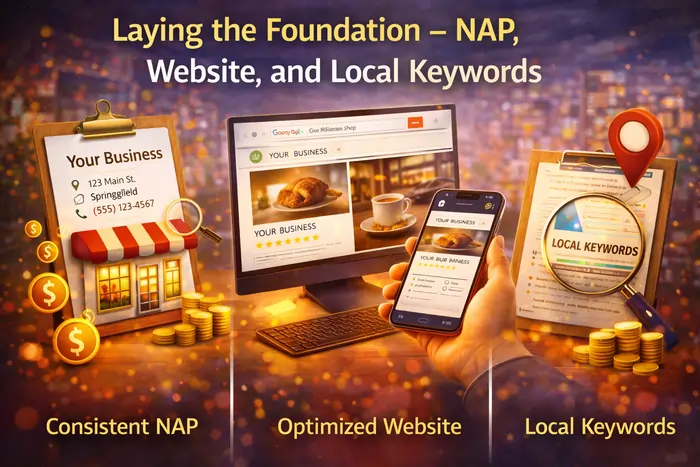
Laying the Foundation – NAP, Website, and Local Keywords
Get Your NAP Right Everywhere
Your NAP—Name, Address, Phone number—is the core identity of your local SEO business online. Digital Authority Partners’ Essential Local SEO Checklist for Small Business Success stresses that your NAP must be consistent everywhere: on your website, Google Business Profile, social accounts, and online directories.
Key steps:
- Use the exact same business name in all listings (avoid small variations or keyword stuffing).
- Make sure your full address and phone number match across platforms, down to suite numbers and abbreviations.
- Add NAP to your website footer and your contact/location page so Google can easily confirm your information.
Inconsistent NAP confuses both users and search engines, weakening local rankings and trust.
Local Keyword Research for Small Businesses
Local SEO still starts with keywords, but here you’re targeting location‑modified queries like “plumber in Makati,” “bakery Cagayan de Oro,” or “hardware store near me.”
Practical keyword tips:
- Use tools like Google Keyword Planner or Semrush to find combinations of your services with cities, districts, and “near me.”
- Check competitor title tags and content to see which local phrases they’re targeting successfully.
- Prioritize high‑intent phrases like “emergency plumber [city]” or “best dentist in [district]” that signal ready‑to‑buy intent.
E2M Solutions’ Local SEO For Small Businesses: Strategy, Planning, and Results recommends creating a simple keyword map, assigning primary local keywords to specific pages so each page has a clear focus.
On‑Page Local SEO Basics
Once you know which local keywords to target, you need to optimize your core pages:
- Homepage – Clearly state what you do and where you do it (e.g., “Family‑owned bakery in Cagayan de Oro”).
- Service pages – Give each major service its own page with descriptive, location‑aware copy.
- Contact/location page – Include full NAP, an embedded map, clear directions, and your service area.
Best practices from Semrush and Bright SEO Tools include:
- Use your primary local keyword in the page’s title tag, meta description, H1, and early in the content.
- Write helpful, human content that naturally mentions neighborhoods, landmarks, or areas you serve.
- Add FAQ sections answering local questions customers ask (e.g., parking, delivery areas, emergency hours).
Choosing which pages to build or prioritize is easier if you draw on frameworks similar to those in low-cost business ideas—starting with high‑impact, low‑cost opportunities rather than trying to do everything at once.
Optimizing Your Google Business Profile (Google My Business)
Claiming and Completing Your Profile
Your Google Business Profile (GBP) is arguably the single most important asset in local SEO, because it powers your presence in Google Maps and the local pack.
The NCD’s Ultimate Google Business Profile Guide in 2026 and WhiteHat’s Mastering Google Business Profile outline key steps:
- Claim and verify your listing at google.com/business.
- Choose the most accurate primary category, plus relevant secondary categories (e.g., “Coffee shop,” “Bakery,” “Plumber”).
- Fill out all fields: short business description, services, products, website, phone number, address, and hours (including special/holiday hours).
- Add attributes such as accessibility, payment methods, and amenities (e.g., “wheelchair accessible,” “free Wi‑Fi”).
A fully completed profile gives Google strong relevance signals and helps customers quickly see why your business fits their needs.
Photos, Posts, and Ongoing Optimization
An active, visually appealing GBP attracts more clicks and visits.
Loganix’s 20 Local SEO Tips that Work in 2026 and Semrush’s checklist suggest:
- Upload high‑quality photos of your storefront, interior, team, and popular products or work—businesses with more photos tend to get more interactions.
- Add a recognizable logo and cover image that match your other branding.
- Use Google Posts to share offers, events, new products, and updates, so your profile always looks fresh.
- Regularly update your hours and service area when anything changes.
Think of GBP as your second homepage for local search; updating it consistently is like keeping your physical shop window clean and inviting.
Citations and Directory Listings
Building Consistent Local Citations
Citations are mentions of your NAP on third‑party sites like directories, review platforms, and industry lists. Semrush and Digital Authority Partners note that consistent citations help confirm your legitimacy and strengthen local ranking signals.
Action steps:
- Submit your business to key platforms such as Google, Apple Maps, Bing Places, Yelp, Facebook, and local or industry directories.
- Make sure each listing uses the exact same NAP and website URL.
- Focus on reputable directories and avoid spammy listing farms.
Cleaning Up Existing Listings
If you’ve changed address, number, or business name, there may be inconsistent or duplicate listings floating around.
Using Semrush’s tools or similar services, you can:
- Audit citations to find outdated or conflicting entries.
- Request corrections or removals from directory owners so everything matches your canonical NAP.
- Re‑check periodically to catch new inconsistencies.
Cleaning up citations is a behind‑the‑scenes task, but it reduces confusion for both customers and search engines.
Reviews, Ratings, and Local Reputation
Getting More Google Reviews (Ethically)
Reviews are a powerful combination of ranking factor and social proof. The U.S. Chamber and SarmLife’s Simple Guide to Local SEO for Small Businesses in 2026 emphasize building a steady stream of genuine reviews on Google and other key platforms.
Practical systems for reviews:
- Ask for a review after successful purchases or completed services—via email, SMS, printed cards, or in‑person prompts.
- Make it easy by sharing direct links or QR codes to your review pages.
- Train staff to make review requests part of the normal service experience.
Avoid offering incentives that break platform rules; focus instead on simple, consistent asks that gradually build volume, authenticity, and recency.
Responding to Reviews and Managing Reputation
Responding to reviews—positive and negative—shows you are engaged and customer‑focused.
Best practices:
- Thank happy customers by name and reinforce key strengths they mention (e.g., “We’re glad you appreciated our quick response in [city]!”).
- Handle critical reviews with empathy: acknowledge the issue, apologize when appropriate, and offer to continue the conversation offline.
- Look for patterns in feedback to guide improvements in service, processes, or communication.
Dealing with public feedback requires resilience, humility, and consistency—the same entrepreneur traits that help owners navigate broader business challenges, explored more deeply in entrepreneur traits.
Local Content and Link‑Building Strategies
Creating Locally Relevant Content
Local content helps you capture more specific queries and long‑tail searches while reinforcing your relevance to the area.
Ideas from Semrush, Loganix, Bright SEO Tools, and E2M:
- Blog posts covering local events, festivals, or news connected to your niche.
- “Best [service] in [city]” or “local buyer’s guide” style posts that compare options and position your business honestly.
- Case studies or success stories featuring clients from specific neighborhoods.
- Location‑specific landing pages for each branch or service area, with localized photos, testimonials, and directions.
If your budget is tight, focus on simple, low‑cost content plays—like Q&As, short guides, or event round‑ups—taking inspiration from ideas in low-cost business ideas and adapting them to your local niche.
Earning Local Backlinks and Partnerships
Backlinks from other local sites strengthen your prominence and authority.
Effective tactics:
- Collaborate with nearby businesses on cross‑promotions, bundles, or events and request mutual links.
- Sponsor or participate in local charities, schools, or sports teams and ask to be listed on their websites.
- Pitch local newspapers, bloggers, or community sites with useful stories or expert commentary.
This kind of community‑centric link building is often more achievable—and more impactful—for small businesses than chasing big national links.
Technical and Advanced Local SEO
Mobile, Speed, and User Experience
Most local searches happen on mobile devices, often by people on‑the‑go who need quick answers. Boulder SEO Marketing’s 2026 guide and Loganix both warn that a slow or poorly designed mobile site can hurt both rankings and conversions.
Focus on:
- Responsive design that works smoothly on phones and tablets.
- Fast loading times through image compression, caching, and reducing heavy scripts.
- Clear calls‑to‑action (tap‑to‑call buttons, “Get directions,” booking links) above the fold.
A better mobile experience not only supports local SEO but directly increases the chances that searchers turn into paying customers.
Local Schema and Maps
Adding LocalBusiness schema markup helps search engines better understand your business details.
Steps:
- Use JSON‑LD schema on your contact/location page to encode NAP, opening hours, geo‑coordinates, and other key info.
- Embed a Google Map showing your actual location on your contact or location page, reinforcing geographic relevance.
Boulder SEO Marketing and WhiteHat note that schema isn’t a magic ranking button, but in competitive markets it can offer a small edge and enable richer search features. As AI‑driven search evolves, structured data may also help your business be interpreted correctly in more complex, conversational queries—an area connected to broader shifts described in AI in global markets.
Tracking Results and Improving Over Time
Key Local SEO Metrics to Monitor
To know whether your local SEO efforts are working, track a small set of meaningful metrics:
- Google Business Profile Insights – Profile views, website clicks, calls, and direction requests, plus the queries people use to find you.
- Local rankings – Positions for your primary local keywords in the Map Pack and organic results.
- Website analytics – Local traffic, form submissions, calls, and other conversions on key pages.
- Review trends – Number of new reviews, average star rating, and how quickly you’re responding.
Bright SEO Tools’ Local SEO Checklist for Small Businesses recommends building a simple monthly dashboard so you can spot improvements (or drops) and adjust accordingly.
Simple Local SEO Checklist and Routine
Local SEO is a continuous process, much like the iterative testing described in the lean startup model. Trainual’s Local SEO process template and multiple checklists suggest adopting a recurring routine:
Weekly:
- Respond to all new reviews across Google and key platforms.
- Check Google Business Profile for new questions or suggested edits.
- Post a short update, offer, or event if there’s something timely to share.
Monthly:
- Review GBP insights and local rankings for your target keywords.
- Audit your NAP consistency and key citations for issues.
- Update or add at least one piece of local content (blog post, case study, or landing page).
- Identify at least one new local partnership or backlink opportunity.
As your local visibility grows, it’s important to connect rankings and traffic back to real business metrics—revenue, margins, and profitability—so you’re not just chasing vanity KPIs. Understanding your profit and loss structure, as outlined in profit and loss guide, and your day‑to‑day liquidity from managing cash flow helps you see which local SEO efforts actually contribute to a stronger, more stable business.
Local SEO for small businesses doesn’t require massive budgets or enterprise‑level tools; it requires clarity, consistency, and a willingness to experiment. Start by fixing your NAP, fully optimizing your Google Business Profile, and implementing a simple review‑collection system, then expand into local content, partnerships, and technical improvements as you gain momentum.
As you test different tactics—using the iterative mindset from the lean startup model—and combine them with strategic thinking from competitive advantage, financial clarity from profit and loss guide and managing cash flow, and mindset insights from entrepreneur traits, you can turn local visibility into long‑term dominance in your market—even as AI‑driven search and broader AI in global markets continue to reshape how customers find and choose businesses.
