

The Brent Crude Price is one of the most important global benchmarks shaping Australia’s economy right now, driving petrol costs, freight charges, inflation pressures, and key investment decisions.
As Brent swings on geopolitical risks, OPEC+ decisions, and shifting demand, Australian households feel the impact at the pump, while businesses see it in their fuel and transport bills.
Understanding how Brent is priced, why it’s moving, and how those changes flow into local fuel prices, the Australian dollar, and monetary policy can help you plan better—whether you’re setting a household budget, managing a fleet, or positioning your investment portfolio for the next oil price shock.
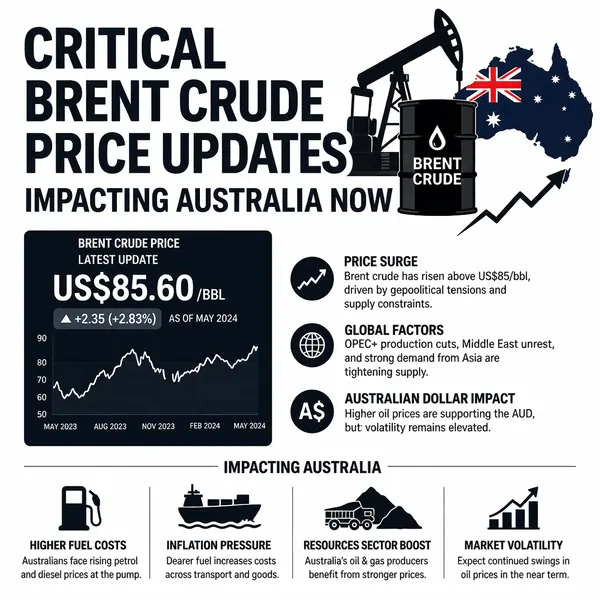
With Brent swinging between sharp spikes on geopolitical shocks and forecasts of longer‑term easing, understanding the latest updates is critical for businesses, households, and policymakers alike.
1. Today’s Brent Crude Price Snapshot
The latest Brent Crude Price data shows the benchmark trading above 100 US dollars per barrel in early 2026, after a period of intense volatility linked to supply risks and Middle East tensions. Trading Economics reports Brent crude above 100 USD per barrel at the end of March 2026, up sharply on a year‑ago basis and still elevated despite recent daily pullbacks.
You can view the live Brent Crude Price and intraday chart on the Trading Economics Brent crude oil page, which tracks current quotes, historical performance and forward projections. For Australian traders and investors, localised real‑time quotes are also available via sites like Investing.com AU’s Brent Oil Price page. These platforms let you monitor how each move in the Brent benchmark may feed into Australian fuel prices and market sentiment.
2. International Benchmarks Driving Australian Fuel Prices
Australia does not set domestic fuel prices in isolation; instead, pump prices are heavily influenced by global benchmarks like the Brent Crude Price and Singapore refined‑product prices. The Australian Institute of Petroleum’s International Market Watch shows how recent movements in Brent and other benchmarks translate into the terminal gate prices that eventually feed through to Australian petrol and diesel.
These benchmark‑linked import costs, combined with local taxes, distribution, and retail margins, determine the final price at the bowser. When the Brent Crude Price surges, Australian wholesale fuel prices typically rise within days, with retail prices following as service stations adjust to higher replacement costs. Conversely, sustained falls in Brent usually lead to lower pump prices, although the timing and extent can vary by city and retailer.
3. Volatility Spike: Geopolitics and the Strait of Hormuz
One of the most critical Brent Crude Price updates impacting Australia right now is the heightened geopolitical risk around the Strait of Hormuz, a key chokepoint for global oil shipments. New economic modelling cited by Australian media suggests that if the Strait remains closed until late 2026, Brent could spike toward 190 US dollars per barrel, exceeding even the 2008 price peaks.
Analysts warn that such a surge in the Brent Crude Price would create a major energy shock for Australia, driving up fuel costs, squeezing household budgets and potentially tipping the economy into recession if the disruption is prolonged. ABC News finance coverage has already highlighted sessions where crude traded around 110 US dollars per barrel as markets price in the risk of supply disruptions and escalating regional tensions. For Australian portfolios, commentary from local market specialists has flagged a dual impact: higher energy‑sector earnings, but also stronger imported inflation and pressure on consumer‑facing sectors.
4. Brent Crude Price and Australian Inflation
Changes in the Brent Crude Price have a direct and measurable effect on Australia’s inflation dynamics. The Reserve Bank of Australia (RBA) has previously estimated that a sustained 10% increase in global oil prices can add roughly 0.25–0.3 percentage points to headline inflation over time, mainly via higher petrol and transport costs.
The RBA’s earlier analysis in “Box C: The Effects of the Fall in Oil Prices” explains how falling Brent prices acted as a positive shock to real household disposable income by lowering the cost of automotive fuel. You can read the full discussion in the RBA’s Box C: The Effects of the Fall in Oil Prices, which, although written during a previous downturn in the Brent Crude Price, remains highly relevant for understanding today’s environment. In 2025 analysis of oil prices in Australia, DiscoveryAlert also highlighted that oil‑linked price swings were a key consideration in the RBA’s interest‑rate decisions as it tried to balance inflation control with growth.
5. Impact on Australian Households and Petrol Prices
Households across Australia feel Brent Crude Price changes most directly through petrol and diesel prices. When Brent rises, motorists quickly notice higher prices at the bowser, which can erode real incomes and force families to cut back spending in other areas.
The Australian Institute of Petroleum’s International Market Watch provides charts that trace how the Brent Crude Price and relevant refined‑product benchmarks move together over time. DiscoveryAlert’s explainer on Oil Prices in Australia outlines how these international benchmarks set the base cost of fuel, before adding local taxes and margins. Combined, these sources show why even global price movements that happen thousands of kilometres away can materially affect weekly household budgets across Sydney, Melbourne, Brisbane, Perth and regional Australia.
6. Effects on Australian Businesses and Industry
For Australian businesses, especially those in transport, logistics, aviation, agriculture and mining, the Brent Crude Price is a major input cost driver. Trucking fleets and airlines see their fuel bills rise rapidly when Brent spikes, unless they have hedging arrangements in place to smooth costs. These higher energy costs can then filter through to freight charges, airfares and ultimately retail prices for goods.
Mining and LNG exporters face a more complex picture. Because many LNG contracts are indexed to oil, higher Brent Crude Price levels can boost export revenues for Australian energy producers, supporting investment and employment in resource‑rich regions. At the same time, these sectors must manage the impact of a stronger US dollar and any resulting upward pressure on the Australian dollar, which can influence competitiveness. Understanding this two‑sided impact is essential for policymakers weighing the net effects of oil shocks on the broader economy.
7. Brent Crude Price and the Australian Dollar
The Brent Crude Price also interacts with Australia’s currency, with important implications for trade and financial markets. When Brent surges on geopolitical risk, the US dollar often strengthens as investors seek safe‑haven assets, which can weigh on commodity‑linked currencies such as the Australian dollar (AUD).
A recent note from Australian market commentators pointed out that Brent’s surge above 110 US dollars per barrel, combined with a stronger US dollar, created a two‑fold challenge for Australian portfolios by lifting imported inflation while also generating currency volatility. You can track these dynamics by pairing the Brent crude oil chart on Trading Economics with the Australian Dollar quote page, giving a side‑by‑side view of how oil and AUD react to global shocks. For investors in energy and resource stocks, understanding the linkage between the Brent Crude Price, the AUD, and equity valuations is essential.
8. Conflicting Brent Crude Price Forecasts to 2026–2027
One of the most important updates for Australia now is the divergence between different forecasts for the Brent Crude Price over the next few years.
- The US Energy Information Administration (EIA) projects a moderate easing from elevated levels, with its March Short‑Term Energy Outlook showing a Brent spot price forecast that peaks in 2026 before easing as supply catches up with demand. You can review the latest projections in the EIA’s Short‑Term Energy Outlook.
- DiscoveryAlert’s summary of the EIA Brent price forecast 2026–2027 highlights a modelled decline from around 69 US dollars per barrel in 2025 to about 55.87 in 2026, and just over 54 in 2027, as supply growth outpaces demand. See their full breakdown at EIA Brent Price Forecast 2026 2027.
- In contrast, Bank of America recently raised its 2026 Brent Crude Price forecast to 77.50 US dollars per barrel, citing the risk that sustained disruptions in the Strait of Hormuz could tighten global supply and accelerate inventory drawdowns. The details of this more bullish outlook are covered in the article “BofA raises Brent oil price forecast for 2026”.
- J.P. Morgan’s energy team takes a more bearish stance, expecting Brent Crude Price to average around 60 US dollars per barrel in 2026 under soft supply‑demand fundamentals. Their latest analysis is summarised in J.P. Morgan’s Oil Price Forecast for 2026.
- Statista’s aggregated forecasts, by comparison, point to an average Brent crude oil price in the high‑70s in 2026, showing how consensus can differ depending on sources and assumptions. See the Statista overview at Brent crude oil price forecast 2027.
For Australian planners, this spread of scenarios complicates budgeting and risk management, as the Brent Crude Price path is central to inflation, fuel costs, and investment plans.
9. Scenario Risks: Energy Shock and Recession Threat
Energy‑crisis modelling by groups such as Oxford Economics has highlighted a worst‑case scenario in which an extended closure of the Strait of Hormuz drives the Brent Crude Price toward 190 US dollars per barrel, triggering a global supply crunch. An ABC News report summarised this scenario, warning that Australia could face a recession by late 2026 and consumer‑price inflation above 6% if the disruption runs into August.
In such a scenario, the Brent Crude Price shock would sharply raise fuel and transport costs, compress real wages, and hit consumer spending. While energy producers might see windfall profits, most households and non‑energy businesses would face severe financial strain. Monitoring developments in the Middle East and other key supply regions via reliable news outlets and market‑data services is therefore essential for understanding the tail risks around Brent and their potential spillovers into the Australian economy.
10. How Australia Can Manage Brent Crude Price Shocks
In the face of these critical Brent Crude Price updates, Australia’s policy and business community are focusing on risk‑management strategies rather than attempting to control global prices directly. Key approaches include:
- Encouraging fuel‑efficiency and alternative transport modes to reduce household and business exposure to oil price swings.
- Supporting diversified energy investment, including renewables and storage, to limit reliance on imported oil over the long term.
- Using clear and transparent fuel‑price monitoring so consumers better understand how the Brent Crude Price and taxes contribute to retail prices, which can improve competition and pricing discipline.
- For businesses, employing hedging strategies and flexible pricing models that share some cost risk with customers, instead of absorbing all volatility in margins.
Analyses like DiscoveryAlert’s “Understanding Oil Prices in Australia: 2025 Market Dynamics” offer a helpful roadmap for how oil‑price shocks, exchange rates, and refining spreads interact in the Australian context. Combined with RBA research on past oil price declines, this provides a framework to think through future Brent Crude Price surges or slumps.
Conclusion
To wrap up, the Brent Crude Price has emerged as one of the most important external forces shaping Australia’s economic outlook right now, influencing everything from weekly petrol costs and freight charges to headline inflation and interest‑rate decisions. Short‑term spikes driven by geopolitical tension and supply disruptions can quickly squeeze household budgets and business margins, while longer‑term shifts in global demand, energy policy, and investment flows will determine whether today’s elevated levels give way to a more sustainable trading range.
For policymakers, investors, and consumers alike, managing this volatility is less about trying to control global oil markets and more about understanding how benchmark prices feed into local fuel costs, wages, and asset values, then putting sensible hedging, budgeting, and diversification strategies in place.
At the same time, it’s crucial to remember that oil is only one part of the picture: the Australian dollar, domestic policy choices, and the health of key trading partners all play decisive roles in how global price shocks are felt on the ground.
Keeping an eye on both energy benchmarks and currency moves can help you better anticipate their combined impact on inflation, interest rates, and real purchasing power over the next few years. If you want to dig deeper into the currency side of this story, you can also read Australian Dollar Exchange Rate Today: Key Updates and Market Impact, which explains how shifts in the AUD are reshaping trade flows, price pressures, and investment decisions across the Australian economy.
Brent Crude Price – FAQs
What is the Brent Crude Price?
The Brent Crude Price is the global benchmark for crude oil, widely used to price international oil trade and fuel imports.
Why does the Brent Crude Price matter for Australia?
Australia relies on imported fuel, so changes in Brent directly impact petrol prices, business costs, inflation, and interest rates.
How does Brent Crude Price affect petrol prices?
Fuel prices depend on Brent oil costs, taxes, and retail margins. When Brent rises, pump prices usually increase after a short delay.
Why is the Brent Crude Price so volatile?
It reacts quickly to geopolitical events, OPEC+ decisions, supply disruptions, and global demand shifts, making prices highly unpredictable.
What’s the difference between Brent and WTI?
Brent is the global seaborne benchmark, while WTI is a US-based benchmark. Australia’s fuel prices align more with Brent and Asian markets.
How do exchange rates affect Brent’s impact?
Both Brent prices and the Australian dollar (AUD) matter. A strong AUD can offset rising oil prices, while a weak AUD can amplify fuel cost increases.
How can businesses manage Brent price risk?
Companies can use fuel hedging, efficiency improvements, route optimization, and cost pass-through strategies to reduce exposure.
How does Brent influence inflation and interest rates?
Higher oil prices increase transport and energy costs, which can push inflation higher and influence central bank policy decisions.
Does a higher Brent price always hurt Australia?
Not always—while it raises costs, it can benefit energy exporters and resource companies, boosting parts of the economy.
How quickly do fuel prices respond to Brent changes?
Wholesale prices adjust quickly, while retail fuel prices change over days or weeks, often following pricing cycles.
Where can I track live Brent Crude Price?
You can monitor it on financial news platforms, commodity trackers, and real-time charts showing price trends and updates.
Should I trust Brent price forecasts?
Forecasts are useful for planning scenarios, but oil markets are unpredictable, so they should not be treated as guarantees.
What happens if Brent stays high long-term?
Households may face higher fuel costs and reduced disposable income, while businesses may adjust pricing or operations.
How does Brent affect investment portfolios?
Oil prices influence energy stocks, transport companies, inflation, and currency markets, making them important for investors.
How can Australia reduce exposure to Brent prices?
Long-term solutions include renewable energy, electric vehicles, efficiency improvements, and stronger energy security systems.