

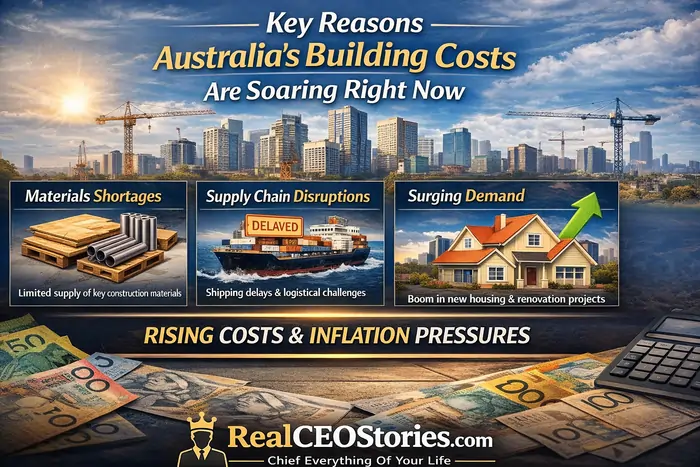
Australia Building Costs Soar in 2026 due to a perfect storm of higher material prices, labour shortages, intense competition from mega‑infrastructure projects, rising interest rates, builder insolvencies and increasing regulatory and climate‑related pressures. These forces are keeping construction budgets elevated even as broader inflation starts to cool, putting pressure on homeowners, renovators and developers alike. Understanding the seven key drivers behind these cost increases can help you budget more realistically, negotiate smarter with builders and decide whether to build now, stage your project, or wait for conditions to stabilise.
Australia’s building costs are rising faster than most households, developers and even seasoned builders expected, and 2026 is shaping up as another expensive year to build.
Australia Building Costs Soar | 7 Key Reasons Right Now
1. Material prices are still elevated (even if the spikes have slowed)
The first and most visible driver of soaring building costs in Australia is the price of construction materials like timber, steel, concrete, copper, aggregates and bricks. While the wild double‑digit spikes of 2021–2022 have eased, prices are still sitting on a much higher base than before the pandemic and continue to edge upward.
Australian Bureau of Statistics data and industry analysis show that overall building construction prices jumped by more than 30% between 2020 and 2023, with some material categories climbing even faster. A report cited by Building Garden Supplies notes that construction material costs have risen about 53% over the last decade, reshaping how projects are budgeted and delivered. More recent insights from CoreLogic’s Cordell Construction Cost Index show that growth has slowed to low single digits per quarter, but costs remain historically high—roughly one‑third higher than pre‑COVID levels.
Several interlocking factors sit behind these elevated prices:
- Strong global demand for raw materials and manufactured products.
- Rising energy and fuel costs that make it more expensive to produce and transport bricks, steel, cement and glass.
- Ongoing supply chain disruptions that limit availability and extend lead times.
For a clear explanation of how and why construction material costs have increased in Australia, including supply chains, energy and weather events, this breakdown is a useful reference Why Have Construction Material Costs Increased in Australia?. If you want to zoom out to the broader research picture, Housing Australia has a detailed paper on how supply and demand are affecting building cost inflation How supply and demand are affecting building cost inflation (PDF).
2. Global shocks and supply chain disruptions keep biting
Many builders hoped that post‑pandemic normalisation would bring construction costs back toward “pre‑COVID cheap”, but global shocks keep pushing the other way. ABC News reports that home building in 2026 is facing “COVID‑like price spikes” again as new geopolitical tensions—including conflict in the Middle East—hit shipping routes, fuel prices and materials logistics.
Australia is particularly exposed because of its distance from major manufacturing hubs and its reliance on imported products and components across the construction sector. Shipping delays, port congestion, container shortages and limited freight capacity all feed into higher landed costs for everything from reinforcing steel to fixtures and finishes. Even when materials are technically available, getting them to the right site, in the right quantity, at the right time has become more complex and expensive.
Master Builders Australia warns that higher fuel prices and disrupted supply chains, on top of interest rate rises, are hitting builders “extremely hard” and complicating efforts to increase housing supply. The Queensland Building and Construction Commission similarly notes that global material costs, labour shortages and rising operating expenses are key reasons “why construction costs rise.”
You can see this dynamic discussed from a consumer‑facing angle here Home building industry facing COVID‑like price spikes due to war impacts. For a regulator’s perspective on underlying drivers and how to prepare, check: Why construction costs rise and how to prepare.
3. Labour shortages and wage pressures are driving costs higher
It is not just materials: labour is a huge component of why Australia’s building costs are soaring. Across nearly every trade—carpenters, bricklayers, electricians, plumbers, concreters, project managers—there are persistent shortages, especially in booming regions like Queensland, Western Australia and parts of New South Wales.
Planned Resources’ state‑by‑state outlook for 2026 notes that:
- New South Wales is wrestling with a heavy project pipeline and “increasing delivery challenges”, including limited capacity and approval bottlenecks.
- Western Australia is near “peak capacity”, with strong resources‑linked demand pulling trades away from regular building work and pushing Perth construction costs up by roughly 5.3%.
These tight labour markets mean higher wages, more expensive subcontractor rates and added premiums to secure reliable crews. Master Builders Australia has already flagged “significant worker shortages” and says building material price rises are “likely to further stifle efforts to end the housing crisis” by pushing up the cost of newly built homes.
West Edge’s 2025/26 outlook makes a similar point: while material‑driven spikes have eased, labour‑driven cost increases are now a dominant force, with wage growth and insufficient capacity across key trades keeping escalation above historical norms. For a short summary of these pressures, see: Higher building material costs fuel housing inflation.
4. Massive infrastructure and energy projects are competing with housing
Another big reason Australia’s building costs are soaring is that housing is no longer competing only with other houses. It is now fighting for labour, materials and machinery with a huge wave of public infrastructure and energy‑transition projects.
Rider Levett Bucknall (RLB) estimates that Australia’s construction sector is now worth around $318 billion, with cost pressures re‑emerging as a result of strong demand across transport, energy and social infrastructure. Their forecasts suggest construction costs will rise between 4% and 6% nationally in 2026, with some cities like Adelaide and Perth facing even steeper increases. Planned Resources also highlights that capacity constraints are most acute in states with robust pipelines, such as NSW, Queensland and South Australia.
Realestate.com.au cites a leading advisory firm warning that a “market bubble” is forming as six‑figure cost blowouts hit projects, driven in part by a copper price spike and competing demand from big‑ticket public investments. The same report notes that federal government expenditure is set to reach 26.9% of GDP, with a $330 billion defence pipeline and major energy projects “competing directly with housing for the same trades.”
This competition means that when a government‑backed project offers higher pay and long‑term security, many trades and contractors shift away from private residential work, reducing capacity and pushing up prices for everyone else. For more detail on these macro pressures, see: Australia’s construction sector reaches $318 billion as cost pressures re‑emerge. The broader “construction boom under global strain” is also outlined here: Construction Boom Under Global Strain.
5. Higher interest rates and financing costs are squeezing every project
Even if materials and labour were cheap, the cost of money itself has risen sharply. The Reserve Bank of Australia’s rate hikes have lifted borrowing costs for developers, builders and households, adding another layer to why Australia’s building costs feel so punishing in 2026.
Master Builders Australia warns that the RBA’s decision to raise interest rates to 4.1% will hit building and construction “extremely hard,” especially when combined with fuel prices and supply chain issues. Higher rates increase:
- The cost of construction finance for developers, which can mean fewer projects proceed or those that do need higher presale prices.
- Mortgage repayments for owner‑builders and off‑the‑plan buyers, reducing what they can afford and raising the bar for project viability.
- Holding costs when delays occur, as interest compounds over longer build times.
West Edge’s construction outlook notes that while headline inflation is expected to move back toward the RBA’s 2–3% target band by 2026, we should not expect a return to “pre‑COVID cheap” building conditions—higher base financing costs are now baked in.
For a direct statement from Master Builders on how rate rises and supply chain disruptions are hitting builders, see: Rate rise and supply chain disruptions hitting builders.
6. Builder insolvencies and risk premiums are being priced in
One of the more worrying trends behind rising building costs in Australia is the surge in construction company insolvencies and the risk premiums that now accompany new contracts. Realestate.com.au reports that there were 1,894 construction insolvencies in a 12‑month period—the highest of any sector—as soaring material and labour costs made many fixed‑price contracts unviable.
This has several flow‑on effects:
- Subcontractors and suppliers demand tighter payment terms or higher prices to compensate for the risk of builders going under.
- Banks and insurers become more cautious, increasing the cost or reducing the availability of performance bonds, guarantees and construction finance.
- Builders themselves add contingency margins to bids to protect against future cost spikes, which lifts tender prices across the board.
State‑level outlooks from firms like Planned Resources warn that delivery risks and capacity constraints are pushing tender prices higher, even where competition is strong, because underlying risk is simply much greater than before. Advisory firms are also flagging a widening gap between housing approvals and completions, as many planned projects become too expensive to build.
For more on the insolvency picture and its price impacts, Realestate.com.au’s warning piece is worth reading: Fresh warning as build prices soar off 16.5pc copper spike.
7. Climate, regulation and planning bottlenecks add time and cost
Finally, Australia’s building costs are being pushed up by a complex mix of climate‑related disruption, stricter regulations and planning delays. While many of these changes are necessary—for safety, resilience and environmental reasons—they also introduce extra steps, compliance tasks and risk allocations that cost money.
Key factors include:
- Extreme weather events: Bushfires, floods and severe storms have damaged infrastructure, halted quarry operations and disrupted regional supply chains, limiting the availability of critical materials like aggregate and sand.
- Environmental and planning regulations: Tighter rules on quarry expansion, emissions, building standards and energy performance increase compliance costs and extend approval timelines, even if they deliver long‑term social benefits.
- Approvals bottlenecks: In states like NSW and Victoria, slow planning approvals and infrastructure tie‑ins are delaying major housing projects, which increases holding costs and can drive up tender prices as contractors price longer programs.
Building Garden Supplies highlights how weather events and environmental regulations raise material costs by limiting supply and adding compliance overheads across the supply chain. Planned Resources’ state outlook reinforces that approvals and infrastructure delays are a recurring theme, especially for high‑density and mixed‑use projects.
If you are looking for practical advice on how owners and builders can prepare for these rising costs—from budgeting to risk management—the QBCC’s guidance is a good starting point: Why construction costs rise and how to prepare.
As you can see, Australia’s building costs are rising because of a perfect storm: elevated material prices, global disruptions, labour shortages, massive competing infrastructure, higher interest rates, insolvencies and regulatory complexity. Together, these factors mean that even as inflation cools on paper, the real‑world cost to break ground and finish a project remains stubbornly high.
In conclusion, Australia’s building costs are being driven higher by a combination of elevated material prices, tight labour markets, intense competition from mega‑infrastructure projects, higher interest rates and growing risk premiums across the industry. Together, these forces are reshaping how homeowners, builders and developers budget, price and deliver projects, and there is little sign of a return to “pre‑COVID cheap” any time soon.
If you are also tracking the broader economic backdrop that influences borrowing costs, sentiment and investment decisions, it can help to keep an eye on equity markets too. For a quick snapshot of where Wall Street is heading before the opening bell, you can follow Dow Futures Today: Live Updates on US Market Direction here: Dow Futures Today: Live Updates on US Market Direction.
FAQs About Australia’s Soaring Building Costs
Why are building costs in Australia so high right now?
Building costs are elevated due to expensive materials like steel, timber, and concrete, combined with labor shortages and strong demand from infrastructure and energy projects competing with housing.
Will construction costs in Australia go back to pre-COVID levels?
Most forecasts suggest costs may stabilize or grow more slowly, but they are unlikely to return to pre-COVID levels. The market has shifted to a higher baseline.
How much have construction material prices increased?
Many materials have risen by double-digit percentages, with some key inputs increasing by 30–50% or more compared to early 2020.
Are labor shortages a major factor in rising building costs?
Yes. A shortage of skilled workers has driven up wages and subcontractor rates, increasing overall construction expenses.
How do interest rates affect building costs?
Higher interest rates increase borrowing costs, raise project holding expenses, and add financial risk—often leading builders to increase pricing.
Why are builder and subcontractor quotes higher now?
Quotes now include higher material and labor costs, longer timelines, contingency allowances, and risk premiums due to market uncertainty.
What impact do infrastructure and energy projects have on housing costs?
Large-scale projects draw resources away from residential construction, creating supply bottlenecks and pushing prices higher.
How do global events and supply chain issues affect building prices?
Global disruptions like conflicts, shipping delays, and fuel price spikes increase import costs and reduce material availability, raising local prices.
Are builder insolvencies increasing construction costs?
Yes. More builder failures lead to higher risk pricing from suppliers, subcontractors, and lenders, adding to total project costs.
What role do regulations and planning approvals play?
Stricter codes and slow approvals increase compliance costs, delays, and uncertainty, which result in higher overall construction pricing.
Is it cheaper to renovate than build new in 2026?
It depends on the project. Smaller renovations can be cost-effective, but large-scale renovations may approach the cost of new builds due to similar material and labor pressures.
How can homeowners manage cost blowout risks?
Get multiple quotes, include a 10–20% contingency, clarify inclusions, limit design changes, and choose financially stable builders.
What practical steps can help control a building budget?
Simplify designs, use standard materials, reduce custom features, stage construction if possible, and lock in prices early when available.
Is now a bad time to build, or should I wait?
It depends on your situation. Waiting may allow better financial preparation, while building now locks in current prices but comes with higher costs.
Where can you track economic signals affecting building costs?
Follow construction reports, interest rate trends, and global market updates to understand factors influencing building costs and financing conditions.