

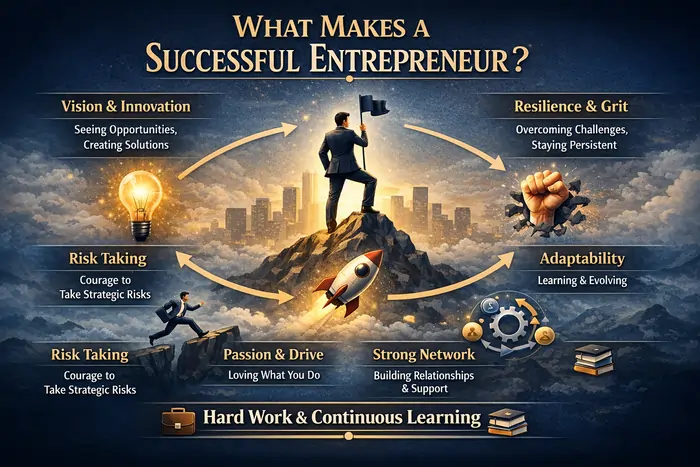
Entrepreneur traits serve as the vital foundation for turning a raw concept into a thriving reality, as success rarely hinges on the idea alone but on the character of the person driving it. At the heart of this mindset is a high level of resilience, allowing a founder to navigate constant rejection and the inevitable “trough of sorrow” without losing momentum.
This is paired with an intense adaptability, where the entrepreneur remains more in love with solving the problem than with their original solution, enabling them to pivot when the market demands it. Ultimately, success is defined by a blend of calculated risk-taking and relentless execution; the most effective entrepreneurs aren’t those who never fail, but those who possess the self-awareness to hire for their weaknesses and the decisiveness to move forward when the path is unclear.
Redefining “Successful Entrepreneur Traits”
Ask ten people what makes a successful entrepreneur and you’ll hear ten different answers: money, freedom, impact, or even fame. At its core though, entrepreneurial success usually blends sustainable results (profit, growth) with personal fulfillment and the ability to keep going when things get hard.
Instead of treating successful founders as “born different,” this guide breaks down the traits, mindset, skills, and daily habits that research and real-world stories keep repeating. Success becomes less about a secret recipe—and more about specific behaviors you can choose to develop over time.
How Do We Measure Entrepreneurial Success?
Traditional definitions of success revolve around revenue, valuation, and growth. Those metrics matter, but they don’t tell the whole story. Many founders also measure success through:
- Personal freedom and control over time.
- Impact on customers, employees, or a community.
- The ability to keep learning and building after failures.
A helpful way to frame it is: successful entrepreneurs consistently create value, survive setbacks, and build a business that aligns with their version of a good life. Articles like 10 Characteristics of Successful Entrepreneurs – HBS Online highlight that personality traits and behaviors are just as important as financial outcomes.
Another myth is the “overnight success” story. Longitudinal studies and founder interviews usually reveal years of experimentation, pivots, and failures behind any visible win. When you anchor your definition of success to the journey, not a single exit event, it becomes much easier to see what you can control today.
Core Traits of a Successful Entrepreneur
Most lists of entrepreneurial traits overlap around a few big themes. The good news: you don’t need to be born with them in full strength; they can be developed.
Resilience and Grit
Resilience is the ability to bounce back from setbacks and keep moving. Research on entrepreneurial intention and performance repeatedly points to persistence and emotional stability as predictors of who actually launches and sustains ventures. Founders who succeed rarely avoid failures; they recover faster and extract lessons more effectively.
Calculated Risk-Taking
Entrepreneurs are often seen as “risk lovers,” but successful ones usually take calculated risks. They gather enough information to act, understand downside scenarios, and design small experiments instead of all-or-nothing bets. Traits like internal locus of control and a moderate risk-taking propensity show up consistently in entrepreneurial profiles.
Self-Belief and Confidence
Self-efficacy—the belief that your actions can produce results—is a strong predictor of entrepreneurial intention and behavior. Successful founders tend to have a strong sense of self, are comfortable backing their own decisions, and can keep moving even when external validation is weak. That doesn’t mean ignoring feedback; it means not collapsing the moment someone doubts your idea.
Curiosity, Creativity, and Problem-Solving
Curiosity and creativity underpin opportunity recognition, innovation, and “seeing solutions where others see obstacles.” Many successful entrepreneurs describe themselves as problem-solvers first and businesspeople second—they love figuring out better ways to do things. Being naturally curious about how systems work, how people behave, and where friction exists is a huge advantage.
For a deeper trait breakdown with examples, resources like 10 Essential Traits for Successful Entrepreneurs (Indeed) and 8 Traits of Successful Entrepreneurs (Start Up Loans) give practical lists you can benchmark yourself against.
The Entrepreneurial Mindset: How Successful Founders Think
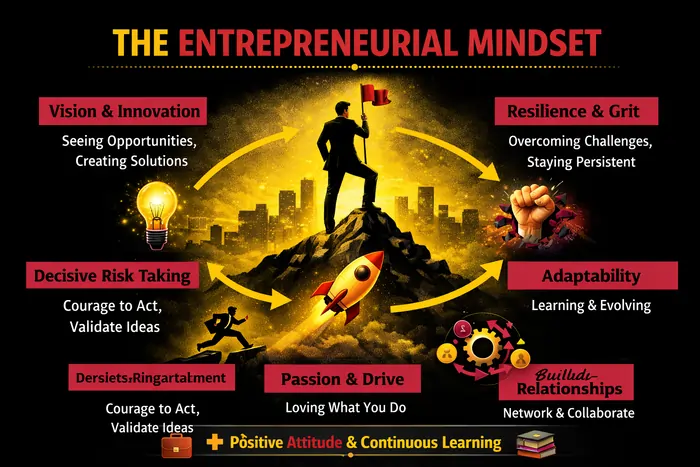
Beyond traits, mindset is about how entrepreneurs interpret situations, make decisions, and respond to uncertainty. Universities and entrepreneurship programs consistently frame the entrepreneurial mindset as a distinct set of beliefs and thought patterns.
Growth Mindset and Continuous Learning
Successful founders assume they can learn what they don’t yet know. Instead of seeing gaps as permanent weaknesses, they treat them as learning projects. This shows up as:
- Willingness to seek mentors and feedback.
- Taking courses, reading, and experimenting.
- Updating their beliefs when data changes.
Guides such as Entrepreneurial Mindset: Key Traits and Characteristics emphasize that this mindset can be developed through deliberate practice, not inherited.
Opportunity Recognition
Where most people see problems, entrepreneurs see opportunities. They’re constantly scanning for unmet needs, inefficiencies, or emerging trends. Models like NFTE’s Entrepreneurial Mindset Index formalize this into domains such as opportunity recognition, comfort with risk, and future orientation.
Long-Term Thinking and Comfort With Uncertainty
Successful entrepreneurs balance short-term survival with long-term vision. They make decisions under uncertainty, knowing they’ll rarely have perfect information. Instead of waiting for guarantees, they run small experiments, learn, and adjust—what lean startup frameworks call “build–measure–learn” cycles. One of the most effective ways to practice this mindset is to stop planning in the abstract and start running small experiments, following the logic of the lean startup model—launch something simple, learn from customer feedback, and iterate—which we explore step by step in our Lean Startup Model guide.
For a concise summary of how this mindset looks in practice, see MIT Sloan’s article on 3 traits of an entrepreneurial mindset, which highlights resilience, resourcefulness, and solutions-orientation.
Skills That Make Entrepreneurs Succeed
Ideas matter, but what separates successful entrepreneurs from the rest is usually execution. Skills can be built deliberately, and most guides on entrepreneurial success emphasize several core categories.
Strategic Thinking and Business Literacy
You don’t need an MBA, but you do need to understand basics like:
- How your business makes money (revenue model, margins).
- Who your customers are and why they buy.
- How to read simple financial statements and track cash flow.
Resources like The Entrepreneur’s Guide to Building a Successful Business walk through these fundamentals in a structured way.
Communication, Storytelling, and Relationships
Successful entrepreneurs are rarely working alone; they must persuade customers, partners, investors, and team members. That requires:
- Clear, concise messaging.
- The ability to frame a vision people care about.
- Empathy and active listening.
Articles like Characteristics of Successful Entrepreneurs – BusinessNewsDaily emphasize networking and relationship-building as key factors in growth.
Execution and Discipline
Ideas without follow-through go nowhere. Successful founders develop routines around planning, prioritization, and consistent action. They:
- Break big goals into specific weekly tasks.
- Focus on a small number of priorities.
- Learn to say “no” to shiny distractions.
If you want examples of how real founders structure their days, posts like The Daily Routines of 15 Successful Entrepreneurs and Buffer’s Daily Routines and Schedules of Famous Entrepreneurs show the range of approaches.
Habits and Daily Practices of Successful Entrepreneurs
Traits and skills are reinforced by daily habits. Many successful entrepreneurs share patterns in how they structure their days and energy.
Common habits include:
- Goal-setting and review: Setting weekly “most important tasks” and reviewing progress.
- Learning time: Reading, listening to podcasts, or taking courses to stay sharp.
- Reflection: Journaling or debriefing wins and mistakes to extract lessons.
- Health rituals: Sleep, exercise, and breaks to sustain performance over years, not months.
These habits aren’t about copying someone else’s perfect morning routine—they’re about designing a rhythm that keeps you mentally sharp, focused, and resilient.
Environment, Network, and Support Systems
Even the strongest individual traits struggle in a weak environment. Research and case studies repeatedly show that networks, mentors, and ecosystems significantly affect entrepreneurial outcomes.
Key levers include:
- Surrounding yourself with other builders (founder communities, coworking spaces, online groups).
- Finding mentors who have done what you’re trying to do.
- Plugging into support programs like accelerators, incubators, or university entrepreneurship centers.
Programs like NFTE’s Entrepreneurial Mindset Index and university hubs such as CSU Chico’s STEM Entrepreneurial Mindset resources show how structured ecosystems can deliberately grow founders rather than waiting for talent to “just appear.”
Can Anyone Become a Successful Entrepreneur?
The nature vs. nurture debate is big in entrepreneurship research, but recent work leans toward nurture with constraints: personality matters, but behaviors and skills are highly trainable.
Studies on personality and entrepreneurial intention suggest that traits like self-confidence, openness, and risk tolerance influence who is drawn to entrepreneurship—but training, experience, and environment significantly shape outcomes. Educational programs and mindset frameworks (like NFTE’s EMI) are built on the premise that entrepreneurial behaviors can be taught.
Put simply: not everyone will build a unicorn, but many more people could become “successful entrepreneurs” by their own definition if they deliberately develop the traits, skills, and support systems described here.
Action Plan: Start Thinking and Acting Like a Successful Entrepreneur
You don’t need to overhaul your personality overnight. A practical approach is to treat this as a 90-day experiment.
Step 1: Self-Assessment
Compare yourself against trait and skill lists from resources like 10 Essential Traits for Successful Entrepreneurs (Indeed) or 10 Characteristics of Successful Entrepreneurs – HBS Online.
Ask:
- Which 2–3 traits feel like strengths right now?
- Which 2–3 are clear gaps holding you back?
- Which skills (finance, marketing, communication) do you feel least confident about?
Step 2: Pick One Trait and One Skill
Choose one trait (e.g., resilience, risk tolerance, or communication) and one skill (e.g., basic finance or sales) to focus on for the next 90 days. Narrowing your focus increases your odds of real change.
Step 3: Build a Simple Learning Plan
For your chosen trait and skill, design a light but consistent learning routine:
- 1–2 books or online courses.
- 1–2 podcasts or YouTube channels that share real founder stories.
- 1 small project or experiment where you apply what you’re learning.
Comprehensive guides like The Entrepreneur’s Guide to Building a Successful Business can act as scaffolding for this plan.
Step 4: Track Real-World Metrics
Instead of vague feelings, track specific behaviors for 90 days, such as:
- Number of customer conversations per week.
- Number of small experiments or tests run.
- Number of pitches, proposals, or content pieces shipped.
To make this even more doable, start with an idea that doesn’t require huge capital or complex infrastructure. Our roundup of low-cost business ideas gives you practical, budget-friendly options you can use as your first entrepreneurial “training ground,” while you practice the same lean, experiment-driven approach you’ll use on future ventures.
Tools and frameworks from mindset-focused organizations like NFTE’s Entrepreneurial Mindset Index help you reflect on mindset changes as well as hard metrics.
By focusing on what makes a successful entrepreneur at the level of traits, mindset, skills, habits, and environment—and using practical frameworks and external resources to guide your growth—you shift entrepreneurship from a mysterious talent to a trainable path. Over time, those small, deliberate changes compound into the kind of results and stories that define real entrepreneurial success.