

Trying to figure out which digital transformation tools for SMEs you really need in 2026? This guide walks through the core tool layers—cloud, CRM and customer platforms, ERP and back‑office, collaboration, marketing, analytics, AI, and automation—so you can design a practical roadmap instead of buying random apps.
You’ll also see how these tools plug into your business technology stack 2026, your cloud based business tools 2026, and your AI powered business platforms, so digital transformation becomes a clear plan, not a buzzword.
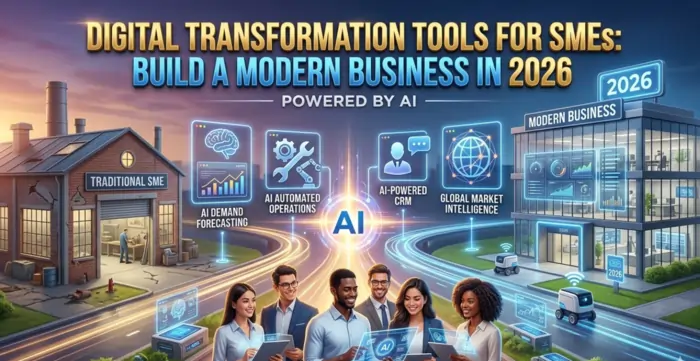
In 2026, digital transformation for SMEs is no longer about “going online”—it’s about building a smarter, connected system that supports how you sell, deliver, and grow. With the right tools, a small or mid‑sized business can operate with the same clarity and efficiency that used to belong only to big enterprises.
This guide shows you which digital transformation tools actually matter for SMEs, how they fit together, and how they connect to the other guides in your series.
What Digital Transformation Really Means For SMEs
For SMEs, digital transformation is about making your business easier to run and easier to grow by using technology deliberately—not about copying what huge enterprises do.
In practice, that looks like:
- Moving from manual, paper‑based or spreadsheet‑heavy processes to connected systems.
- Giving teams access to the same information wherever they work—office, home, or field.
- Using data, AI, and automation to improve decisions, not just to create more dashboards.
Your other guides—especially Business Technology Stack 2026 and Must Have Software for Small Business—give you the building blocks; this page focuses on how to use them strategically.
Core Digital Transformation Tool Layers For SMEs
You don’t transform your business by installing one tool. You do it by building a set of layers that work together.
For SMEs, the key layers are:
- Cloud infrastructure and core business apps
- CRM and customer‑facing platforms
- ERP/back‑office and operations systems (for some SMEs)
- Collaboration and communication tools
- Marketing and customer acquisition platforms
- Data, analytics, and BI tools
- AI and automation platforms
Each of your cluster articles plugs into one or more of these layers:
- Cloud Based Business Tools 2026 for infrastructure.
- Essential SaaS Platforms for Companies for key apps.
- AI Powered Business Platforms and Automation Tools for Businesses 2026 for the intelligence layer.
Cloud As The Foundation Of SME Digital Transformation
Cloud platforms are the backbone of SME digital transformation in 2026. They give you enterprise‑level tools—CRM, ERP, analytics, automation—without buying servers or hiring a big IT team.
Cloud tools help you:
- Scale up or down quickly as your business changes.
- Give staff secure access to systems from any location or device.
- Tap into AI and advanced analytics that run in the cloud, not on local machines.
This foundation is exactly what you mapped in Cloud Based Business Tools 2026 and the infrastructure/security layer in Business Technology Stack 2026.
CRM And Customer Platforms: The Front Door Of Transformation
For many SMEs, CRM is the first visible step in digital transformation. Instead of customer data scattered across inboxes and notebooks, everything lives in one place.
Modern CRM and customer platforms let you:
- Track every interaction with leads and customers in a single timeline.
- Automate reminders, follow‑ups, and basic nurturing.
- Give sales and support teams a unified view of each customer.
- Integrate with marketing, support, and accounting tools.
This connects directly to the CRM and SaaS sections in Essential SaaS Platforms for Companies and the customer‑facing tools in Best Tech Platforms for Businesses 2026.
ERP And Back‑Office Platforms For Growing SMEs
Not every SME needs a full ERP today—but for those with complex inventory, multi‑entity finance, or multiple locations, ERP becomes the central nervous system.
An ERP or integrated back‑office platform can:
- Unify finance, inventory, purchasing, and sometimes HR.
- Reduce duplicate data entry between systems.
- Provide a single source of truth for revenue, costs, and stock.
If you want a sense of what an SME‑friendly ERP ecosystem looks like, reviews and vendor guides like this overview of digital transformation tools show how mid‑market firms combine ERP, CRM, AI, and low‑code platforms.
Collaboration And Communication Tools As Transformation Enablers
Digital transformation fails if your team still communicates in siloed ways. Cloud collaboration tools make information flow easier and faster.
Key collaboration tools include:
- Team chat and internal communication hubs.
- Video conferencing and virtual meeting platforms.
- Shared docs, project boards, and knowledge bases.
Even relatively simple tools like Asana, Notion, Trello, Slack, or Teams—combined with automation platforms like Make or Zapier—can dramatically improve day‑to‑day execution. You’ve already explored these in more detail inside Cloud Based Business Tools 2026 and Business Productivity Software 2026.
Marketing, E‑Commerce, And Customer Experience Tools
On the customer side, digital transformation is about being easy to find, easy to buy from, and easy to stay connected with.
SME‑oriented tools here include:
- Website and e‑commerce platforms that are mobile‑friendly and integrated.
- Marketing automation and email platforms that personalize communication.
- Customer portals, booking tools, and self‑service support.
AI is making a big impact in SME marketing by enabling data‑driven decisions, personalization, automated campaigns, and predictive insights—helping smaller firms compete more effectively.
This connects with the marketing and CX layers from Essential SaaS Platforms for Companies and the AI layer from AI Powered Business Platforms.
Data, Analytics, And Business Intelligence Tools
Data is the raw material of digital transformation, but it’s useless if you can’t see or use it.
Analytics and BI tools for SMEs help you:
- Pull data from CRM, finance, marketing, and operations into dashboards.
- Monitor key metrics like revenue, pipeline, churn, and campaign performance.
- Use AI to spot trends, anomalies, and opportunities.
Your analytics layer is where the whole stack you designed in Business Technology Stack 2026 comes together and where AI insights from AI Powered Business Platforms become visible.
AI And Automation As Transformation Accelerators
AI and automation tools are what turn “we have software” into “we have leverage.” They help SMEs do more with lean teams, which is why adoption is accelerating fast.
In digital transformation, AI and automation can:
- Reduce manual work in order processing, support, marketing, and reporting.
- Unlock predictive insights about customer behavior and demand.
- Enable new digital products and services (e.g., self‑service portals, AI‑guided tools).
Your detailed playbooks here are AI Powered Business Platforms and Automation Tools for Businesses 2026, which show concrete use cases instead of abstract promises.
A Simple Roadmap To Start Digital Transformation As An SME
You don’t need to transform everything at once. In fact, you shouldn’t.
A practical roadmap:
- Audit your current tools and processes. Identify gaps, overlaps, and manual pain points.
- Clarify your main goals. Faster sales cycles? Better visibility? Less manual admin?
- Start with one or two layers. Often CRM + accounting, or collaboration + basic automation.
- Choose cloud‑based tools. Favor flexible, scalable options suitable for SMEs.
- Pilot, then scale. Run small projects, learn, and then roll out more widely.
If you want more detail on common SME paths, you can check guides like this SME digital transformation overview, which emphasize cloud, automation, roadmapping, and training as key steps.
How These Tools Connect To Your Other Guides
Digital transformation tools are the umbrella that tie your content cluster together:
- Must Have Software for Small Business covers the first essential apps you need before any big transformation.
- Essential SaaS Platforms for Companies expands those essentials into full SaaS categories.
- Cloud Based Business Tools 2026 explains the infrastructure that makes transformation possible.
- AI Powered Business Platforms and Automation Tools for Businesses 2026 show how to add intelligence and automation to those tools.
- All In One Business Management Platform and Business Productivity Software 2026 help you choose between unified systems and focused productivity apps.
Final Verdict: Digital Transformation Is A System, Not A Single Tool
In 2026, digital transformation tools for SMEs are less about buying one big platform and more about building a connected, cloud‑first system that fits the way you work. When you thoughtfully combine cloud infrastructure, CRM, back‑office tools, collaboration, marketing, analytics, AI, and automation, you turn technology into a genuine competitive edge rather than a cost center.
From here, you can use Business Technology Stack 2026 to refine your architecture, Best Tech Platforms for Businesses 2026 and Essential SaaS Platforms for Companies to choose specific tools, and then deepen each layer with Cloud Based Business Tools 2026, AI Powered Business Platforms, Automation Tools for Businesses 2026, All In One Business Management Platform, and Business Productivity Software 2026.
Frequently Asked Questions
1. What Are Digital Transformation Tools For SMEs?
Digital transformation tools for SMEs are technologies—usually cloud‑based—that help you modernize how you sell, deliver, and manage your business, from CRM and ERP to collaboration, analytics, AI, and automation.
2. Why Is Digital Transformation Important For Small And Mid‑Sized Businesses?
It helps SMEs stay competitive, improve efficiency, and reach more customers by using modern tools instead of relying on manual, fragmented processes.
3. Is Digital Transformation Only About Buying New Software?
No—it’s about redesigning your processes and culture around better tools; software is part of it, but so are strategy, training, and change management.
4. What Is The First Step In Digital Transformation For An SME?
Most SMEs start with a digital audit of current tools and processes, then upgrade core layers like CRM, accounting, and collaboration before adding more advanced systems.
5. Do All SMEs Need An ERP System?
Not always; smaller SMEs may be fine with integrated SaaS tools for finance, CRM, and inventory, while more complex operations benefit from a full ERP.
6. How Does Cloud Computing Support Digital Transformation?
Cloud makes enterprise‑grade capabilities (like advanced analytics and AI) accessible to SMEs without big infrastructure costs, and supports remote and hybrid work.
7. Can Digital Transformation Be Done On A Tight Budget?
Yes—by prioritizing impactful areas (like CRM, accounting, and collaboration), using SaaS, and starting with small pilots instead of big‑bang projects.
8. How Long Does Digital Transformation Take For An SME?
There’s no fixed timeline; many SMEs transform in phases over 1–3 years, iterating as they learn and as tools evolve.
9. What Role Does AI Play In SME Digital Transformation?
AI brings insights and automation—helping with marketing, support, forecasting, and decision‑making—so lean teams can operate like much larger ones.
10. How Do I Avoid Overcomplicating My Tech Stack During Transformation?
Follow a clear roadmap, add tools layer by layer, and regularly remove anything redundant or under‑used instead of piling on more apps.
11. What Are The Biggest Challenges SMEs Face In Digital Transformation?
Common challenges include limited budget, lack of in‑house tech skills, resistance to change, and underestimating the time needed for training and adoption.
12. How Can SMEs Measure The Success Of Digital Transformation?
You can track KPIs such as revenue growth, cost savings, error rates, customer satisfaction, and cycle times before and after implementing new tools.
13. Is Digital Transformation Only For Tech‑Focused Industries?
No—SMEs in manufacturing, services, retail, healthcare, and more are all using digital tools to improve operations and customer experience.
14. How Important Is Staff Training In Digital Transformation?
Training is critical; without it, even the best tools won’t get used properly, and your transformation efforts will stall.
15. Can SMEs Handle Digital Transformation Without External Consultants?
Some can, especially with simple stacks and motivated internal champions; others benefit from external support for complex ERP or data projects.
16. How Do Digital Transformation Tools Affect Cybersecurity?
They can improve security if you choose reputable cloud tools and implement good practices, but they also increase the need for strong governance and access control.
17. Should SMEs Focus On Automation Or Analytics First?
It depends, but many see quick wins by automating repetitive tasks first, then layering analytics and AI on top once data is flowing cleanly.
18. Can Low‑Code/No‑Code Tools Help With Digital Transformation?
Yes—low‑code/no‑code platforms let SMEs build custom apps and workflows without large dev teams, accelerating transformation if used carefully.
19. How Does Digital Transformation Impact Customer Experience?
It makes you easier to find, easier to buy from, and easier to get help from, thanks to integrated CRM, marketing, e‑commerce, and support tools.
20. What Should I Read Next If I’m Ready To Build My Transformation Toolset?
If you’re ready to choose tools, start with Business Technology Stack 2026 for structure, then use Essential SaaS Platforms for Companies and Best Tech Platforms for Businesses 2026 to decide which platforms belong in your transformation roadmap.