

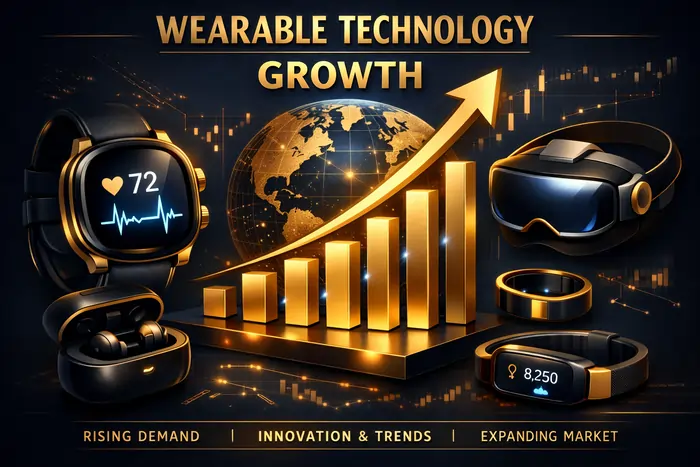
Wearable technology growth is accelerating as smartwatches, fitness trackers, hearables, and medical wearables move from niche gadgets to everyday companions for health, productivity, and convenience. This article explains what’s driving that growth, which devices lead the market, where adoption is strongest, and how AI, big data, and connectivity will shape the next decade.
Overview of the Wearable Technology Market
Wearable technology includes electronic devices worn on the body—such as smartwatches, fitness trackers, hearables, smart glasses, smart rings, and smart clothing—that use sensors, processors, and connectivity to capture data and deliver real-time insights. MarketsandMarkets describes wearables as devices that track health, fitness, and notifications while integrating with smartphones and other systems for hands‑free, always‑on functionality.
Multiple firms confirm strong wearable technology growth over the next decade. MarketsandMarkets projects the wearable technology market will reach about USD 176–177 billion by 2030, up from roughly USD 84–85 billion in 2025, at a CAGR close to 15.9% from 2025 to 2030. Wissen Research similarly estimates the market at around USD 80 billion in 2024, growing to USD 185 billion by 2030 at roughly 15% CAGR. Research and Markets forecasts the sector to reach about USD 186 billion by 2030, expanding at around 14.6% CAGR from 2023 to 2030.
Precedence Research and other analysts highlight that if you extend the horizon to 2034–2035 and include more medical and industrial categories, the broader wearable technology market could reach several hundred billion dollars as new form factors and health applications mature. In short, wearables are one of the fastest‑growing segments in consumer electronics and digital health.
Key Drivers Behind Wearable Technology Growth
Several converging trends explain why wearable technology growth remains robust across regions.
Rising health, fitness, and wellness awareness
Most reports cite health and fitness monitoring as the primary growth engine. Wissen Research notes that heightened post‑pandemic health awareness and a broader cultural focus on wellness are pushing consumers toward devices that track activity, heart rate, sleep, and other vital signs. A JMIR study on healthcare wearable usage and data sharing links rising adoption to interest in preventive care and self‑management of conditions.
Advancements in sensors, batteries, and miniaturization
Component innovations make wearables more capable and comfortable. Market analyses point to rapid improvements in sensors, microelectronics, and battery technology, allowing smaller devices to track more metrics—SpO2, ECG, skin temperature, stress indicators—without frequent charging. AllPCB’s overview of wearable device trends explains how miniaturization and flexible electronics enable categories like smart rings and smart clothing.
Integration with smartphones, IoT, and cloud platforms
Wearables are tightly integrated with phones, apps, and cloud services. MarketsandMarkets notes that Bluetooth, Wi‑Fi, and cellular connectivity let wearables sync data to cloud platforms for long‑term tracking, analytics, and personalized recommendations. As part of the broader IoT ecosystem, wearables feed data into health apps, corporate wellness platforms, smart home systems, and even industrial monitoring dashboards.
As wearables generate ever larger volumes of health and behavioral data, organizations increasingly rely on analytics to transform raw signals into insight. Guides like Big Data and Predictive Analytics show how massive data streams and predictive models work together to forecast risk, personalize recommendations, and support smarter, data‑driven decisions—the same type of intelligence that gives wearables long‑term value.
Growing demand for real-time health monitoring and data
From consumers to clinicians, stakeholders value real-time insight into health and performance. JMIR and PubMed studies on healthcare wearables report adoption rising from roughly 28–30% of adults in 2019 to over 36% in 2022, with strong willingness among users to share data with providers. Fortune Business Insights projects the wearable medical devices market to grow from about USD 117 billion in 2026 to more than USD 500 billion by 2034, at around 20% CAGR, driven by remote monitoring and chronic disease management.
Major Wearable Device Categories Powering the Market
Different device categories contribute differently to wearable technology growth, with wrist‑worn devices still leading.
Smartwatches and Fitness Trackers
Most market reports agree that wristwear—smartwatches and fitness bands—accounts for the largest share of the wearable technology market. MarketsandMarkets expects wristwear to remain the dominant product category through 2030, driven by Apple, Samsung, Garmin, Fitbit/Google, and others.
These devices have evolved from simple pedometers into sophisticated health companions offering:
- Continuous heart rate and HRV monitoring
- Sleep staging and recovery metrics
- SpO2 and ECG features on mid‑ to high‑end models
- Stress and readiness scores using multi‑sensor fusion
TechInsights’ “Five Key Trends for Wearables in 2025” highlights how smartwatches increasingly rely on advanced AI to interpret health data, provide personalized recommendations, and detect anomalies like irregular heart rhythms.
Hearables, Smart Glasses, and Smart Rings
Other form factors are expanding the market beyond the wrist:
- Hearables (wireless earbuds, smart headphones)
These combine audio with sensors for fitness tracking, hearing enhancement, and voice assistants, and are often counted as wearables in adoption studies. - Smart glasses and AR wearables
Still smaller in volume but growing as AR/VR and heads‑up displays mature, particularly for enterprise use and niche consumer applications such as navigation and real‑time translation. - Smart rings and sensor-enabled jewelry
TechInsights and AllPCB note emerging momentum for smart rings, which provide discreet health and sleep tracking with long battery life.
42Gears’ “6 Wearable Technologies You Must Know Right Now” lists smart rings, smart glasses, and hearables as key categories to watch beyond traditional fitness trackers.
Healthcare and Medical Wearables
Healthcare wearables represent one of the fastest‑growing subsegments. JMIR estimates the global healthcare wearables market at around USD 33–34 billion in 2023, with forecasts up to USD 250 billion by 2030. Fortune Business Insights projects the broader wearable medical devices market to reach more than USD 500 billion by 2034, as clinical and remote monitoring use cases scale.
Examples include:
- Clinical-grade ECG patches and long‑term cardiac monitors
- Continuous glucose monitors (CGM) for diabetes management
- Wearable blood pressure and oxygen monitors
- Multi‑sensor remote patient monitoring kits integrated with telehealth platforms
These devices are increasingly built into care pathways for chronic disease management, post‑surgical follow‑up, and aging‑in‑place programs, making them a key pillar of digital health.
Adoption Trends and User Demographics
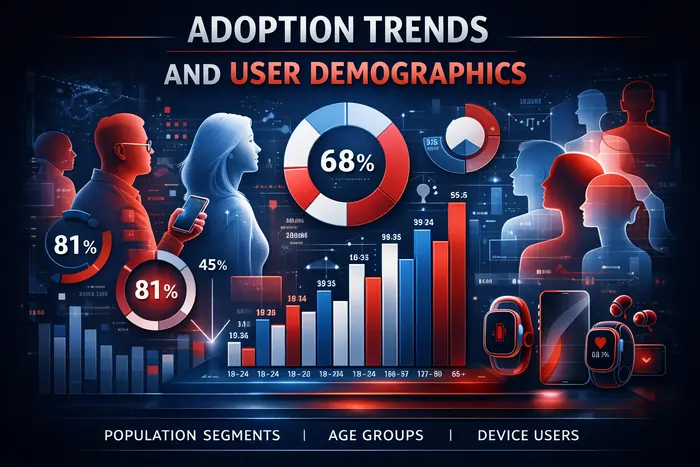
Wearable technology growth differs across age groups and regions, with younger generations leading but older users increasingly targeted for health‑focused devices.
Generational adoption patterns
eMarketer’s “Millennials lead in wearable tech as Gen Z adoption grows” reports that millennials remain the strongest wearables adopters, with about half of millennial internet users expected to use smart wearables by 2028. Gen Z is “rapidly closing the gap,” projected to surpass Gen X usage by that time, driven by rising disposable income and enthusiasm for AI‑driven features.
Kadence’s “Rise of the Wristband Nation” notes that nearly 60% of millennials who own a wearable use it at least five days a week, while Gen Z’s interest is climbing fastest in markets like India and Southeast Asia, where affordable devices are surging. A Semantic Scholar study on Gen Z adoption of wearable technology finds that perceived usefulness, credibility, and ease of use strongly influence their willingness to adopt health-focused wearables.
Older adults and healthcare wearables
Boomers currently show the lowest adoption rates, but eMarketer points out they may benefit most from health-monitoring capabilities such as fall detection, heart monitoring, and hearing support. The JMIR and PubMed studies show that a growing share of older adults use health wearables and that willingness to share data with clinicians is relatively high (around 78%), even though actual sharing is lower (around 26%).
This gap between willingness and behavior suggests opportunities for better user education, simpler data‑sharing flows, and stronger integration between wearable platforms and clinical systems.
Regional adoption patterns
Market reports consistently highlight North America as an early leader in wearable adoption due to high incomes, strong tech ecosystems, and the presence of key vendors. At the same time, Asia-Pacific is often identified as the fastest‑growing region, with MarketsandMarkets projecting APAC to see CAGRs approaching or exceeding 18–19% due to large populations, rising middle classes, and aggressive smartphone penetration. Emerging economies such as India, China, Brazil, and South Korea represent major growth opportunities according to Wissen Research.
Regional Growth Hotspots
Most major reports break the wearable technology market into North America, Europe, Asia-Pacific, and Rest of World, each with distinct dynamics.
- North America
Large installed base, high average revenue per user, and strong presence of Apple, Fitbit/Google, Garmin, and other key players. Healthcare and enterprise use cases are relatively advanced here, especially in the US. - Europe
Mature market with strong emphasis on privacy, data protection (e.g., GDPR), and regulatory approvals for medical-grade devices. - Asia-Pacific
Fastest growth rates thanks to smartphone proliferation, local OEMs (Xiaomi, Huawei, Oppo, etc.), and cost‑effective wearables aimed at young consumers. - Latin America and Middle East/Africa
Smaller but expanding markets, often tied to broader mobile internet expansion and rising health awareness.
Grand View Research, Fortune Business Insights, and SkyQuest provide detailed region-by-region breakdowns of wearable market size, growth, and key drivers.
Beyond Fitness: Enterprise and Industrial Use Cases
While consumer fitness and wellness dominate headlines, enterprise and industrial wearables are an increasingly important piece of wearable technology growth.
- Industrial safety and productivity
Smart helmets, vests, and ID badges monitor worker location, exposure to hazards, and fatigue, alerting supervisors to dangerous conditions. - Field service and manufacturing
AR smart glasses provide hands‑free access to manuals, remote expert support, and real-time overlays, which can reduce errors and training time. - Corporate wellness and insurance
Employers and insurers use wearables to support wellness programs, incentivize activity, and better understand risk profiles (with appropriate consent and privacy safeguards).
In industrial contexts, wearables are increasingly part of a broader Industry 4.0 stack that includes robots, IoT, and analytics. For example, Manufacturing Robotics | Benefits, Uses & Future Trends explores how robots, sensors, and real‑time data combine on the factory floor—a pattern that mirrors how enterprise wearables plug into connected operations and smart factories.
Reports from The Insight Partners and SkyQuest highlight that while enterprise wearables volumes are smaller than consumer devices, they contribute meaningfully to overall market value and are expected to expand as digital transformation continues.
Challenges to Wearable Technology Growth
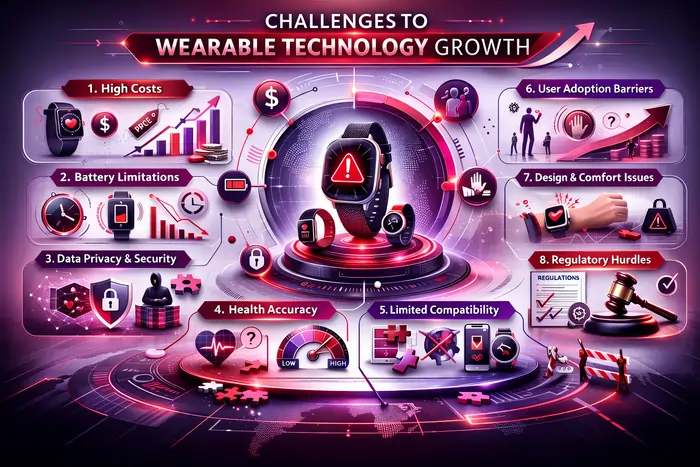
Despite strong momentum, several challenges could shape or moderate wearable technology growth.
Privacy, security, and data protection
Wearables collect highly sensitive data—heart rate, sleep, location, sometimes ECG and other clinical signals. JMIR’s study shows a tension between high willingness to share data and relatively low actual sharing with healthcare providers, implying trust and usability gaps. As regulators scrutinize health data use, compliance with frameworks like GDPR and HIPAA, plus clear consent and transparency practices, remain critical.
Battery life, comfort, and design
Users expect powerful features without bulky designs or daily charging. Analysts point out that limited battery life, discomfort, and aesthetics can undermine long‑term adherence and lead to device abandonment. Continuous innovation in energy efficiency, materials, and form factor design is needed to keep users engaged.
Data accuracy, fragmentation, and interoperability
Accuracy of step counts, calorie burns, and certain health metrics can vary significantly between devices, which can erode trust if not communicated clearly. Additionally, closed ecosystems and fragmented platforms make it hard to create unified health records, prompting calls for better standards and interoperability between wearable vendors and healthcare systems.
User fatigue and long‑term engagement
451 Alliance’s “Wearable tech adoption remains slow and steady” notes that while interest is strong, some users lose enthusiasm after the initial novelty phase, restraining growth to a “slow and steady” curve. Sustained engagement requires meaningful insights, gamification, social features, and continuous product evolution, not just more raw data.
Future Trends Shaping Wearable Technology Growth
Looking ahead, several trends will shape the next decade of wearable technology growth.
AI-powered insights and personalization
TechInsights and other analysts see AI and machine learning as central to the next phase of wearables, shifting devices from trackers to coaches. Wearables increasingly provide:
- Personalized workout and recovery recommendations
- Stress and mental wellness insights
- Early warning alerts for anomalies such as irregular heart rhythms
These AI capabilities are part of a broader wave of enterprise and consumer innovation; stories like The Rise of Artificial Intelligence in Business show how AI‑driven analytics and automation are transforming industries end to end, including the wearable tech ecosystem.
More medical-grade sensors and regulatory approvals
The line between consumer gadget and medical device continues to blur. More wearables are securing FDA and CE approvals for features like atrial fibrillation detection, sleep apnea screening, and hearing augmentation. This trend will likely increase reimbursement options and clinical adoption, but also heighten regulatory and validation requirements.
Convergence with AR/VR, smart clothing, and ambient computing
Wearables are expected to integrate more deeply with AR/VR headsets, smart apparel, and ambient sensors, enabling richer multimodal experiences. AllPCB’s trends piece points to smart clothing, haptic feedback wearables, and extended reality (XR) integrations as emerging frontiers.
Role of advanced connectivity (5G/6G)
As wearables rely more on real-time data and edge/cloud collaboration, advanced connectivity becomes critical. Perspectives like The Future of 5G and 6G Connectivity explain how ultra‑low latency, higher bandwidth, and massive IoT support will enable richer, continuous data streams from wearables—especially in telehealth, industrial safety, and smart city scenarios.
What Wearable Technology Growth Means for Consumers and Businesses
For consumers, wearable technology growth means more options, more accurate data, and more personalized health and lifestyle insights at progressively accessible price points. Younger users see wearables as lifestyle enhancers, while older users increasingly view them as health tools that support independence and safety.
For businesses and organizations, the expanding wearables market opens multiple opportunities:
- Device manufacturers and tech brands can differentiate through sensors, AI, design, and ecosystem integration.
- App developers and digital health startups can build services on top of wearable data—coaching, telehealth, diagnostics, and wellness platforms.
- Employers and insurers can use wearables, with proper consent, to support wellness initiatives and risk management.
- Healthcare providers can integrate wearables into remote patient monitoring, chronic disease management, and virtual care programs.
As part of the broader connected‑technology stack—alongside robotics and AI‑enhanced analytics covered in Manufacturing Robotics | Benefits, Uses & Future Trends and Big Data and Predictive Analytics—wearables show how sensors, data, and intelligence are reshaping both daily life and enterprise operations.
Wearable technology growth is not just about more gadgets on wrists; it reflects a deeper shift toward continuous, data‑driven, personalized experiences in health, work, and everyday living. The companies that succeed will be those that combine compelling hardware with trustworthy data practices, meaningful AI‑powered insights, and seamless connectivity into the wider digital ecosystem.