

Introduction
Launching and scaling a startup is rarely a straight path. Founders navigate product development, market validation, team building, fundraising, legal compliance, and competitive positioning—often simultaneously.
In this complex environment, understanding how Accelerators and Incubators Help early-stage companies can make the difference between stagnation and sustainable growth.
While many entrepreneurs have heard of startup accelerators and incubators, fewer fully understand how Accelerators and Incubators Help shape funding readiness, refine business models, expand networks, and accelerate execution.
These structured programs provide more than office space or short-term capital—they offer strategic guidance, mentorship, accountability, and ecosystem access.
In today’s competitive startup landscape, where investor expectations are higher and market windows move quickly, knowing how Accelerators and Incubators Help startups navigate uncertainty is essential.
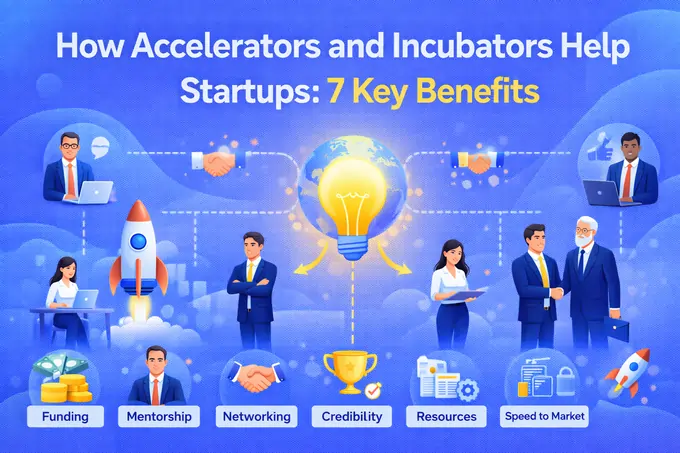
This in-depth guide explores seven key benefits, clarifies the difference between accelerators and incubators, and provides practical insights for founders considering these programs.
Understanding the Difference Between Accelerators and Incubators
Before exploring how Accelerators and Incubators Help, it is important to distinguish between the two models. Although they share similarities, they serve different purposes and stages of development.
What Is a Startup Accelerator?
An accelerator is typically a structured, time-bound program—often lasting three to six months—designed to rapidly scale early-stage startups. Accelerators usually:
- Invest seed capital in exchange for equity
- Provide mentorship from experienced founders and investors
- Offer curriculum-based business training
- Conclude with a demo day where startups pitch to investors
Accelerators focus on rapid growth and funding readiness.
What Is a Startup Incubator?
Incubators, on the other hand, often support startups at an earlier conceptual stage. They may:
- Provide shared workspace
- Offer business advisory services
- Support idea validation and prototype development
- Operate without strict timelines
Incubators emphasize foundational development.
Understanding these distinctions clarifies how Accelerators and Incubators Help startups at different growth phases.
Why Accelerators and Incubators Matter in Today’s Ecosystem
The modern startup environment is saturated with competition. Investors receive thousands of pitches annually. Customers expect polished solutions. Talent markets are tight. In this context, structured support systems are invaluable.
Examining how Accelerators and Incubators Help startups reveals several strategic advantages:
- Reduced trial-and-error learning
- Access to experienced mentors
- Credibility signals for investors
- Faster iteration cycles
- Stronger operational discipline
Founders who understand how Accelerators and Incubators Help can strategically leverage these ecosystems for accelerated progress.
Benefit 1: Access to Early-Stage Funding
One of the most immediate ways Accelerators and Incubators Help startups is through financial support.
Seed Capital in Accelerators
Accelerators typically provide:
- Initial seed investment
- Structured equity agreements
- Follow-on funding introductions
- Access to investor networks
For early-stage founders, securing funding independently can be challenging. Accelerators reduce friction by bundling capital with mentorship.
Grant and Subsidy Support in Incubators
Incubators may offer:
- Government-backed grants
- Research funding access
- University partnerships
- Subsidized operational costs
By lowering initial financial barriers, Accelerators and Incubators Help startups extend runway and focus on product-market validation.
Benefit 2: Structured Mentorship and Expert Guidance
A defining characteristic of how Accelerators and Incubators Help startups is mentorship access.
Learning From Experienced Founders
Accelerator programs connect startups with mentors who have:
- Scaled companies
- Navigated fundraising
- Managed operational crises
- Negotiated acquisitions
This guidance reduces costly mistakes.
Industry-Specific Advisory Networks
Incubators often provide domain expertise in sectors such as:
- Biotechnology
- Artificial intelligence
- Fintech
- Clean energy
Sector-focused mentorship ensures targeted strategic advice.
By offering curated mentorship, Accelerators and Incubators Help startups avoid avoidable pitfalls.
Benefit 3: Accountability and Structured Growth Frameworks
Many founders struggle with prioritization. Programs impose structure.
Curriculum-Based Learning in Accelerators
Accelerators typically include modules on:
- Lean startup methodology
- Financial modeling
- Customer acquisition strategies
- Legal compliance
- Pitch development
These frameworks accelerate strategic clarity.
Milestone Tracking in Incubators
Incubators may emphasize:
- Prototype completion timelines
- Market research benchmarks
- Operational checklists
This accountability enhances focus.
Structured programming demonstrates how Accelerators and Incubators Help startups maintain disciplined progress.
Benefit 4: Investor and Corporate Networking
Relationships drive startup success.
Understanding how Accelerators and Incubators Help reveals their networking advantage.
Demo Days and Investor Introductions
Accelerators culminate in demo days, where startups:
- Pitch to venture capitalists
- Connect with angel investors
- Engage corporate innovation teams
These curated introductions increase funding probability.
Strategic Corporate Partnerships
Incubators affiliated with universities or corporations may facilitate:
- Pilot testing opportunities
- Enterprise partnerships
- Supply chain integration
Networking multiplies opportunity.
Benefit 5: Validation and Credibility
Participation in reputable programs signals quality.
Brand Association
When startups graduate from recognized accelerators, it communicates:
- Screening rigor
- Business viability
- Market readiness
This validation influences investor perception.
Peer Community Support
Accelerators and incubators provide peer networks where founders:
- Share insights
- Collaborate
- Exchange resources
Community reduces isolation and strengthens resilience.
Through reputation and ecosystem integration, Accelerators and Incubators Help startups build trust.
Benefit 6: Operational Resource Access
Beyond capital and mentorship, operational infrastructure matters.
Shared Workspaces and Tools
Incubators frequently provide:
- Co-working facilities
- Laboratory space
- Meeting rooms
- Administrative support
These resources reduce overhead.
Legal and Financial Advisory Services
Accelerators may connect founders with:
- Startup attorneys
- Tax consultants
- Accounting professionals
Access to professional services enhances compliance.
Operational support demonstrates how Accelerators and Incubators Help startups reduce structural friction.
Benefit 7: Faster Iteration and Market Entry
Speed is critical in competitive markets.
Programs create compressed timelines, forcing rapid experimentation.
Lean Testing Cycles
Accelerators encourage:
- Quick prototype launches
- Customer feedback loops
- Data-driven pivots
Iteration improves product-market fit.
Market Exposure Opportunities
Incubators may offer:
- Showcase events
- Industry conferences
- Media introductions
Exposure accelerates traction.
Through structured acceleration, Accelerators and Incubators Help startups reduce time-to-market.
Challenges and Considerations
While exploring how Accelerators and Incubators Help, founders should also evaluate potential trade-offs.
Equity Dilution
Accelerators typically require equity stakes.
Program Fit
Not all programs align with every business model.
Geographic Limitations
Some programs require relocation.
Due diligence ensures optimal outcomes.
How to Choose Between an Accelerator and Incubator
Choosing depends on startup stage.
Early Idea Stage
Incubators provide:
- Foundational support
- Prototype guidance
- Research validation
Post-MVP Stage
Accelerators offer:
- Seed capital
- Scaling mentorship
- Investor introductions
Aligning stage with program maximizes benefits.
Long-Term Impact on Startup Trajectory
Graduates of top programs often experience:
- Higher funding rates
- Increased media visibility
- Stronger founder networks
- Accelerated scaling
Understanding how Accelerators and Incubators Help positions founders to leverage structured growth ecosystems effectively.
Final Thoughts
The startup journey is demanding. Isolation, uncertainty, and limited capital can slow progress. Structured ecosystems provide leverage.
By offering funding, mentorship, networking, accountability, validation, and operational support, Accelerators and Incubators Help startups navigate complexity with greater confidence and speed.
For founders evaluating growth pathways, understanding how Accelerators and Incubators Help is not just informative—it is strategic.
FAQs
1. How do Accelerators and Incubators Help startups differently?
Accelerators focus on rapid scaling and funding readiness, while incubators emphasize early-stage development and foundational support.
2. Do accelerators always require equity?
Most accelerators exchange seed funding for equity, though terms vary by program.
3. Are incubators better for idea-stage startups?
Yes. Incubators often support concept validation and early prototype development.
4. How competitive are accelerator programs?
Highly competitive. Acceptance rates can be below 5% for top-tier programs.
5. Can startups join both an incubator and accelerator?
Yes. Some startups begin in incubators and later join accelerators for scaling.