

5G is still rolling out worldwide, yet the wireless industry is already architecting its successor: 6G, a network generation designed not just for faster downloads, but for truly intelligent, sensing‑aware connectivity. Together, 5G, 5G‑Advanced, and 6G will underpin ultra‑reliable wireless systems for everything from immersive reality to autonomous vehicles and massive industrial IoT.
5G and 6G Connectivity: The Future of Wireless Tech
5G has transformed wireless from basic mobile broadband into a platform for real‑time applications, powering enhanced mobile broadband, ultra‑reliable low latency communications (URLLC), and massive IoT at scale. Yet as early 5G deployments mature, researchers and vendors have already turned to 5G‑Advanced and 6G as the next leaps forward in performance, intelligence, and reach.
Leading players like Qualcomm, Ericsson, and others describe 6G as an AI‑native, cloud‑native network that fuses communication, sensing, and compute to deliver terabit‑level speeds, microsecond latency, and seamless connectivity across terrestrial, aerial, and satellite links. In this guide, you’ll see how we get from 5G to 6G, what distinguishes 6G, the most important use cases, the rough timeline to 2030, and the key technical and societal challenges ahead.
From 5G to 6G – How Wireless Is Evolving
4G LTE gave us the mobile internet as we know it: app stores, HD video streaming, and ride‑hailing services. 5G, standardized in 3GPP Release 15 and beyond, expanded on that by introducing three primary service categories: enhanced Mobile Broadband (eMBB), URLLC, and massive Machine‑Type Communication (mMTC).
- eMBB improves throughput and capacity, supporting 4K/8K video, cloud gaming, and dense urban usage.
- URLLC targets mission‑critical applications like industrial automation and low‑latency control.
- mMTC supports large fleets of sensors and IoT devices with efficient signaling and power usage.
However, as Infobip’s “5G to 6G: Tracing the evolution of wireless technology” notes, emerging applications—immersive XR, massive digital twins, and ubiquitous AI‑driven services—will eventually push 5G to its limits.
What Is 5G‑Advanced?
5G‑Advanced (starting with 3GPP Release 18) is described as the bridge between today’s 5G and tomorrow’s 6G.
According to Lumenci’s “5G‑Advanced to 6G: The Future of Wireless Connectivity”, 5G‑Advanced enhances 5G with:
- Better spectral efficiency and capacity through improved MIMO and waveform techniques.
- Enhanced energy efficiency for both network and devices.
- More intelligent network management using AI/ML for optimization.
Infobip similarly positions 5G‑Advanced as a stepping stone that introduces features—like improved support for XR and industrial IoT—that 6G will later generalize and extend.
What Is 6G and How Will It Work?
6G is the proposed sixth generation of mobile networks, expected to be standardized toward the end of this decade and deployed commercially around 2030. Where 5G is about connecting people and things, 6G is often framed as connecting intelligence and senses, merging communication with sensing and compute.
Performance Targets
Sources like Built In’s “6G: What It Is, How It Works, When It Will Launch” and TechTarget’s 6G overview outline ambitious targets:
- Peak data rates potentially reaching 1 Tbps under ideal conditions.
- Latency in the microsecond range, enabling near‑instantaneous feedback for critical applications.
- Support for millions of devices per square kilometer, enabling ultra‑dense IoT.
Qualcomm’s 6G research page emphasizes that 6G will be AI‑native and cloud‑native, designed from the ground up to embed distributed intelligence and advanced sensing in the network itself.
Core Technical Pillars of 6G
Across vendor and academic roadmaps, several core technologies appear repeatedly:
- Terahertz (THz) spectrum: 6G is expected to utilize frequencies above 100 GHz, including sub‑THz bands, to enable extremely wide channels and ultra‑high throughput, though with shorter range and more challenging propagation.
- Ultra‑massive MIMO (UM‑MIMO): Extending 5G’s massive MIMO with even more antenna elements to shape beams precisely and manage interference in dense environments.
- Integrated Sensing and Communication (ISAC): Combining radar‑like sensing with communication so networks can detect objects, motions, and environmental changes while transmitting data.
- Non‑terrestrial networks (NTN): Integrating satellites, high‑altitude platforms, and aerial relays seamlessly with terrestrial infrastructure, providing coverage overlays and redundancy.
Ericsson’s 6G vision describes 6G as a “network of networks,” merging terrestrial, aerial, and space‑based connectivity to create truly global, resilient coverage.
5G vs 6G – What’s the Difference?
While 5G is still being rolled out, early 6G concepts help clarify how the next generation differs. TechTarget’s 6G definition and Infobip’s evolution article outline several key distinctions:
- Speed: 5G peak rates (multi‑Gbps) vs 6G’s potential hundreds of Gbps to Tbps in ideal scenarios.
- Latency: 5G targets sub‑10 ms latency; 6G aims for sub‑millisecond or even microsecond‑level latency in certain services.
- Intelligence: 5G uses AI/ML mainly for optimization; 6G is conceptualized as AI‑native, embedding learning and inference throughout network layers.
- Capabilities: 5G focuses on eMBB, URLLC, and mMTC; 6G extends into sensing, positioning, and environment awareness, enabling new categories of applications like internet of senses and high‑precision digital twins.
Researchers at TechTalent in “6G Technology Explained – Timeline, Key Innovations, and Real‑World Impact” summarize it as the shift from “connecting things” to “connecting intelligence and experiences.”
AI‑Native Networks – The Brain Behind 6G
AI already plays a role in 5G networks—for example, in traffic prediction, resource allocation, and anomaly detection—but 6G is envisioned as AI‑native, meaning intelligence is a core design principle rather than an add‑on.
Infobip and Qualcomm both describe several dimensions of AI‑native networking:
- Self‑optimizing networks: Dynamic tuning of parameters (power, beamforming, scheduling) based on real‑time conditions and predicted demand.
- Distributed intelligence at the edge: Running ML models close to users and devices, reducing latency and offloading cloud resources.
- Cognitive and sensing‑aware networks: Using ISAC to feed environmental data into AI models, enabling networks that “perceive” obstacles, movements, and context.
- Autonomous service provisioning: Automatically instantiating slices, QoS policies, and security controls for use cases as they appear, without manual intervention.
Built In notes that this kind of intelligence will be critical to handling the sheer complexity of 6G, with enormous device density and dynamic requirements across industries.
AI already plays a role in 5G networks—for example, in traffic prediction, resource allocation, and anomaly detection—but 6G is envisioned as AI‑native, meaning intelligence is a core design principle rather than an add‑on. This dovetails with broader enterprise trends described in The Rise of Artificial Intelligence in Business, where AI is becoming the default engine behind decision‑making, automation, and new business models across industries.
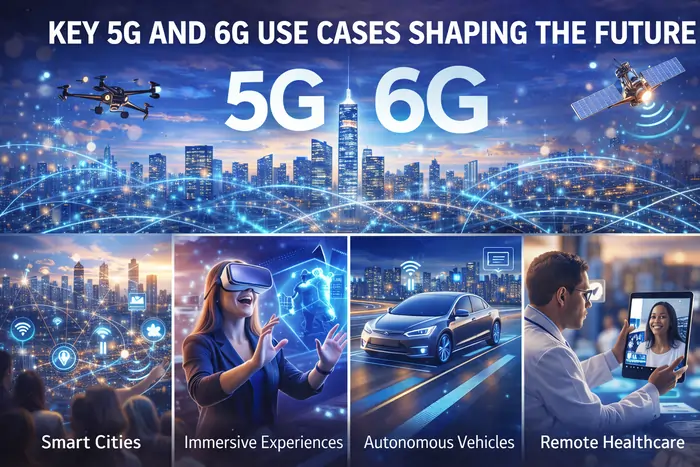
Key 5G and 6G Use Cases Shaping the Future
Immersive Experiences – AR, VR, and the “Internet of Senses”
One of the most hyped 6G use‑case clusters is ultra‑immersive media. Ericsson’s blog “6G Use cases: Beyond communication by 2030” and Researchwire’s 6G industry trends highlight:
- High‑fidelity XR: Seamless AR/VR with ultra‑high resolution, no noticeable lag, and lifelike rendering.
- Holographic communication: 3D telepresence for meetings, entertainment, and remote collaboration.
- Internet of senses: Multi‑sensory experiences that combine visual, auditory, haptic, and potentially other sensations, demanding extremely high bandwidth and synchronization.
These experiences rely on both 5G‑Advanced and 6G for their eventual mainstream adoption, especially as device form factors (like lightweight AR glasses) mature.
Industry 4.0, Smart Cities, and Massive IoT
Industrial automation and smart infrastructure are already key 5G use cases, but 6G is expected to deepen and broaden their impact.
According to ASE’s 5G/6G applications page and Infobip:
- Smart factories will use ultra‑reliable, deterministic wireless links for robotics, cobots, and machine‑vision systems.
- Massive digital twins of plants, supply chains, and entire cities will be synchronized in real time, requiring high‑bandwidth uplinks and low‑latency control.
- Smart cities will integrate traffic management, public safety, environmental sensing, and utilities into unified, data‑driven systems.
6G’s ability to connect millions of devices per km² and perform fine‑grained sensing makes it key infrastructure for truly pervasive IoT and digital‑twin ecosystems.
Autonomous Systems and Mobility
5G has already enabled pilots of connected and autonomous vehicles (CAVs), but 6G’s promise of microsecond latency and greater reliability will be crucial for more advanced autonomy.
Orbis Systems’ 6G telecom innovations overview and Ericsson’s 6G content highlight:
- V2X (vehicle‑to‑everything) communication, allowing vehicles to coordinate with each other, infrastructure, and pedestrians.
- Autonomous drones and logistics, including delivery networks and inspection systems relying on reliable command and control.
- High‑precision positioning, improving safety and efficiency in transport and logistics beyond what GNSS alone can offer.
These applications will depend on both terrestrial 6G and non‑terrestrial networks (like LEO satellites) to achieve truly global coverage.
Health, Education, and Social Impact
Reports such as TechTalent’s 6G overview and ScienceDirect‑hosted articles on 6G applications point to significant potential in health and education:
- Remote surgery and telemedicine: Ultra‑reliable, ultra‑low latency connections for remote robotic procedures and critical monitoring.
- E‑health platforms: Continuous, secure monitoring of chronic conditions via wearables and implants.
- Immersive education: Holographic classrooms, interactive labs, and real‑time global collaboration powered by XR and digital twins.
If deployed inclusively, 5G/6G could help bridge parts of the digital divide by bringing advanced health and education services to remote or underserved communities, though this depends heavily on policy and investment choices.
6G Timeline, Standards, and the Global Race
Multiple sources converge on a similar timeline:
- R&D phase: Ongoing now through the mid‑2020s, with universities, vendors, and standards bodies exploring candidate technologies.
- Standardization: Early 6G specifications likely to emerge in late 2020s, around 3GPP Release 20 and onwards.
- Commercial rollout: Initial 6G networks expected around 2030, overlapping with advanced 5G.
Qualcomm’s 6G page, Ericsson’s “Follow the journey to the next generation networks”, and Built In all emphasize that 6G will coexist with 5G for years, rather than replacing it overnight.
The global race for 6G involves major initiatives in the US, EU, China, Japan, South Korea, and others, with collaborative projects between academia and industry such as Hexa‑X in Europe and various national 6G programs in Asia.
Challenges on the Road to 6G
Technical and Infrastructure Hurdles
6G’s ambitious goals bring serious engineering challenges. ScienceDirect’s article “Exploring the key technologies and applications of 6G wireless” and TechTarget’s 6G overview highlight several:
- Propagation at THz frequencies: Higher frequencies have shorter range and poorer penetration, requiring new antenna designs, intelligent reflecting surfaces, and ultra‑dense deployments.
- Hardware and packaging: THz radios and ultra‑massive MIMO arrays demand advanced semiconductors and packaging solutions, such as those described by ASE’s 6G advanced packaging.
- Integration of terrestrial and non‑terrestrial networks: Harmonizing performance, hand‑off, and resource allocation between ground networks and satellites is non‑trivial.
Energy, Sustainability, and Cost
With ever‑higher data rates and denser infrastructure, energy efficiency becomes crucial.
Researchwire and Ericsson both highlight a push for “green 6G”, focusing on:
- More efficient hardware and transmission schemes.
- AI‑driven energy management that powers down or reconfigures network elements dynamically.
- Using 6G itself to support environmental monitoring and sustainability, such as precise climate and pollution sensing.
At the same time, operators must manage CAPEX and OPEX, reusing as much 5G infrastructure as possible and carefully choosing where ultra‑dense deployments make economic sense.
Security, Privacy, and Regulation
As TechTarget notes, 6G will massively expand the attack surface, with more devices, more data, and more critical systems connected than ever. This raises several concerns:
- Zero trust architecture: Moving from perimeter‑based security to continuous verification and least‑privilege models for all entities.
- Confidential computing: Protecting data in use via secure enclaves and hardware‑based isolation, especially important for AI workloads.
- Sensing and privacy: ISAC may allow networks to infer detailed information about environments and individuals, raising new privacy questions and regulatory issues.
Governments and standards bodies will need to update spectrum policy, satellite coordination frameworks, and data protection regulations to account for these new capabilities.
What 5G and 6G Mean for Consumers and Businesses
For consumers, 5G and eventually 6G will translate into smoother streaming, lower‑latency gaming, more immersive media, and better connectivity in crowded areas and on the move. Over time, devices may integrate more sensing and AI capabilities, delivering context‑aware experiences that adjust to users’ environments in real time.
For businesses and industries, the implications are broader:
- Telecom operators will need to evolve into providers of programmable, AI‑driven platforms, exposing network capabilities via APIs and network slicing.
- Cloud and edge providers will increasingly converge with telecoms, jointly delivering low‑latency compute and storage alongside connectivity.
- Enterprises in manufacturing, logistics, healthcare, and media can build new products and services—from fully automated warehouses to remote care platforms—on top of ubiquitous, reliable connectivity.
Reports like Researchwire’s “Industry Predictions and Revolutionary Trends of 6G Technology” argue that early movers who experiment with 5G‑Advanced and prepare for 6G will gain competitive advantages in efficiency, innovation speed, and customer experience.
Conclusion
5G is still in the process of realizing its full potential, but the outlines of 6G connectivity are already clear: multi‑hundred‑gigabit to terabit speeds, microsecond‑level latency, integrated sensing, and AI‑native intelligence running across terrestrial and non‑terrestrial networks. Together, 5G‑Advanced and 6G will move wireless from today’s “connected devices” paradigm toward a world of connected intelligence, experiences, and digital twins.
At the same time, the path to 6G comes with substantial engineering, economic, security, and ethical challenges. As you plan strategies, products, or policies for the next decade, the most effective approach is to treat 5G and 6G like evolving platforms: start experimenting with 5G and 5G‑Advanced capabilities today, stay close to emerging standards and use‑case roadmaps, and align your investments with the sectors—like XR, Industry 4.0, autonomous systems, and e‑health—where next‑generation wireless can unlock the most value.