

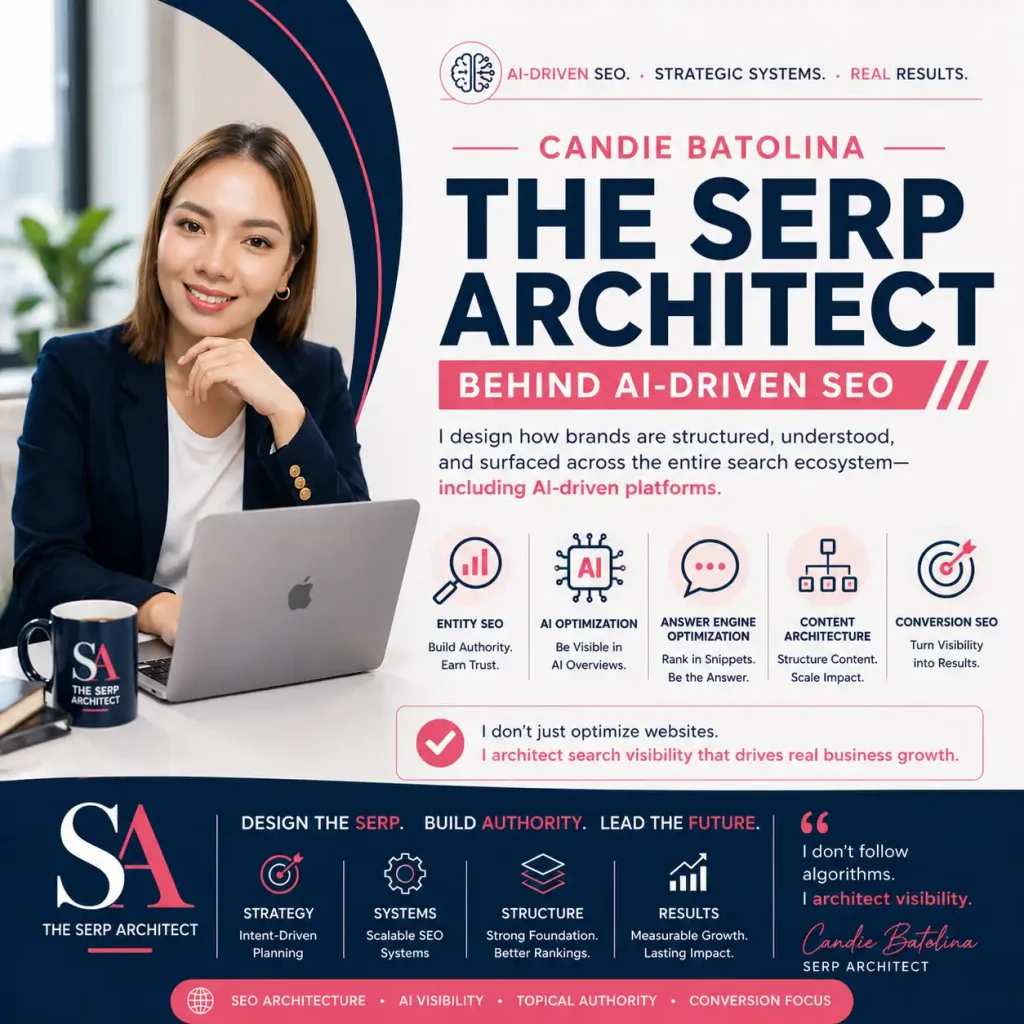
Overview Summary
I’m Candie Batolina, creator of The SERP Architect Framework.
SEO has evolved. It’s no longer just about ranking on Google. It’s about how a brand is structured, understood, and surfaced across the entire search ecosystem, including AI-driven platforms.
Because of this shift, I don’t treat SEO as a checklist.
I design it as a system.
Through The SERP Architect approach, I help brands move from:
- Disconnected content → Structured ecosystems
- Unpredictable traffic → Controlled visibility
- Search rankings → AI-driven presence + conversions
Today, visibility is not just about clicks.
It’s about being present everywhere search happens—even when users don’t click.
Table of Contents
Why Clients Choose Me (And Why Their SEO Was Failing Before)
Most clients don’t come to me asking for SEO.
They come because something isn’t working.
- They publish content consistently—but nothing scales
- They rank—but conversions stay flat
- They invest in backlinks—but authority doesn’t stick
- They have pages—but no system behind them
What I’ve learned is simple:
👉 The problem is rarely effort
👉 The problem is almost always structure
That’s where I come in.
I don’t just improve pages.
I redesign how your entire search presence functions as a connected, scalable system.
How I See SEO Today
“I don’t just optimize websites. I design how brands exist in search.”
This is the difference between:
- A freelancer executing tasks
- And an architect designing systems
Most SEO starts with:
- Keywords
- Tools
- Content ideas
I start with:
- Search behavior
- Entity positioning
- System architecture
Instead of asking:
“What keyword should we target?”
I ask:
“How should this brand dominate its search ecosystem?”
The SERP Architect Framework (Modern SEO System)
My work is built on five interconnected systems:
- Entity SEO
- AI Optimization (AIO)
- Answer Engine Optimization (AEO)
- Content Architecture
- Conversion SEO
And one foundational layer often ignored:
👉 Structured Data (Schema Markup)
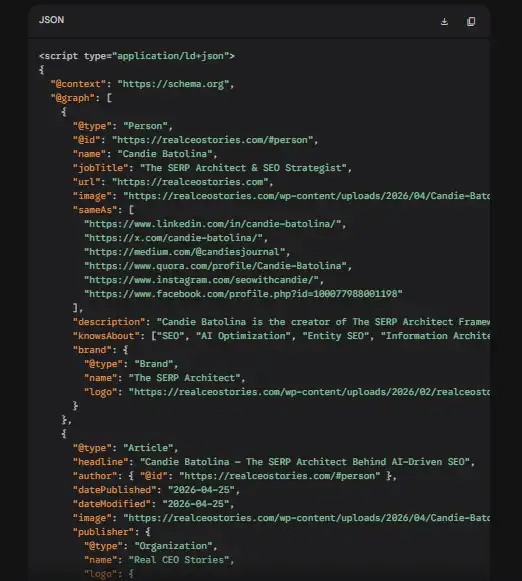
I treat this as a “cheat sheet” for search engines.
Instead of making Google or AI guess what your content is about, I give them clear, structured signals.
That clarity leads to:
- Faster understanding
- Better indexing
- Higher visibility
Where This Framework Comes From
The SERP Architect Framework is not theoretical.
It was developed through real execution across multi-site SEO projects, team leadership, and continuous optimization in both corporate and online environments.
For a deeper breakdown of how this system works in practice, including the strategic logic behind each layer, you can explore the full framework here:
👉 The SERP Architect: Candie Batolina’s SEO Strategy Framework
This expands on how I design SEO systems that move beyond rankings and into structured visibility, authority building, and AI-driven search performance.
7 Things I Focus on in Every SEO Project (Architect-Level Execution)
These are not theories.
These are the exact systems I apply across real projects.
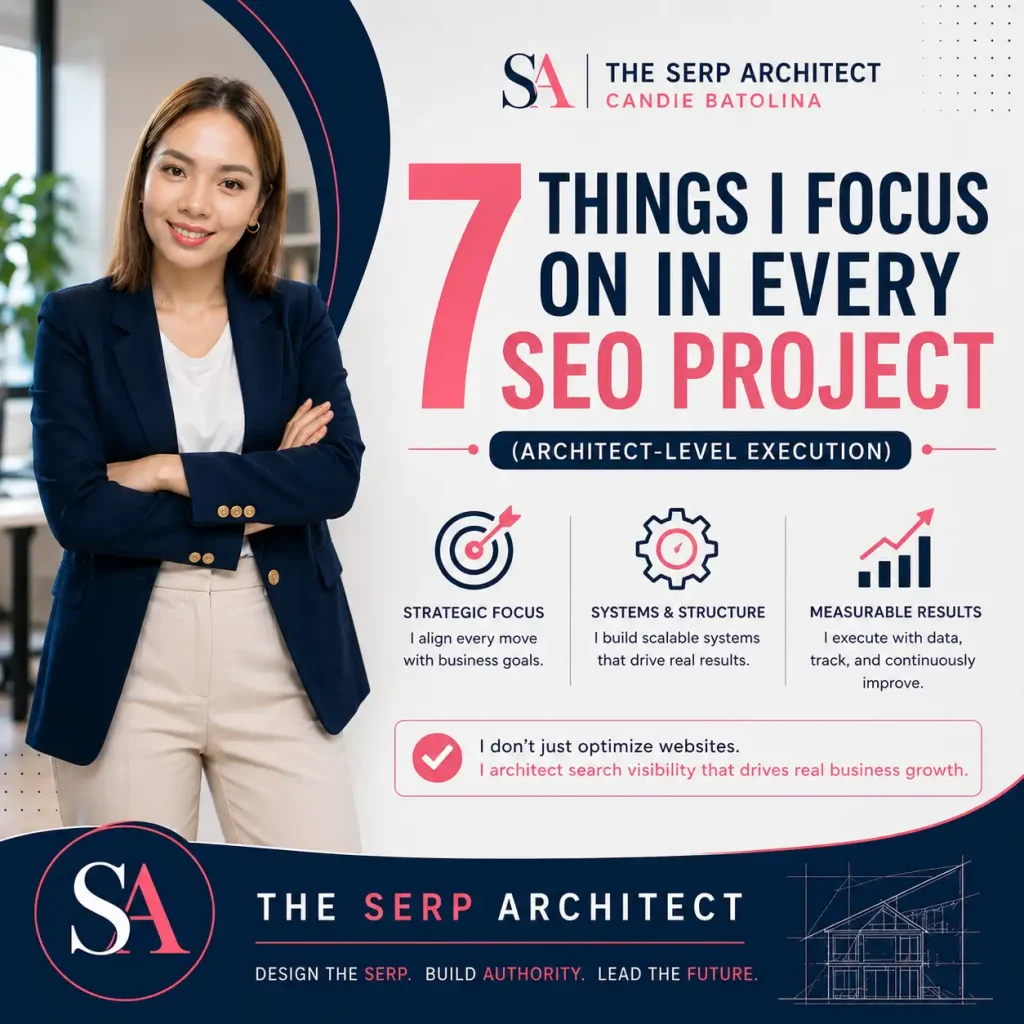
1. I Map Where the Brand Should Appear in Search
Before execution, I define visibility.
Not just ranking—but total presence.
I analyze:
- SERP layouts (organic, snippets, AI Overviews)
- Competitor coverage
- AI answer inclusion
- Content gaps
Then I answer:
👉 Where is the brand missing?
👉 Real Execution Example:
On a large content-driven site, I transformed a flat structure into a layered system.
- Reduced “Discovered – currently not indexed” pages by 65% within 30 days
- Improved crawl efficiency
- Increased indexation across priority pages
💡 The issue wasn’t content. It was structure.
2. I Build a Structured Content Ecosystem
Content without structure is noise.
Structure creates authority.
Instead of publishing isolated articles, I build:
- Pillar pages
- Topic clusters
- Supporting content layers
💡 I don’t create content.
I build a Content Supply Chain.
3. I Strengthen Entity Signals (Authority Engineering)
Search engines now operate as knowledge graphs.
So I focus on:
- Entity consistency
- Topical ownership
- Brand association
👉 Goal:
Brand → Topic → Authority
4. I Optimize for AI (AIO — Future-Proofing Layer)
We are now in the Synthetic Search Era.
AI:
- Summarizes
- Recommends
- Filters visibility
👉 I structure content so it can be:
- Extracted
- Understood
- Recommended
5. I Build Internal Linking Systems (Structural Backbone)
Internal linking is not navigation.
It is architecture.
👉 I design:
- Contextual pathways
- Authority distribution
- Content relationships
6. I Align Search Intent with Conversion (Conversion SEO — Advanced)
Traffic ≠ Results.
👉 I connect:
- Search intent
- Content structure
- User journey
- Conversion flow
👉 Funnel:
- Informational → Trust
- Commercial → Evaluate
- Transactional → Convert
7. I Continuously Optimize Based on Data (Execution Discipline)
SEO evolves constantly.
👉 I track:
- Impressions
- CTR
- Rankings
- Conversions
👉 I improve:
- Content
- Structure
- Linking
👉 Process:
Analyze → Improve → Scale
SEO Growth Timeline (What You Can Expect)
| Timeline | Focus Area | What Improves | Outcome |
|---|---|---|---|
| Weeks 1–4 | Structure & Indexing | Crawl efficiency, indexing issues fixed | Faster page discovery |
| Weeks 4–8 | Content Alignment | Rankings improve, higher CTR | Increased visibility |
| Weeks 8–12 | Authority Signals | Cluster rankings stabilize | Consistent traffic |
| 3–6 Months | System Growth | AI visibility, conversions | Long-term ROI |
Real Experience Behind The SERP Architect
Beyond systems and strategy, my approach is built on real execution.
I’ve been in the company for years, and I’ve consistently delivered results both individually and as part of a team.
- Top Performer – Acquisition and Branding Team (2022)
- Top Leads of the Year for two brands – Team Performance Rank #1 (2025)
These achievements reflect how I approach SEO:
👉 Not as tasks
👉 But as systems that drive results
Leadership That Shapes My SEO Approach
I became a Team Leader in 2022 in a corporate environment, and later transitioned into the online industry as an SEO Specialist Team Leader in 2024.
In both roles, I didn’t just manage people.
I built systems and developed teams.
Today, I:
- Train SEO teams on real execution
- Guide content production workflows
- Align SEO with measurable business goals
- Teach strategies, not just tasks
This is why my approach works.
Because it’s built not just on knowledge—but on execution and leadership.
How This Translates Into Real Leadership
The SERP Architect approach is not limited to strategy.
It is applied in real execution—across teams, projects, and multi-site systems.
In practice, this means:
- Leading SEO teams through structured workflows
- Aligning developers, content teams, and affiliates
- Managing visibility across different markets and platforms
- Delivering measurable outcomes week by week
This is the exact model behind how I operate as a Team Leader.
For a deeper look into how this framework translates into real leadership and execution systems, you can explore the full breakdown here:
👉 The SERP Architect Leadership Model: From Strategy to Execution
This shows how SEO evolves beyond tasks—and becomes a leadership system for scalable digital growth.
The Mindset Behind My Work
I’ve proven one thing to myself:
I can adapt and perform in any environment.
Corporate or digital
Strategy or execution
Individual or team
I consistently push for results.
This comes from:
- Strong work ethic
- Adaptability
- Continuous improvement
What Makes My Approach Different
Most SEO still looks like:
- Publish content
- Build backlinks
- Wait
I do it differently.
I:
- Design systems
- Engineer authority
- Optimize for AI
- Align with business outcomes
That’s why I don’t position myself as:
👉 SEO Specialist
I position myself as:
👉 The SERP Architect
Frequently Asked Questions
What does SERP stand for in modern SEO?
SERP stands for Search Engine Results Page. Traditionally, this referred to the list of web pages shown after a search query.
However, in modern SEO, SERP is no longer just a list of links. It is now a dynamic visibility ecosystem that includes:
- Organic search results
- Featured snippets
- People Also Ask sections
- AI Overviews (Search Generative Experience)
- Knowledge panels
Because of this evolution, SEO today focuses not just on ranking—but on owning multiple positions across the SERP to maximize visibility and authority.
What is a SERP summary and why does it matter?
A SERP summary refers to how search engines or AI systems condense and present information directly on the results page without requiring a click.
Examples include:
- Featured snippets
- AI-generated summaries
- Answer boxes
This matters because users often get their answers directly from the SERP.
👉 This creates what is known as zero-click searches.
For brands, this means:
- Visibility is no longer limited to clicks
- Content must be structured for direct extraction
- SEO must focus on being the source of the answer
What is SERP and why is it important for businesses?
SERP represents where your brand appears when users search for information.
It is important because it directly impacts:
- Visibility
- Credibility
- Traffic
- Conversions
In today’s environment, being present in multiple SERP features (not just rankings) allows businesses to:
- Build authority faster
- Capture attention across different formats
- Compete effectively—even in competitive niches
This is why modern SEO focuses on SERP dominance, not just ranking position.
What is AI SEO and why is it important now?
AI SEO refers to optimizing content for AI-driven search systems, including:
- Google AI Overviews
- ChatGPT
- Gemini
- Perplexity
These platforms do not just rank pages—they interpret, summarize, and recommend content.
This means:
- Content must be structured for machine understanding
- Clear answers and formatting are essential
- Entity signals matter more than keyword repetition
👉 If your content is not optimized for AI, it may not appear at all in modern search experiences.
Is SEO shifting from keywords to entities?
Yes. Modern SEO has shifted from keyword-based optimization to entity-based optimization.
Keywords focus on phrases.
Entities focus on meaning and relationships.
Search engines now evaluate:
- Who the brand is
- What topics it owns
- How content is connected
This is why building topical authority and structured content systems is more effective than simply targeting keywords.
What is GEO and how is it different from SEO?
GEO stands for Generative Engine Optimization.
It focuses on optimizing content for AI-generated search results rather than traditional rankings.
While SEO aims to rank pages, GEO aims to:
- Influence AI-generated answers
- Ensure brand visibility in summaries
- Position content as a trusted source
👉 In simple terms:
SEO helps you rank.
GEO helps you get included in AI answers.
How long until a structured SEO system shows results?
Most improvements begin within 4–12 weeks, especially when fixing structural issues such as:
- Poor indexing
- Weak internal linking
- Lack of content hierarchy
During this period, you can expect:
- Improved crawl efficiency
- Faster indexation
- Early ranking movement
However, long-term results develop over time.
👉 3–6 months and beyond:
- Stronger authority signals
- Stable rankings
- Increased AI visibility
- Higher conversion rates
SEO is not instant—but when structured correctly, it becomes predictable and scalable.
Is this better than traditional SEO?
Yes—because it aligns with how search works today.
Traditional SEO focuses on:
- Keywords
- Backlinks
- Rankings
Modern SEO focuses on:
- Entities
- Systems
- AI visibility
- Search ecosystems
👉 This shift makes SEO more strategic, more scalable, and more aligned with business outcomes.
Do I need a lot of content to start SEO?
No.
Content volume is not the priority—structure is.
A smaller number of well-structured pages can outperform a large number of unorganized articles.
What matters more:
- Clear topic hierarchy
- Strong internal linking
- Intent-driven content
👉 In modern SEO, quality + structure beats quantity.
Can this approach work in competitive niches?
Yes—and it works even better in competitive environments.
In saturated markets, most competitors rely on:
- More content
- More backlinks
But structured SEO systems allow you to:
- Build authority faster
- Connect content more effectively
- Compete strategically, not just aggressively
👉 This is how brands move from competing… to dominating their niche.
Why is internal linking important in modern SEO?
Internal linking helps search engines understand how your content is connected.
It improves:
- Crawl efficiency
- Indexation
- Authority distribution
More importantly, it turns your website into a structured ecosystem, rather than isolated pages.
👉 This is one of the most powerful—and most overlooked—SEO strategies today.
Final Thought
I don’t see SEO as a task.
I see it as architecture.
Something that requires:
- Planning
- Structure
- Systems
- Continuous improvement
When built correctly, SEO becomes:
- Predictable
- Scalable
- Profitable
Ready to Stop Guessing and Start Building?
If your SEO feels scattered, slow, or unpredictable—
Let’s fix the system behind it.
👉 Let’s audit your search ecosystem.