

RBA Rate Hike Predictions 2026 point to interest rates staying higher for longer as the Reserve Bank of Australia battles stubborn inflation above its 2–3% target. With the cash rate already lifted to 4.10% and markets pricing in the risk of at least one more rate hike, Australian homeowners, renters, and savers should stress‑test their budgets, explore refinancing options, and actively seek better deposit rates to stay ahead of any further moves.
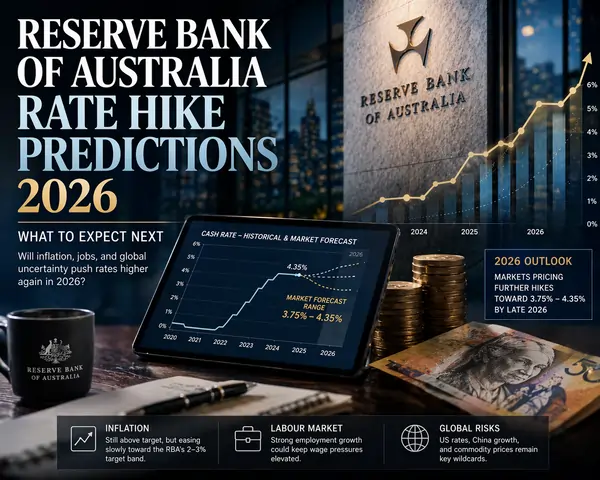
The Reserve Bank of Australia (RBA) has already surprised borrowers in 2026 with back-to-back interest rate hikes, pushing the official cash rate to 4.10% in March. With inflation still running above target and economists revising their forecasts higher, RBA Rate Hike Predictions 2026 have become one of the most closely watched topics for Australian households, property investors, and business owners.
In this guide, we break down what the RBA has already done this year, how markets and major banks see the rest of 2026 playing out, and what different rate paths could mean for your mortgage, rent, savings, and broader financial plan. You’ll find clear explanations, data-based scenarios, and practical tips so you can prepare—not panic—for what might come next.
Where the RBA Cash Rate Stands in 2026
After holding rates steady for much of 2025, the RBA has changed course in 2026. In February and March, the Bank delivered two consecutive 0.25 percentage point increases, lifting the cash rate from 3.60% to 4.10%. ABC News and other outlets reported that the March decision was a split vote, highlighting how finely balanced the Board’s judgment currently is.
According to RBA communications and independent trackers:
- The current cash rate is 4.10% following the March 2026 decision.
- The RBA has indicated it is responding to inflation that “picked up materially” in late 2025 and early 2026, as well as higher fuel costs and capacity pressures in the economy.
- The next rate decision is scheduled for 5 May 2026, with markets already pricing in some chance of another move.
For official rate history and current settings, the RBA’s cash rate statistics and main website at rba.gov.au remain the authoritative sources.
What the RBA Is Signalling for 2026
The RBA’s February 2026 Statement on Monetary Policy provides one of the clearest windows into its thinking and underpins many RBA Rate Hike Predictions 2026. In that statement, the Bank:
- Noted that economic activity, the labour market, and inflation had all been stronger than previously expected.
- Assumed, based on market pricing at the time, that the cash rate would rise by around 60 basis points over the forecast period rather than fall.
- Flagged that underlying inflation is expected to peak around 3.7% in mid‑2026 and remain above the 2–3% target band until early 2027.
In plain language, that means RBA officials are preparing the public for the possibility that:
- Further hikes in 2026 are more likely than cuts, unless inflation slows faster than expected.
- Even if additional rate hikes are relatively small, rates may stay higher for longer to squeeze out persistent price pressures.
The RBA reiterates on its site that its primary goal is to keep inflation “low and stable,” averaging 2–3% over time. With the Bank now forecasting inflation above that band for longer, it logically keeps rate hikes “on the table” throughout 2026.
Market-Based RBA Rate Hike Predictions 2026
One way to gauge RBA Rate Hike Predictions 2026 is to look at market pricing, particularly interest rate futures.
The ASX 30 Day Interbank Cash Rate Futures provide a widely cited “RBA Rate Tracker” that translates market prices into implied probabilities for future rate decisions. As of early April 2026:
- The May 2026 futures contract was trading around 95.775, implying roughly a 60% probability of another 0.25 percentage point hike by the RBA in the coming months.
- Pricing further out suggests that markets expect the cash rate to be higher by the end of 2026 than it was at the start of the year, consistent with the RBA’s own assumption of a higher rate path.
While these probabilities move with each data release, they reflect the collective view of professional traders and institutions who are putting real money behind their expectations.
What Economists and Big Banks Expect
Economists at major Australian banks and universities are similarly repositioning their forecasts in light of the RBA’s more hawkish tone.
Big Four Bank Views
- Earlier in 2026, some bank economists expected the RBA to pause after the February hike while it assessed incoming data.
- As inflation data surprised on the upside and global oil prices rose, forecasts shifted to anticipate hikes in both March and May 2026, according to coverage from financial comparison and news outlets.
- Commonwealth Bank analysis after the March decision framed the move as “not if, but when,” with the Bank warning that elevated inflation and geopolitical instability could force further tightening.
Academic and Independent Experts
Economists from institutions such as UNSW Business School have also emphasised that persistent inflation pressures would likely mean more rate increases in 2026, not fewer. In a February 2026 explainer, UNSW economists noted that the path of wages, productivity, and global conditions would be key in determining how far and how fast the RBA moves.
Taken together, the expert consensus leans toward:
- A high likelihood that the cash rate stays at or above 4.10% through much of 2026.
- A meaningful risk that one or two additional hikes could push it closer to 4.5% if inflation continues to overshoot.
Key Economic Drivers: Inflation, Growth, and Jobs
At the heart of RBA Rate Hike Predictions 2026 are three interconnected variables: inflation, economic growth, and the labour market.
Inflation Running Hotter Than Expected
Recent data from the Australian Bureau of Statistics show that trimmed mean inflation was running at about 3.4% annually in early 2026, above the RBA’s 2–3% target range. The RBA’s February projections go further, suggesting:
- Underlying inflation to peak at 3.7% in mid‑2026.
- Headline inflation potentially reaching around 4.2% before easing back toward 2.6% by 2028.
Higher global fuel prices and strong domestic demand have both been cited as drivers of this revised inflation outlook.
Growth and Labour Market Conditions
The RBA expects GDP growth to slow to below potential from late 2026 as higher borrowing costs bite. At the same time:
- The unemployment rate is forecast to edge higher from late 2026 as activity cools.
- Wages growth is expected to remain “a little higher” than previously forecast, contributing to persistent inflation pressures.
This combination—still-strong inflation, moderate growth, and a relatively tight labour market—creates a challenging backdrop and helps explain why the RBA remains open to further tightening even after repeated hikes.
Scenarios for RBA Rates in Late 2026
No one can predict the exact path of interest rates, but based on current data and guidance we can outline three plausible scenarios for RBA Rate Hike Predictions 2026.
Scenario 1: Base Case – One More Hike, Then Hold
- Cash rate peaks around 4.35% or 4.50% after another 0.25–0.40 percentage point increase in mid‑2026.
- Inflation gradually declines but stays above 3% for much of the year, prompting a “higher for longer” stance.
- RBA holds rates steady into 2027, waiting to see clearer evidence of inflation returning to target.
Scenario 2: Hawkish Case – Multiple Hikes
- Global energy prices spike again or domestic data shows stronger-than-expected demand, pushing inflation well above forecasts.
- RBA responds with two or more additional hikes, taking the cash rate toward 4.75% or higher.
- Growth slows more sharply, unemployment rises faster, and talk of a policy-induced downturn dominates headlines.
Scenario 3: Dovish Case – Early Pause, Possible Cut
- Inflation decelerates faster than expected, perhaps due to weaker global growth or a sharp pullback in consumer spending.
- RBA halts at 4.10% or after one small additional hike, and starts discussing the conditions for eventual cuts.
- Any rate cuts are more likely a 2027 story unless there is a major negative shock.
Most current forecasts from banks and market pricing cluster around Scenario 1, with Scenario 2 and 3 representing higher- and lower-risk tails.
What Rising or Steady Rates Mean for Borrowers
Regardless of the exact path, elevated RBA rates in 2026 will have real consequences for variable-rate borrowers and those rolling off fixed-rate deals.
Immediate Impact on Mortgage Repayments
With the cash rate now at 4.10%, average variable mortgage rates have moved significantly higher than their pandemic-era lows. Even a single 0.25 percentage point hike can add hundreds of dollars per month to repayments on large loans.
For example (illustrative only, not financial advice):
- A $600,000 loan with 25 years remaining could see monthly repayments rise by roughly $90–$100 for each 0.25 percentage point increase, depending on the rate and lender.
- Two additional hikes of that size over 2026 could therefore add around $180–$200 per month on top of already higher repayments.
Comparison sites and bank calculators can help you model the impact of rate changes on your specific situation; ASIC’s Moneysmart mortgage calculator is a widely used tool for this purpose.
Refinancing, Fixing, and Negotiating
In a high-rate environment, borrowers should consider:
- Reviewing their current interest rate and comparing it against market offers, as lenders do not automatically pass on their best deals to existing customers.
- Negotiating with their bank or switching lenders if they find a materially lower rate.
- Weighing fixed versus variable options, acknowledging that fixing at the top of a cycle can be risky if rates later fall, but may provide certainty for some households.
The RBA itself encourages Australians to understand how rate changes affect their budgets and to consider seeking independent financial advice for complex decisions.
Impact on Savers, Investors, and the Property Market
RBA Rate Hike Predictions 2026 are not only about pain; they can also create opportunities, especially for savers and cautious investors.
Savers and Term Deposits
Higher cash rates tend to translate into better returns on savings accounts and term deposits, especially if you’re willing to shop around. While bank pass-through is never perfect, competition for deposits can lead to improved offers for:
- Online savings accounts with bonus rate conditions.
- Short- to medium-term term deposits.
- Cash-like products used by conservative investors.
Property Prices and Rental Markets
Sustained higher interest rates typically:
- Put downward pressure on property prices or at least slow price growth, as borrowing capacity is reduced.
- Increase landlords’ holding costs, which can feed into higher rents where vacancy rates are low.
This creates a mixed environment where:
- First-home buyers may benefit from less intense price growth but face tougher serviceability tests and higher repayments.
- Existing investors need to monitor cash flow, particularly if they are highly leveraged.
Other Asset Classes
For diversified portfolios:
- Higher rates can weigh on share valuations, particularly for highly leveraged companies or sectors sensitive to consumer spending.
- Bond yields often rise, potentially improving future income for fixed-income investors but reducing prices in the short term.
As always, these effects are general trends, not guarantees; individual outcomes depend on portfolio mix, time horizon, and risk tolerance.
Pro Tips and Expert Insights
To make this practical, here are some actionable insights for navigating RBA Rate Hike Predictions 2026.
For Homeowners and Buyers
- Stress-test your budget: Run scenarios with rates 0.5–1.0 percentage points higher than today to see if your cash flow can cope.
- Build a rate buffer: Aim to direct any spare cash toward offset accounts or redraw facilities to soften the blow of future hikes.
- Avoid over-leveraging: If you’re buying in 2026, be cautious about stretching to the absolute maximum your lender will approve.
For Renters
- Expect upward pressure on rents in tight markets if landlords’ costs continue to rise.
- Consider longer leases if you find affordable rent and value stability, but balance this with your need for flexibility.
For Savers and Investors
- Shop around for deposit rates; small percentage differences can add up quickly in a high-rate environment.
- Review portfolio risk: Higher rates can change the risk–reward balance across shares, bonds, and property.
- Stay diversified: Avoid concentrating risk in a single asset class that might be particularly exposed to rising rates.
For more general guidance on managing money in a changing rate environment, government-backed sites like Moneysmart provide neutral, educational resources.
FAQ: RBA Rate Hike Predictions 2026
What is the current RBA cash rate in 2026?
As of March 2026, the RBA cash rate is 4.10%, following two consecutive 0.25 percentage point hikes in February and March.
Why did the RBA raise rates in early 2026?
The RBA cited stronger-than-expected inflation, resilient demand, and higher fuel prices as reasons to tighten policy to bring inflation back toward its 2–3% target.
Are more RBA rate hikes likely in 2026?
Market pricing and RBA forecasts both suggest a high likelihood of at least one more hike in 2026, with the cash rate path skewed upward rather than downward.
When is the next RBA interest rate decision?
The next scheduled decision is on 5 May 2026, with the Board meeting over 4–5 May and announcing the outcome at 2:30 pm Sydney time.
How does inflation affect RBA Rate Hike Predictions 2026?
Higher-than-target inflation is the main driver of rate hikes; the RBA’s February 2026 outlook sees underlying inflation peaking at 3.7% and staying above the target band into 2027, which supports further tightening.
What do major banks expect from the RBA this year?
Australia’s major banks have shifted toward expecting multiple hikes in 2026, including the moves already seen and potential additional increases later in the year.
Will interest rates fall in 2026?
Most current forecasts point to stability or further hikes in 2026, with any significant cuts more likely from 2027 onwards, assuming inflation moderates.
How can I see what markets are pricing in?
The ASX 30 Day Interbank Cash Rate Futures “RBA Rate Tracker” shows implied market expectations for upcoming cash rate decisions.
How do RBA rate hikes affect my mortgage?
Rate hikes typically lead banks to increase variable mortgage rates, which directly increases monthly repayments; the exact impact depends on your lender and loan type.
Should I fix my home loan rate in 2026?
Fixing can provide repayment certainty but may lock you in near the peak of the cycle; whether it’s suitable depends on your risk tolerance and expectations about future rates, so independent advice is recommended.
What does a higher cash rate mean for savings?
Higher cash rates often lead to better returns on savings accounts and term deposits, especially if you are proactive about comparing and switching providers.
How will higher rates affect house prices?
Sustained higher rates usually dampen borrowing capacity, which can slow price growth or put downward pressure on certain markets, though local supply–demand dynamics also matter.
Are rate hikes bad for the economy?
Rate hikes are designed to cool demand and control inflation; while they can slow growth and increase financial stress, they also help prevent more damaging, entrenched inflation.
How can I prepare my household budget for higher rates?
Build a buffer by reducing discretionary spending, paying down high-interest debt, and using tools like Moneysmart’s budget planner and mortgage calculator to model scenarios.
What happens if inflation falls faster than expected?
If inflation falls back toward the target range more quickly, the RBA could pause hikes sooner and potentially consider rate cuts earlier than currently projected.
How often does the RBA change interest rates?
The RBA Board meets 11 times a year (monthly, except January) to review economic conditions and decide whether to raise, cut, or hold the cash rate.
Where can I find official RBA forecasts?
The RBA publishes its Statement on Monetary Policy each quarter, including detailed forecasts and commentary, available on its official website.
Do global events affect RBA decisions?
Yes. Global growth, commodity prices, and geopolitical risks—such as conflicts that drive up energy costs—are explicitly cited by the RBA and bank economists as factors that can influence rate decisions.
What if I’m already under mortgage stress?
If you’re struggling with repayments, contact your lender early to discuss options and consider seeking help from accredited financial counsellors; the Australian government lists free services via Moneysmart.
Conclusion: How to Prepare for the Next RBA Move
RBA Rate Hike Predictions 2026 point to a year where interest rates are more likely to stay high or rise further than to fall, driven by stubborn inflation and a still-resilient economy. While no forecast is perfect, the RBA’s own outlook, market pricing, and bank research all suggest borrowers should plan for a cash rate around or above 4.10% for some time yet.
The good news is that you’re not powerless: by understanding how the RBA operates, tracking credible sources like the official RBA website and Statements on Monetary Policy, and taking proactive steps with your mortgage, savings, and budget, you can navigate 2026 with more confidence and less stress. If you’d like, I can next create a short AI overview snippet and a quick comparison table showing how different cash rate levels would impact a sample mortgage.
If you’re also watching how individual lenders are adapting to this higher‑for‑longer environment, make sure to read our detailed update on one of Australia’s major regional banks: Bendigo Bank Update: Key Changes and What It Means for Australians in 2026, which breaks down product shifts, customer impacts, and what it could mean for your everyday banking.