

Bendigo and Adelaide Bank in 2026 is focusing on three core priorities: higher interest rates, stronger digital banking, and long-term cost efficiency. The bank is passing on recent rate increases to home loan customers, which may lead to higher repayments, while still working to keep its savings and deposit products competitive. At the same time, it is investing heavily in technology, including its digital bank Up and a modern lending platform, designed to speed up applications and simplify everyday banking.
Behind the scenes, new strategic partnerships and productivity programs are being introduced to reduce operational costs and support sustainable profits, without compromising Bendigo Bank’s community-focused identity.
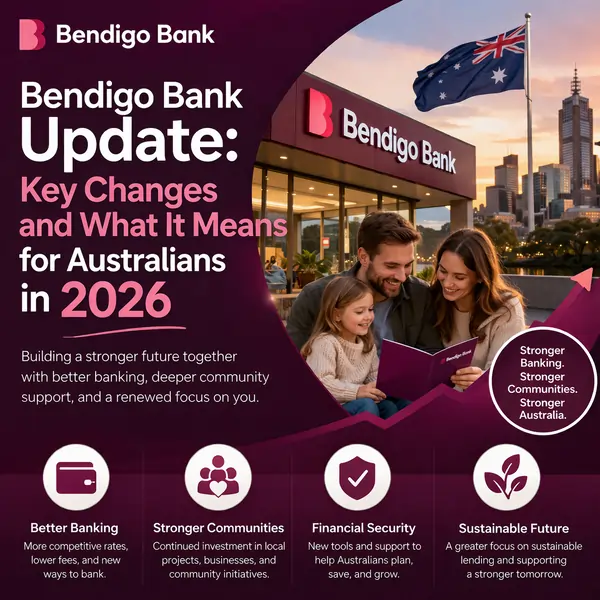
Bendigo Bank has entered 2026 with higher profits, new strategic partnerships, and a sharper focus on digital transformation, cost efficiency, and its community banking model, all of which have direct implications for Australian customers. For everyday Australians, the key changes include shifting interest rate settings, upgraded digital experiences, and a long-term push to keep costs in check while maintaining Bendigo Bank’s community-first identity.
Bendigo Bank in 2026: Where Things Stand
Bendigo and Adelaide Bank heads into 2026 as one of Australia’s largest regionally based banks, with a clear strategy built around community, digital innovation, and disciplined cost management. The bank has reported growing cash earnings into FY26 and sees technology-led productivity as central to its 2030 strategy. At the same time, it is responding to a higher-rate environment, competitive home lending markets, and changing customer expectations about digital banking.
A recent half‑year result for the period ending December 2025 showed solid cash earnings, supported by a net interest margin near 2% and strong growth in lower-cost deposits. Management continues to emphasise Bendigo Bank’s position as a trusted, community-focused institution while investing heavily in digital platforms like its neobank Up and the Bendigo Lending Platform. For Australians, that means 2026 is a year where Bendigo Bank is trying to balance better digital tools and sharper pricing with the personal service that has underpinned its brand.
Key Changes at Bendigo Bank in 2026
Several key developments are shaping Bendigo Bank’s direction in 2026, spanning interest rates, technology, partnerships, and business mix.
- Interest rate changes for home loans
Bendigo Bank has passed through Reserve Bank of Australia cash rate movements to its variable home loan customers, including a 0.25% per annum increase on variable rate home loans announced for late March following an RBA hike. For borrowers, this means higher monthly repayments but also reflects the broader rate environment rather than a Bendigo-specific move. - Ongoing 2030 strategy and transformation program
Bendigo and Adelaide Bank is executing a long-term transformation program aimed at simplifying the bank, modernising its technology stack, and digitising core processes ahead of its 2030 strategic targets. The bank expects this to lower its cost‑to‑income ratio over time and support more sustainable growth in lending and deposits. - Expansion of digital capabilities and Up
Bendigo Bank fully acquired digital bank Up in 2021 and is using it as a key growth engine, with over one million customers by late 2024 and several billion dollars in deposits and loans by early 2025. The bank continues to invest in Up and its own mobile banking experience to deliver faster onboarding, richer budgeting tools, and better digital support. - Strategic partnerships to boost efficiency
In April 2026, Bendigo and Adelaide Bank announced a new phase of its productivity program, anchored by strategic partnerships designed to improve technology, processes, and operational efficiency. These partnerships are expected to deliver recurring expense benefits of about $65–$75 million per year by FY28, albeit with upfront transition costs of around $85–$95 million, mostly in FY27. - Focus on lower-cost deposits and savings franchise
Management has highlighted strong growth in lower-cost deposits, with products like EasySaver and the “Grow & Flow” offering driving meaningful deposit inflows and improving the mix of funding. By strengthening its deposit base, Bendigo Bank aims to maintain a competitive funding cost and support loan growth without over-reliance on wholesale markets. - Refinement of business and agribusiness operations
The bank is consolidating its business and agribusiness divisions onto a single core banking system and branding under Bendigo Bank, with completion targeted around 2025–2027. This consolidation is designed to streamline operations, remove duplication, and enable above‑system growth in these sectors. - Network and international changes (e.g., Nauru exit)
Outside Australia, Bendigo Bank has closed its agencies in Nauru and will cease banking services to Nauruan customers from March 2026. While this is a small part of its overall business, it reflects a focus on core markets and efficiency.
Interest Rates, Savings and Home Loans
Interest rates remain a top concern for Australian households, and Bendigo Bank’s 2026 settings reflect both RBA decisions and the bank’s own funding mix.
Variable home loan rates
Following an RBA cash rate increase of 0.25 percentage points, Bendigo Bank announced that variable rate home loan customers would see their interest rate rise by 0.25% per annum from late March. This move is consistent with industry practice, where major banks generally pass through RBA moves on variable products to maintain margins.
For borrowers, even a 0.25% rise can add tens or hundreds of dollars to monthly repayments depending on the loan size. While Bendigo Bank does not disclose every scenario in its public announcements, customers can use the bank’s online tools or talk to a lender to quantify the impact on their mortgage. The bank’s cautious approach to mortgage competition via brokers and third‑party channels has also meant residential loan balances contracted at an annualised rate in one quarter, showing it is prioritising margin quality over pure volume growth.
Savings accounts and deposit mix
On the deposit side, Bendigo and Adelaide Bank has made clear progress in lifting the share of low-cost deposits in its funding. Lower-cost deposits grew at over 3% annualised in one recent quarter and now account for more than half of total customer deposits, while term deposits have decreased as a proportion. Products like EasySaver have seen double‑digit year‑on‑year growth, and campaigns such as “Grow & Flow,” launched in 2025, have helped add hundreds of millions of dollars in deposits.
For savers, this competitive deposit environment means Bendigo Bank is motivated to offer attractive features and rates on everyday and savings accounts, especially within its digital channels. The bank’s own economic update suggests that a long period of stable cash rates is the most likely outcome for 2026, which may limit big swings in deposit and lending rates, but product‑level competition will still matter.
If you want to monitor current rate changes or product details, you can visit the official Bendigo Bank interest rates page here: Bendigo Bank interest rates.
Digital First: Apps, Up, and the Bendigo Lending Platform
Digital banking is at the heart of Bendigo Bank’s 2026 strategy, both for its main brand and its digital bank Up.
Up: Bendigo’s digital growth engine
Up is a smartphone‑first digital bank owned by Bendigo and Adelaide Bank, and it has become a major contributor to customer growth. By late 2024, Up had reached around one million customers, with more than a billion dollars in loans and several billion dollars in deposits. It offers features such as instant sign‑up, in‑app budgeting tools, and gamified savings experiences, targeting younger and digitally savvy Australians.
For Bendigo Bank, Up functions as both a standalone brand and a pipeline for digital innovation, feeding insights and technology back into the wider group. This means that even if you primarily bank with Bendigo’s main brand, you are likely to see more Up‑inspired features, such as richer transaction insights and smoother digital support, in the coming years.
To learn more about Up and its features, you can explore the official site here: Up digital bank.
Bendigo Lending Platform
The Bendigo Lending Platform is a modern credit and loan origination system that the bank is rolling out across its branches and mobile lender network. By late 2025, it had been implemented across all states except Victoria and Tasmania, where rollout was scheduled for November that year, and further expansion continued into 2026. The platform is designed to automate key parts of the credit decisioning process and streamline home loan applications, reducing turnaround times.
This matters for Australians applying for home loans, business lending, or other credit products with Bendigo Bank because it should mean faster decisions, less paperwork, and more consistent outcomes. It also supports the bank’s ambition to grow home lending at above‑system rates while keeping risk and operational costs under control.
More detail about Bendigo Bank’s technology and platform investments can be found in its investor and strategy updates: Bendigo and Adelaide Bank investor centre.
Better onboarding and digital account opening
Bendigo Bank has also upgraded its digital onboarding, enabling customers to open accounts quickly via the app and streamlining in-branch processes so that account setup flows directly into the digital experience. The bank reports that these changes have helped drive strong year‑on‑year growth in deposits and increased the proportion of customers engaging digitally.
For customers, this means you can likely complete more tasks from your phone—opening accounts, adjusting limits, monitoring spending—without needing to visit a branch, while still having the branch network available when you want human support.
Productivity Program, Costs and Jobs
Behind the scenes, Bendigo and Adelaide Bank is pushing a major productivity and efficiency agenda designed to support long‑term profitability without undermining customer experience.
Strategic partnerships and cost savings
In April 2026, the bank announced new strategic partnerships as part of the second phase of its productivity program. These partnerships aim to leverage external expertise and technology to streamline operations, improve processes, and accelerate the 2030 strategy. According to the bank, the combined process and operational improvements are expected to deliver ongoing expense benefits of about $65–$75 million per year by FY28.
However, achieving these savings will require significant upfront investment, with transition costs estimated at $85–$95 million, largely in FY27. This means that while cost savings will help the bank over the long term, there may be some short‑term impact on reported profits and a period of internal change and restructuring.
You can review the ASX‑released trading update and partnership details here: Bendigo and Adelaide Bank strategic partnerships update (ASX).
Workforce and technology changes
The bank has flagged that these partnerships and process changes will affect parts of its workforce, particularly in technology and business operations. Consultations will occur with staff, and while not every detail is public, the direction is towards a leaner, more digitally enabled organisation. For customers, this should translate into faster service and fewer manual bottlenecks, even if some roles behind the scenes are reshaped or moved.
Management also stresses that the transformation will keep customer connection and trust at the centre of the bank’s model, building on its regional and community banking roots. That means local branches and community banking partners are expected to continue playing a significant role, even as more processes move into the cloud and onto mobile apps.
Community Banking and Brand Strategy
Bendigo Bank has long differentiated itself with a community banking model, where local branches and community partners share in profits to fund local initiatives. In 2026, this model remains part of its strategy, complemented by digital channels and national brand positioning.
Community Bank model
Under the Community Bank model, local communities can establish Bendigo Bank-branded branches that return a share of profits to local projects and organisations. This has historically helped the bank gain traction in regional areas and build a reputation for supporting local economies and grassroots initiatives.
While the bank continues to modernise and digitise, it still highlights the Community Bank network as a distinctive strength that supports customer acquisition and loyalty, particularly outside major metropolitan centres. For Australians who value local presence and community engagement, this model offers an alternative to purely centralised or online-only banks.
You can find more on Bendigo Bank’s community banking structure here: Bendigo Bank Community Bank model.
Executive team and leadership changes
To support the next phase of growth and transformation, Bendigo and Adelaide Bank has made adjustments to its executive team, focusing on areas like digital banking, the Bendigo Lending Platform, and the Business and Agri transformation. Leadership has emphasised that these changes are about accelerating progress while maintaining the bank’s status as one of Australia’s most trusted banks.
For customers, leadership reshuffles are mostly felt indirectly, through the speed of product rollouts, the stability of digital platforms, and how well the bank navigates regulatory and economic shifts.
What It All Means for Australians in 2026

Pulling these threads together, Bendigo Bank’s 2026 update has several practical implications for Australian customers, savers, and borrowers.
For home owners and buyers
- Expect variable home loan rates to move broadly in line with RBA decisions, including the 0.25% increase passed on in March.
- The Bendigo Lending Platform should gradually shorten approval times and reduce paperwork for home loan applications.
- The bank’s cautious approach to broker-channel competition may mean it does not always offer the absolute lowest rate in the market, but it is focusing on sustainable margins and service.
Australians exploring mortgages can compare Bendigo Bank’s current offerings with other lenders using independent comparison tools, as well as the bank’s own site: Bendigo Bank home loans.
For savers and everyday banking customers
- Growth in low‑cost deposits and competitive savings products (like EasySaver) suggest ongoing focus on attractive savings features and digital convenience.
- Up provides an additional option for those wanting a purely digital experience with strong budgeting tools and instant onboarding.
- Improved digital onboarding and streamlined branch processes make it easier to open and manage accounts, whether you prefer mobile banking or face‑to‑face support.
You can view and compare Bendigo Bank’s savings products here: Bendigo Bank savings accounts.
For business and agribusiness customers
- Consolidation of business and agribusiness divisions onto a single core system is designed to simplify banking relationships and improve service consistency.
- The bank aims for above‑system growth in these segments, which should translate into competitive offerings and targeted support for SMEs and agricultural customers.
- Transformation efforts and partnerships could result in more tailored digital tools and faster response times for business lending and cash‑flow management.
More information on business banking offerings is available here: Bendigo Bank business banking.
For regional and community‑focused Australians
- The Community Bank model remains a core part of Bendigo Bank’s identity and growth strategy, supporting local projects and jobs.
- Even as the bank pushes digital initiatives, it continues to position its regional footprint and local relationships as key differentiators.
- Customers who value local engagement, sponsorships, and visible contributions to their area may find Bendigo Bank’s community approach appealing.
Snapshot: Bendigo Bank 2026 – At a Glance
| Aspect | 2026 Position / Change |
|---|---|
| Interest rates | 0.25% p.a. increase to variable home loan rates following RBA cash rate hike; outlook for 2026 cash rate mostly “on hold” per Bendigo’s own economist. |
| Profitability | Cash earnings growth into HY26 and 3Q26, supported by improved margin and deposit mix. |
| Deposits and savings | Strong growth in lower-cost deposits, EasySaver up double digits year‑on‑year, “Grow & Flow” launched to boost deposits. |
| Lending and home loans | Residential loan balances temporarily contracted due to cautious competition; Bendigo Lending Platform rollout to support future growth. |
| Digital and Up | Up at ~1 million customers by late 2024; ongoing investment in digital onboarding and app functionality. |
| Productivity program | Strategic partnerships announced, targeting $65–$75m annual expense benefits by FY28, with $85–$95m transition costs mainly in FY27. |
| Community Bank model | Continues as a core differentiator, linking banking services with local community funding and engagement. |
| International presence | Closure of Nauru agencies; services to Nauruan customers ending March 2026 as bank refocuses on core markets. |
| Strategy horizon | 2030 strategy focused on operating simply and efficiently, optimising deposit franchise, and driving sustainable growth. |
For a deeper look at Bendigo Bank’s strategic direction and financials, you can review its half‑year results and investor presentations: Bendigo and Adelaide Bank half‑year 2026 results.
Conclusion: What Australians Should Watch Next
Bendigo Bank’s 2026 updates show a bank trying to balance higher interest rates, stronger digital services, and deep community roots while still delivering sustainable profits for the long term. For Australians, that means keeping a close eye not just on home loan and savings rates, but also on how digital features, customer service, and community investment continue to evolve across the year.
At the same time, broader economic forces will shape how effective your banking decisions are in 2026 and beyond. Global energy markets are particularly important for Australia’s inflation outlook and household budgets, so staying updated on the Brent crude price and how it is moving right now can help you understand potential shifts in fuel costs and living expenses; you can track these developments here: 10 Critical Brent Crude Price Updates Impacting Australia Now. Keeping an eye on the Australian dollar exchange rate today is just as crucial, especially if you travel, shop online in foreign currencies, or manage international investments; for live insights and analysis, see: Australian Dollar Exchange Rate Today: Key Updates and Market Impact.
Frequently Asked Questions (FAQs)
What is changing at Bendigo Bank in 2026?
Bendigo Bank is implementing three major changes: higher interest rates, stronger digital banking, and cost-efficiency programs. It is upgrading its lending systems, expanding digital platforms like Up, and introducing productivity initiatives to stay competitive while maintaining its community-focused model.
How will Bendigo Bank’s 2026 updates affect my home loan?
If you have a variable-rate home loan, repayments may increase as rate hikes are passed on. However, new digital lending systems aim to make applications and refinancing faster and smoother.
Are Bendigo Bank interest rates going up?
Yes, variable rates generally rise in line with Reserve Bank of Australia changes. Recent increases have already impacted many customers, while fixed rates vary depending on the product.
What is Bendigo Bank doing to improve digital banking?
The bank is investing heavily in mobile and online banking, including:
- Digital onboarding
- Improved mobile app features
- Faster loan management systems
These upgrades make everyday banking more convenient and efficient.
What is Up and how does it relate to Bendigo Bank?
Up is a fully digital, mobile-first bank owned by Bendigo and Adelaide Bank. It offers advanced budgeting tools and modern user experience, while also contributing innovation to Bendigo’s main banking systems.
Will branch services be reduced because of digital upgrades?
No, branches remain a core part of Bendigo Bank’s strategy. While more services are going digital, the bank continues to support its Community Bank network for face-to-face service and local engagement.
How do productivity and cost-saving programs impact customers?
These programs focus on back-end efficiency and technology improvements, leading to:
- Faster service
- Fewer delays
- More stable pricing over time
Customers benefit even if changes happen internally.
Is Bendigo Bank still focused on regional and community banking?
Yes, the Community Bank model remains a key differentiator. Locally owned branches continue to support communities by reinvesting profits locally, unlike larger centralized banks.
How competitive are Bendigo Bank’s savings products in 2026?
Bendigo Bank aims to offer competitive savings and deposit products, but:
- Rates and features vary by product
- It’s still important to compare with other banks
What does the 2030 strategy mean for customers?
The strategy focuses on:
- Simpler operations
- Stronger digital capabilities
- Sustainable growth
For customers, this means better digital experiences and more tailored financial products.
Has Bendigo Bank changed its international operations?
Yes, the bank is refocusing on core markets and has exited some smaller international services. Most Australian customers won’t notice any direct impact.
Are Bendigo Bank home loans still a good option in 2026?
Yes, especially for customers who want a mix of digital tools and community-based service. However, always compare:
- Interest rates
- Fees
- Features
- Customer service
How secure is Bendigo Bank’s digital banking?
The bank uses industry-standard security measures, including:
- Encryption
- Multi-factor authentication
- Fraud monitoring
Customers should still follow best practices like strong passwords and secure devices.
What should I do if I’m struggling with higher repayments?
Act early and contact the bank. Options may include:
- Refinancing
- Extending loan terms
- Financial assistance programs
This can help reduce financial stress before issues escalate.
How do economic factors affect Bendigo Bank customers?
Global factors like oil prices and exchange rates impact inflation and interest rates. This influences:
- Loan costs
- Living expenses
- Savings value
Monitoring these trends helps you make smarter financial decisions.