

The Australian Fuel Excise Cut is a temporary reduction in the federal tax on petrol and diesel, aimed at lowering fuel prices and easing cost-of-living pressures for motorists and businesses. By cutting 26.3 cents per litre from the excise rate for a limited period, the government provides immediate savings at the bowser. However, this measure also costs billions in lost revenue, raises fairness concerns, and may undermine long-term climate and energy goals. While high-mileage drivers and freight operators benefit the most, non-drivers and future taxpayers gain little, underscoring the need for more targeted, long-term solutions beyond short-term fuel tax relief.
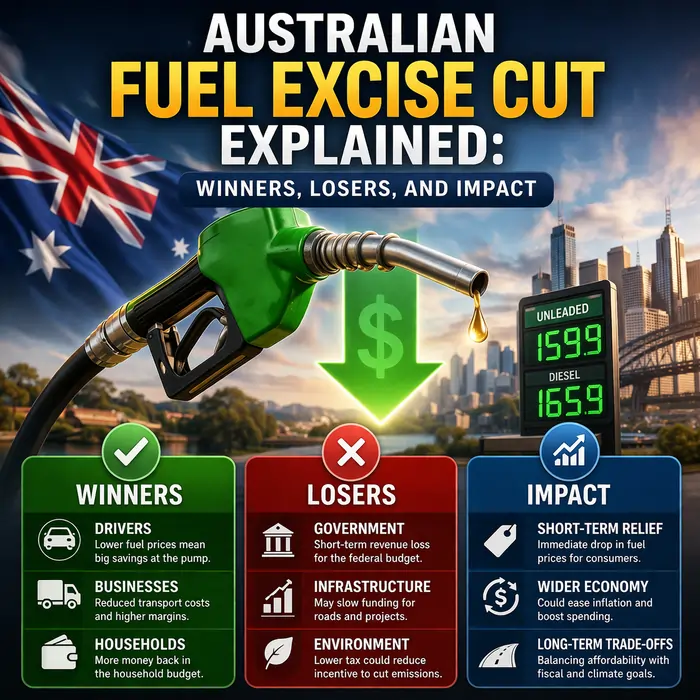
Australia’s decision to temporarily slash the fuel tax has made the Australian Fuel Excise Cut one of the most closely watched cost‑of‑living measures in years. The cut delivers real but uneven savings at the bowser, while raising longer‑term questions about inflation, the federal budget, and Australia’s climate commitments.
What Is the Australian Fuel Excise?
Fuel excise is a federal tax charged on every litre of petrol and diesel sold in Australia. It is a volume‑based tax (cents per litre), not a percentage of the pump price, which means the tax itself does not automatically change when global oil prices move up or down.
The Australian Automobile Association offers a clear breakdown of how the tax works and what it funds in its explainer on fuel excise in Australia. In short:
- The standard fuel excise rate (before the current cut) is set in cents per litre and is indexed twice a year to inflation.
- The tax is levied on fuel producers and importers, but it is built into the final price paid by motorists.
- Revenue from fuel excise goes into general government coffers and helps fund a wide range of services and infrastructure, rather than being hypothecated to roads only.
For a deeper structural view, the Parliamentary Budget Office provides a useful overview of fuel taxation in Australia, covering excise, indexation, and fuel tax credits.
What Is the Australian Fuel Excise Cut?
The current Australian Fuel Excise Cut halves the petrol and diesel excise rate for a limited period to deliver immediate relief from soaring prices. Practically, that means:
- A reduction of 26.3 cents per litre for petrol and diesel over a three‑month window.
- A temporary reduction of the heavy‑vehicle road user charge to zero, aimed at lowering trucking and freight costs.
- A total budget impact in the billions of dollars, as the government forgoes excise revenue over the cut period.
The federal government’s own fuel excise relief fact sheet sets out the headline details, including the timing of the cut, the cents‑per‑litre change, and the interaction with heavy‑vehicle charges and fuel tax credits.
Media explainers have unpacked what this means at the pump. ABC News has a practical guide on when petrol and diesel prices will drop with the fuel excise halved, while SBS asks whether the fuel excise cut could actually drive up inflation over the medium term.
Why Was the Fuel Excise Cut Introduced?
The Australian Fuel Excise Cut is a response to an acute fuel‑price shock layered on top of an already severe cost‑of‑living crisis. Motorists have faced bowser prices around or above record highs, with global oil market turmoil pushing up the cost of crude and refined products while domestic supply chains remain under pressure.
News outlets have documented the political and economic pressures culminating in the decision:
- SBS explains how the government moved to halve fuel excise amid concerns about inflation and household budgets in its analysis of the fuel excise cut and inflation risk.
- ABC’s coverage of when fuel prices will drop highlights the link between global price spikes, local bowsers, and political pressure.
In short, the cut is meant to:
- Provide quick, visible relief to motorists and businesses.
- Ease pressure on inflation indicators in the short term.
- Buy time while broader fuel security and energy strategies are developed.
How Much Will Households Actually Save?
On paper, the Australian Fuel Excise Cut is straightforward: fuel excise is reduced by 26.3 cents per litre, which should be passed straight through to pump prices. In practice, the actual savings depend on how much you drive, where you live, and how quickly local service stations pass on the full reduction.
Government figures and media analysis show:
- A typical 65‑litre tank should be around 17–19 dollars cheaper while the cut is in place, assuming the full 26.3‑cent saving is passed through.
- A driver filling a 55‑litre tank weekly could save roughly 13–15 dollars per week.
- Households that drive long distances, own multiple vehicles, or live in regional areas will see larger cumulative savings over the three‑month period.
ABC’s explainer on fuel prices after the excise cut notes that:
- Prices at individual servos may take days to fall as they sell through pre‑cut stock.
- Wholesale price moves can either amplify or dilute the benefit of the cut.
Meanwhile, The Conversation cautions in its article on what the fuel excise cut will actually save you that headline savings figures often overstate the benefit for typical motorists, once driving patterns and retailer behaviour are taken into account.
Who Wins From the Australian Fuel Excise Cut?
The Australian Fuel Excise Cut does not benefit everyone equally. The biggest winners are those who consume the most taxable fuel and are most exposed to volatility in retail prices.
1. High‑Mileage Commuters and Regional Drivers
Drivers who rely heavily on private vehicles for work, especially in outer‑suburban and regional areas with limited public transport, enjoy the largest weekly savings.
- Long‑distance commuters filling up once or twice a week will see material cost reductions for the life of the cut.
- Households in car‑dependent areas, where public transport is sparse or unreliable, get more relief than inner‑city households with multiple transport options.
Because the benefit scales with litres purchased, larger, less fuel‑efficient vehicles gain more in absolute dollar terms per tank than small, efficient cars.
2. Trucking, Freight, and Logistics
Heavy‑vehicle operators, freight companies, and logistics businesses are significant winners under the Australian Fuel Excise Cut, particularly given the interaction with fuel tax credits and the road user charge.
Grant Thornton’s client alert on fuel excise halved and fuel tax credit implications breaks this down:
- Light vehicles and heavy vehicles not using public roads effectively benefit by 26.3 cents per litre.
- Heavy vehicles using public roads gain around 32.4 cents per litre, given the temporary reduction in the road user charge.
This relief helps restrain cost increases for freight‑intensive sectors, from supermarket supply chains to construction and agriculture.
3. Fuel‑Intensive Small and Medium Businesses
Businesses that pay net fuel excise (i.e., those not fully offset by fuel tax credits) also benefit from lower operating costs. These include many trades, couriers, tourism operators, and small fleets.
The same Grant Thornton note on fuel tax credit changes highlights the importance of correctly adjusting accounting systems to reflect:
- Reduced excise outgoings.
- Changes in claimable fuel tax credits across different vehicle types and uses.
For cash‑constrained SMEs, this can act like a temporary operating subsidy at a time of elevated input costs.
Who Misses Out or Loses?
While the Australian Fuel Excise Cut helps many, some groups either gain little or may be worse off once flow‑on effects are considered.
1. Non‑Drivers and Low‑Car Users
Households that rely primarily on public transport, walking, or cycling receive little direct benefit from lower fuel excise, yet they still share the fiscal cost of the policy through reduced government revenue.
- Inner‑city residents who seldom drive, or households without a car, see only modest indirect gains via potentially lower freight costs.
- Because high‑income households tend to drive more and own larger cars, broad fuel excise cuts skew benefits toward higher earners.
This distributional concern is a core critique in The Conversation’s piece arguing that halving the fuel excise is smart politics but flawed policy.
2. Future Taxpayers and Public Services
Fuel excise raises billions of dollars annually. A multi‑month Australian Fuel Excise Cut costs the federal budget several billion, money that must be financed by more borrowing, higher future taxes, or spending cuts elsewhere.
The Parliamentary Budget Office’s analysis of fuel taxation makes clear that excise is a significant revenue source. Forgoing it can:
- Crowd out investment in infrastructure, health, education, or disaster resilience.
- Reduce fiscal space for future downturns or emergencies.
A Victoria University analysis on slashing fuel tax and economic performance concluded previous cuts were mainly ineffective at boosting the economy, while adding to long‑run fiscal pressures.
3. Climate and Clean Transport Goals
Environmental and energy‑policy experts warn that repeated fuel excise holidays are fundamentally at odds with Australia’s emissions‑reduction goals.
The Conversation’s article on cutting fuel excise as a “sugar hit” and its related piece on dependence on imported fuel and the need for long‑term planning argue that:
- Cheaper petrol and diesel encourage higher consumption and delay efficiency improvements.
- Excise cuts undermine incentives to invest in electric vehicles, public transport, and active transport infrastructure.
- Australia’s reliance on imported fossil fuels becomes more entrenched, leaving the economy exposed to future price shocks.
In short, climate and energy security are among the less visible losers from the Australian Fuel Excise Cut.
Economic Impact: Inflation, Growth, and Jobs
Short‑Term Inflation Relief
Temporarily halving fuel excise lowers measured fuel prices and therefore headline inflation, at least for as long as the cut is in place.
- Lower bowser prices slow the rise in CPI, which can reduce immediate pressure on interest rates.
- Households feel some relief in weekly budgets, especially those with long commutes or fuel‑intensive work.
SBS’s analysis of the fuel excise cut and inflation points out, however, that:
- The cut is temporary, so inflation may rise again when excise snaps back.
- If the measure stimulates demand or encourages higher fuel use, it could add to inflationary pressures elsewhere in the economy.
Longer‑Term Growth Effects
Evidence from prior episodes suggests that cutting fuel excise is a blunt macroeconomic tool. The Victoria University study on fuel tax cuts and the economy found that:
- Slashing fuel tax was mostly ineffective at boosting output.
- There were signs of slightly higher unemployment and weaker consumption than expected under more targeted support.
In other words, while the Australian Fuel Excise Cut is highly visible, it is not necessarily the most efficient way to sustain economic growth compared with targeted transfers, investments, or structural reforms.
Environmental and Climate Implications
From a climate perspective, the Australian Fuel Excise Cut acts like a short‑term subsidy for fossil fuels. Cheaper fuel tends to increase driving and slow the shift towards cleaner transport options.
The Conversation’s commentary on fuel excise as a political sugar hit and the need to reduce fuel import dependence highlights several concerns:
- It undermines price signals that would otherwise encourage more efficient vehicles and reduced car use.
- It delays investment in electric vehicles, battery charging infrastructure, and freight rail.
- It risks locking in higher transport emissions, complicating Australia’s pathway to meeting its climate targets.
These critiques do not deny the cost‑of‑living pressures motorists face; instead, they argue for relief measures that are compatible with long‑term decarbonisation.
Lessons From Previous Fuel Excise Cuts
Australia has been here before. During earlier fuel‑price spikes, federal governments have used temporary excise cuts to ease pressure on households.
The combination of academic research and policy analysis—such as Victoria University’s findings on ineffective fuel‑tax cuts and The Conversation’s series on halving the fuel excise and cutting excise as a sugar hit—suggests that:
- Temporary cuts are politically popular but very hard to unwind if prices remain high.
- Benefits are skewed toward higher‑income, high‑mileage drivers and heavy‑vehicle operators.
- Fiscal and climate costs accumulate if “temporary” measures are repeated in successive crises.
These lessons are crucial for assessing whether the current Australian Fuel Excise Cut should be extended, repeated, or replaced with more targeted policies.
Policy Alternatives to Broad Fuel Excise Cuts
Many economists and policy experts argue that there are better ways to protect vulnerable households and businesses than across‑the‑board excise cuts.
Alternatives commonly proposed in analysis pieces such as The Conversation’s articles on fuel excise and long‑term planning include:
- Targeted cash or energy rebates for low‑income households rather than subsidies for all fuel consumption.
- Investment in public and active transport, especially in outer suburbs and regional areas, to give people realistic alternatives to driving.
- Support for cleaner transport options, including electric‑vehicle incentives, charging networks, and freight rail upgrades.
- Structural reforms to fuel security, such as diversifying supply, encouraging efficiency, and reducing dependence on imported fossil fuels.
These policies lack the instant visibility of cheaper fuel overnight, but they can deliver more durable relief, improve resilience, and align with climate targets.
What Happens When the Fuel Excise Cut Ends?
The end of the Australian Fuel Excise Cut is just as important as its introduction. When excise returns to its full rate:
- Pump prices are likely to jump by something close to the 26.3‑cent‑per‑litre reduction, unless offset by falls in global oil prices.
- Households and small businesses may feel a sharp shock, especially if broader cost‑of‑living pressures remain intense.
- Political pressure to extend or reinstate cuts could re‑emerge, creating uncertainty for investors and fiscal planners.
The experience described in earlier analyses—such as the ABC’s coverage of post‑cut fuel prices and Victoria University’s work on fuel‑tax cuts and the economy—suggests that clear communication and a credible exit strategy are essential to avoid confusion and panic behaviour at the bowser.
Conclusion
The Australian Fuel Excise Cut delivers short‑term relief at the bowser, but its longer‑term impacts on the budget, inequality, and climate policy mean it should be seen as a temporary sugar hit rather than a structural solution. For policymakers, motorists, and businesses alike, the bigger challenge is designing a transport and energy system that is less exposed to volatile global fuel markets and more aligned with Australia’s emissions‑reduction goals.
As Australians think beyond immediate cost‑of‑living pressures and start planning for financial security in later life, it is just as important to understand how retirement savings are tracking. For a deeper look at how your super is performing against industry standards, you can read 9 Key Facts About Superannuation Benchmarks for Australian Retirees, which explains how superannuation benchmarks work and why they matter for long‑term retirement outcomes.
Frequently Asked Questions About the Australian Fuel Excise Cut
What is the Australian Fuel Excise Cut?
The Australian Fuel Excise Cut is a temporary reduction in the federal tax on petrol and diesel, introduced to lower fuel prices during periods of high cost-of-living pressure.
How much has the fuel excise been cut?
The excise has been reduced by 26.3 cents per litre, meaning fuel prices should drop by roughly the same amount if fully passed on.
How much will I save per tank?
Savings depend on tank size:
- 50-litre tank: about $13 savings
- 65-litre tank: around $17–$19 savings
When will prices drop at the bowser?
Prices typically fall within a few days, but delays can happen as stations sell older, higher-tax fuel stock first.
Do all fuel companies pass on the full cut?
Not strictly enforced, but competition and public pressure push retailers to pass on most or all of the savings.
Does the cut apply to all fuel types?
It mainly applies to petrol and diesel subject to excise, while premium or specialty fuels may vary.
Who benefits the most?
- High-mileage drivers
- Freight and transport businesses
- Regional commuters
These groups see the largest cumulative savings.
Who benefits the least?
- Non-drivers
- Public transport users
- Low-car households
They share the cost via taxes but gain little direct benefit.
How does it affect inflation?
In the short term, it reduces inflation by lowering fuel costs, but prices may rise again once the cut ends.
What is the impact on the federal budget?
The policy results in billions in lost revenue, which may lead to higher borrowing or future tax adjustments.
Does it help or hurt climate goals?
Generally, it hurts climate efforts by:
- Encouraging more fuel consumption
- Reducing incentives for electric vehicles and efficiency
What happens when the cut ends?
Fuel prices typically jump back up by around 26.3 cents per litre, especially if global oil prices remain high.
Are there better alternatives?
Economists often prefer:
- Targeted financial support (rebates, subsidies)
- Public transport investment
- EV incentives
These are more sustainable long-term solutions.
How should businesses respond?
Businesses should:
- Review fuel expenses and pricing strategies
- Update fuel tax credits
- Plan for long-term efficiency improvements
How does this affect financial planning?
While the cut offers short-term savings, individuals should still focus on long-term financial stability, including retirement planning and managing inflation impacts.