

Axios is a digital news platform built around Smart Brevity—a tight, bullet-driven writing style designed for readers who want to get smarter, faster on politics, business, and tech.
Co-founded in 2016 by former Politico veterans, the Axios News Platform has grown rapidly through email newsletters, niche verticals, and local products, eventually selling a majority stake to Cox Enterprises in a deal valuing the company at about $525 million.
Along the way, it has expanded its editorial approach into a communications business through Axios HQ, influencing how newsrooms, brands, and institutions write for time-poor audiences worldwide.
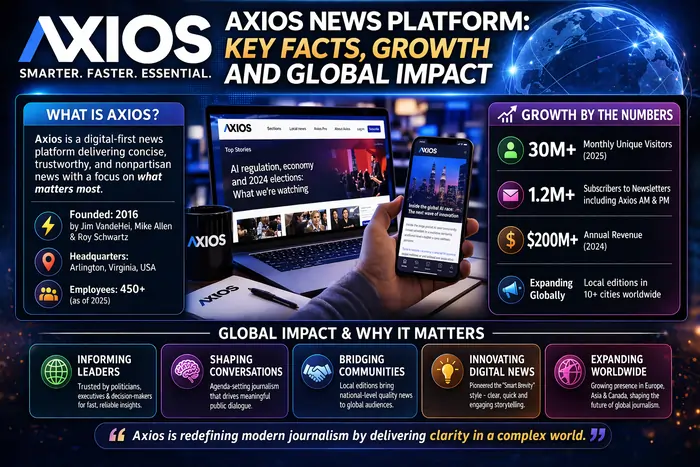
Axios is a US‑based digital news platform known for its “Smart Brevity” style—short, structured articles designed to make busy readers “smarter, faster” about politics, business, tech, and more. Since launching in 2017, Axios has become one of the fastest‑growing news brands in the US, expanded into local and B2B products, sold a majority stake to Cox Enterprises in a deal valuing the company at about 525 million dollars, and spun out its Smart Brevity system into a separate SaaS communications tool.
What Is the Axios News Platform?
The Platform is a digital news organisation headquartered in Arlington, Virginia, built around a distinctive, minimalist presentation of news and analysis. The name “Axios” comes from the Greek word for “worthy,” reflecting its mission to deliver only news that is worthy of readers’ time and attention.
The core News Platform lives at Axios.com, where readers find national coverage of US politics, business, tech, health, climate, media, sports, world affairs, and more, written in a tight, mobile‑friendly format. The Platform generates a large share of its engagement through free email newsletters, which apply the same Smart Brevity structure directly in subscribers’ inboxes.
For a concise background on the company, the Wikipedia entry on Axios (website) and profiles like the Preqin overview of Axios Media Inc. are useful starting points.
Founding Story and Mission
The Platform was founded in 2016 by former Politico leaders Jim VandeHei, Mike Allen, and Roy Schwartz, who launched the site publicly in January 2017. After building Politico into a power‑house in political journalism, they believed the next wave of digital media would favour shorter, cleaner formats tuned to overwhelmed audiences who live on notifications and feeds.
From the outset, The Platform mission has been to create “the cleanest, smartest, most efficient and trustworthy experience for audiences to understand the news.” Internal data the founders cite suggested that most readers abandon articles after a few hundred words, which led them to design pieces that are typically 250–500 words, structured with bold signposts and bullet points.
This “journalism engineered for attention scarcity” is one reason the News Platform has stood out in a crowded market and become a template other publishers now emulate.
Smart Brevity: How Axios Reinvented Text‑Based News
The hallmark of the Platform is its trademarked Smart Brevity writing style. Rather than long narrative features, Axios favours:
- A sharp, one‑sentence “Why it matters” or lede.
- Short paragraphs with bolded phrases as structural signposts.
- Bullet points for key facts, numbers, and takeaways.
- Minimal jargon, dense data distilled into plain language.
World Press Institute and journalism trade coverage describe Smart Brevity as a deliberate response to mobile news habits, where readers glance at headlines between dozens of daily notifications and rarely stay with any one article for more than half a minute. Research cited by The Platform co‑founder Roy Schwartz suggests that as many as 80 percent of readers abandon a typical article after roughly 350 words, reinforcing the case for ultra‑concise formats.
You can see Smart Brevity in action across the Axios news site and in their newsletters, which have become a morning ritual for thousands of readers who want a quick, trustworthy scan of what matters. For a deeper look at Smart Brevity as a method, pieces like Journalism.co.uk’s explainer on how Axios uses smart brevity and the World Press Institute’s “Smart brevity, big impact” article are helpful.
Business Model and Revenue Streams
From the start, The Platforms was built with a clear commercial model rather than chasing undifferentiated scale. Key revenue streams for the The Platform News have included:
- Native and display advertising, especially short‑form sponsored content aligned with newsletters and topic verticals.
- Branded newsletters and sponsorships targeting high‑value audiences in politics, business, tech, and healthcare.
- Premium subscription products such as Axios Pro, which offer deeper, niche coverage for investors and industry professionals.
- Licensing and SaaS revenue from Axios HQ, the Smart Brevity‑as‑a‑service platform for corporate and institutional communications.
By 2017 The Platform had already raised around 30 million dollars in venture funding and was on track to surpass 10 million dollars in revenue in its first seven months. Later reporting from Digiday showed The Platform nearing 86 million dollars in annual revenue by 2022, growing about 40 percent year‑over‑year while remaining profitable for multiple years.
Analyses like Vizologi’s Axios business model canvas break down how tightly the editorial product and commercial strategy are aligned around concise, high‑value information for busy professionals.
Growth Trajectory and the Cox Enterprises Deal
Axios’ growth story is one of rapid brand recognition, product expansion, and eventually a major strategic sale. After launching with a focus on Washington politics, business, and tech, the The Platform news quickly expanded into:
- Dedicated verticals for media, healthcare, science, climate, and more.
- High‑profile newsletters written by well‑known journalists and subject‑matter specialists.
- Axios Local, a network of city‑focused newsletters delivering quick‑hit local news in dozens of US markets.
In December 2020, The Platform acquired the Charlotte Agenda to accelerate its local arm, which later evolved into The Platform Local—a network that reached nearly 30 markets and generated about 8.6 million dollars in revenue in 2022. While expansion later slowed to consolidate readership and monetisation, The Platform Local became an important proof‑of‑concept for concise local news delivered via email.
The biggest milestone in the company’s growth came in 2022, when media conglomerate Cox Enterprises agreed to acquire The Platform in a deal valuing the company at roughly 525 million dollars. Coverage in outlets like Observer and Adweek notes that the sale price was around five times Axios’ projected 2022 revenue of over 100 million dollars, a rich multiple relative to many digital peers.
Articles such as “4 key takeaways from the Axios acquisition” and Progress Partners’ briefing on what the Axios sale says about digital media valuations argue that the premium reflected Axios’ strong brand, profitable growth, and diversified revenue beyond standard display ads.
Axios HQ: Smart Brevity as a SaaS Product
One of the most interesting offshoots of the News Platform is HQ, a software‑as‑a‑service tool that helps organisations apply Smart Brevity to internal and external communications. The product emerged when multiple corporations approached The Platform asking for help to make their email updates and memos as clear and concise as The Platform newsletters.
Axios HQ now positions itself as a communications platform that uses Smart Brevity templates and AI‑assisted editing to help teams write shorter, more impactful updates for employees, customers, and stakeholders. According to reporting in Forbes, Axios HQ uses machine learning to analyse long documents and suggest distilled, Smart Brevity‑style versions, akin to how Grammarly applies AI to grammar and style.
The Axios HQ about page at AxiosHQ.com explains that the product “started in a newsroom” and is now used by hundreds of clients who want to cut through noise in corporate communications. This SaaS extension underscores how The Platform has turned its editorial format into a broader content‑strategy and communications business.
Audience, Reach and Engagement

The Platform primarily targets time‑poor professionals who want high‑signal news in minimal time. Profiles on sites like ZoomInfo describe Axios as “one of the fastest‑growing news organisations in the United States,” thanks to a mix of exclusive scoops and highly shareable newsletter content.
Key audience and engagement dynamics include:
- Heavy newsletter consumption: The Platform’ flagship newsletters—such as AM rundowns of US politics or markets—are read by influential audiences in government, corporate leadership, and media.
- Strong social citation: Because of its short, quotable “Why it matters” lines and structured bullets, Axios copy is often cited or referenced by other outlets and on social platforms.
- Mobile‑centric design: The site and emails are optimised for quick reading on phones, aligning with the reality that many readers scroll and swipe between meetings or commutes.
While detailed proprietary analytics aren’t public, the company’s sustained revenue growth and valuation suggest robust engagement among its target demographics. The University of Maryland’s profile of co‑founder Roy Schwartz highlights how carefully The Platform calibrated article length and bullet structure to match observed reader behaviour.
Editorial Approach and Global Impact
Axios’ editorial brand is built on three pillars: speed, clarity, and context. Reporters are encouraged to focus on what’s new, why it matters, and what comes next, rather than lengthy narrative scene‑setting. This has influenced how other outlets structure newsletters and live‑blog coverage, especially around politics and policy.
Internationally, the News Platform has had outsized impact considering its relatively lean newsroom compared to legacy giants:
- Its political scoops and bullet‑point breakdowns are frequently referenced by global wire services and broadcasters seeking quick summaries of complex US developments.
- The Smart Brevity style has inspired newsroom training and format experiments in Europe and beyond, as noted in articles like “Smart brevity, big impact: A lesson from Axios”.
- The company’s expansion into world, climate, and science coverage gives international audiences fast, context‑rich snapshots of issues ranging from wars to pandemics to AI regulation.
From a media‑industry perspective, The Platform is often cited as a leading example of newsletter‑centric growth, alongside brands like Morning Brew and TheSkimm. Its success has reinforced the idea that focused, email‑first products can sustain significant ad and subscription revenue in an era of platform volatility.
Critiques and Limitations
Despite its successes, The Platform has also faced critiques and constraints. Some observers worry that extreme brevity can oversimplify complex issues, potentially leading readers to underestimate nuance or uncertainty. Others note that Smart Brevity is better suited to incremental updates and explainer‑style coverage than to deeply reported narrative investigations.
The Platform has responded by combining its short formats with links to deeper documents, data, and external sources, and by occasionally publishing longer‑form work when warranted. Still, its core promise is to save time rather than to replace long‑form journalism entirely.
On the business side, The Platform Local’s decision to pause expansion after missing some revenue targets highlights the challenges of monetising local news, even with an efficient format. Adweek’s reporting on Axios Local’s slowed expansion points out that even strong newsletter engagement must be matched with sustainable local advertising and sponsorship markets.
Future Directions for Axios
Looking ahead, The Platform under Cox Enterprises ownership is positioned to continue expanding selectively while deepening existing franchises. Likely priorities include:
- Growing The Platform Local audiences and revenue in the markets where it already operates, rather than a land‑grab into new cities.
- Scaling The Platform Pro and other specialised B2B products aimed at investors and industry insiders.
- Investing further in Axios HQ and Smart Brevity tools that leverage AI to help organisations communicate more clearly.
- More global‑facing coverage as US politics, tech regulation, climate policy, and conflicts continue to have worldwide implications.
Cox has said it intends to let The Platform operate with editorial independence while providing capital and infrastructure to support long‑term growth, similar to its approach with other media investments. This suggests the News Platform will remain a distinct brand rather than being folded into a larger conglomerate identity.
Conclusion
The News Platform shows how a clear editorial mission, distinctive writing system, and disciplined business strategy can still create real value in a crowded digital news ecosystem. By pairing Smart Brevity with newsletters, niche verticals, and SaaS‑driven communications tools, Axios has carved out a durable role in how professionals around the world consume and share information.
At the same time, Axios’ story is just one example of how media and technology are constantly reshaping what audiences expect, how companies communicate, and how information spreads online. For a glimpse of how fast digital culture can react when major stories break, you can look at 13 Nintendo Leaks That Just Broke the Internet, which captures how a single wave of leaks can dominate feeds, spawn memes, and shift industry speculation overnight.
FAQs About the Axios News Platform
What is Axios?
Axios is a US-based digital news organisation delivering concise, structured coverage of politics, business, tech, and more through its website and email newsletters.
Who founded Axios and when?
Axios was founded in 2016 and launched in 2017 by Jim VandeHei, Mike Allen, and Roy Schwartz, former Politico leaders.
What does “Axios” mean?
The name comes from the Greek word “axios,” meaning “worthy,” reflecting its mission to deliver news worth readers’ time.
What is Smart Brevity?
Smart Brevity is Axios’ trademark writing style using short paragraphs, bold cues, and bullet points to deliver key insights quickly.
What topics does Axios cover?
Axios covers politics, business, technology, health, science, climate, media, sports, and local news verticals.
How does The Platform make money?
Revenue comes from advertising, sponsorships, premium newsletters (Axios Pro), and SaaS tools like Axios HQ.
What is Axios Local?
Axios Local is a network of city-focused newsletters providing concise local news across multiple US markets.
What is Axios HQ?
Axios HQ is a SaaS platform that helps organisations create clear, concise communication using Smart Brevity and AI tools.
Who owns Axios now?
A majority stake in Axios was acquired by Cox Enterprises in 2022, valuing the company at around $525 million.
How big is Axios’ audience?
Axios is considered one of the fastest-growing news platforms, with strong newsletter readership among business and political audiences.
Why is Axios influential?
It frequently breaks major stories first and delivers easy-to-digest insights widely used by media and professionals.
Does Smart Brevity replace long-form journalism?
No—it’s a complementary format, offering quick insights while linking to deeper reporting and data.
Has Axios faced criticism?
Yes—some argue brevity can oversimplify complex issues, and scaling local news remains challenging.
Where can I learn more about Axios’ strategy?
Resources like “Smart Brevity, Big Impact”, Journalism.co.uk, and Forbes analyses explain its editorial and business model.
How does The Platform fit into digital disruption?
Axios shows how modern media brands succeed by combining email-first distribution, efficient formats, and aligned business models in a rapidly changing digital landscape.