


NASA Satellite Crashing: When you see a “NASA satellite crash alert” in the news, it can sound like something straight out of a disaster movie. In reality, almost all of the satellite burns up high in the atmosphere, and the risk to anyone on the ground is extremely small. In this guide, we’ll break down what actually happens when a NASA satellite falls back to Earth, why space agencies allow “uncontrolled” reentries, what the real risks are, and how you can use trusted external resources to keep yourself informed.
Just as Australian investors track global risk events like satellite reentries alongside financial indicators on platforms such as Forex Factory, understanding the real science behind these alerts can help you separate signal from noise in both markets and media.
What a “NASA Satellite Crash Alert” Really Means
When headlines say a “NASA satellite is about to crash back to Earth,” they are usually referring to an uncontrolled reentry of an old spacecraft that has reached the end of its useful life. The term “uncontrolled” simply means mission teams no longer have the ability to steer the spacecraft precisely with its engines — not that it’s plunging directly toward a city.
A recent example is NASA’s Van Allen Probe A, a roughly 600‑kilogram (about 1,300‑pound) spacecraft launched in 2012 to study Earth’s radiation belts. After nearly 14 years in space, it finally re‑entered Earth’s atmosphere and broke apart, as confirmed in NASA’s own update: NASA’s Van Allen Probe A Re‑Entered Atmosphere.
News outlets such as NBC explained that while the reentry was “uncontrolled,” the risk to the public was still considered low, with NASA estimating about a 1‑in‑4,200 chance that any debris could injure someone, as reported in NBC’s coverage of the NASA satellite reentry. That’s a higher risk than NASA’s usual guideline, but still very small when spread over billions of people.
For a readable, news‑style breakdown of the event and its danger level, you can also check USA Today’s explainer on the Van Allen satellite crash and BBC’s report on the 1,300‑lb spacecraft reentry.
NASA Satellite Crashing: Why Satellites Fall Back to Earth
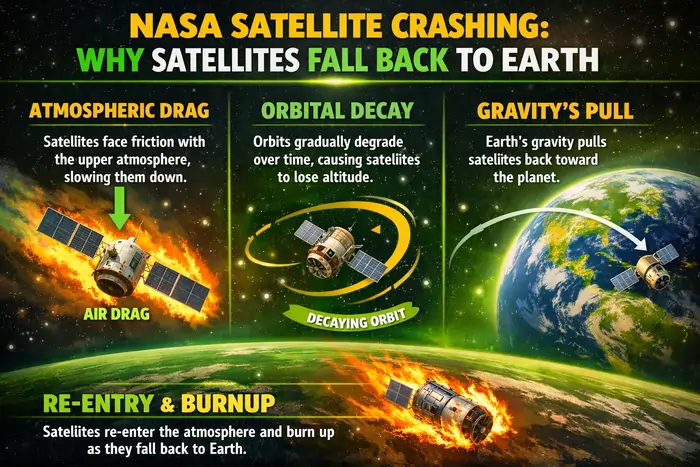
Satellites don’t stay in orbit forever. Over time, several physical processes slowly lower their orbits until reentry becomes inevitable.
Key reasons satellites come down
- Atmospheric drag
Even hundreds of kilometers above the surface, there are still faint traces of Earth’s atmosphere. These molecules exert drag on an orbiting satellite, gradually slowing it down and causing its orbit to decay. During periods of high solar activity, the upper atmosphere expands and becomes denser, increasing drag and speeding up orbital decay. This is why the Van Allen Probe A fell earlier than originally expected, a point described in more detail in this CNET overview of the 1,300‑pound NASA satellite’s return. - Gravity and orbital perturbations
Earth is not a perfectly uniform sphere. Small variations in its gravity field, along with gravitational pulls from the Moon and Sun, can slowly alter satellite orbits over the years. Combined with drag, these effects eventually bring many satellites down. - End‑of‑mission fuel limits
Once a satellite runs out of fuel or its systems are no longer reliable, ground teams cannot boost it into a higher “graveyard” orbit or steer it into a controlled descent. Many older satellites were designed knowing they would eventually reenter naturally due to drag, within a timeframe considered acceptable under debris‑mitigation guidelines such as the UNOOSA Space Debris Mitigation Guidelines.
For a more technical explanation of these processes and the long‑term strategy behind allowing some spacecraft to reenter, you can refer to the U.S. government’s National Orbital Debris Implementation Plan (PDF).
Controlled vs Uncontrolled Reentry
Not all reentries are handled the same way. Space agencies choose between controlled and uncontrolled reentry based on a spacecraft’s size, design, orbit, and remaining fuel.
Controlled reentry
A controlled reentry happens when mission teams intentionally fire a spacecraft’s engines to guide it into a remote part of the ocean, usually a designated “spacecraft cemetery” in the South Pacific, far from air traffic and shipping lanes.
Controlled reentries:
- Require enough fuel and functioning systems to perform a precise deorbit burn.
- Allow agencies to choose when and where breakup occurs.
- Are typically reserved for large vehicles that would pose a higher risk if left to fall at random.
The European Space Agency (ESA) has performed multiple controlled reentries of its cargo vessels and documents its approach in detail on its Reentry and collision avoidance page.
Uncontrolled reentry
An uncontrolled reentry occurs when the spacecraft can no longer be steered — often because it has no fuel left or its systems are shut down. Gravity and drag then determine the reentry time and location, within a predicted window.
Uncontrolled reentries:
- Are common for defunct satellites and upper rocket stages.
- Still involve careful tracking and modeling by agencies such as NASA and the U.S. Space Force.
- Usually pose very low risk because most of the mass burns up and Earth is mostly ocean.
NBC’s article on the Van Allen Probe A highlights how such reentries are tracked and how risk is communicated in practical terms: NASA satellite to fall back to Earth, with a small risk of debris.
What Actually Happens During Reentry
As a satellite falls into denser layers of the atmosphere, it experiences extreme heating and stress that lead to breakup. This process is sometimes called “demise.”
Step‑by‑step breakup
- Initial contact with denser air
Once the spacecraft drops below roughly 120 kilometers altitude, atmospheric density rises sharply. Friction with air molecules converts orbital energy into heat, and the gas around the satellite becomes a glowing plasma. - Heating, melting, and ablation
External structures such as solar panels, antennas, and light aluminum components heat up, melt, and vaporize. Parts break away and burn out. The spacecraft begins to fragment. - Structural breakup
At altitudes of around 70–80 kilometers, many satellites break apart into multiple pieces due to combined thermal and mechanical stress. Internal components made of higher‑melting‑point materials (like titanium propellant tanks) may survive longer. - Surviving fragments
Only a fraction of the original mass reaches the ground, often in the form of scattered fragments along the ground track. ESA’s analysis, summarized in its reentry and collision avoidance overview, explains how engineers estimate the “survival fraction” and design spacecraft to break up more completely (design‑for‑demise).
For a more popular‑science angle, Firstpost’s piece on the Van Allen satellite breaks down what might survive and what that means for people on the ground: What happens if 600‑kg NASA satellite crashes into Earth.
Case Study: Van Allen Probe A
The Van Allen Probes mission, launched in 2012, involved two identical spacecraft sent to study Earth’s radiation belts — zones where high‑energy particles are trapped by the planet’s magnetic field. Their data reshaped scientists’ understanding of space weather and its impact on satellites and astronauts. A concise, layperson‑friendly recap of the mission and its end can be found in this People.com feature on the NASA satellite burning up after its radiation study.
Mission timeline and reentry
- Mission operations
Both probes operated successfully for years, returning invaluable data on the structure and dynamics of the radiation belts. - End of mission
Fuel was deliberately used up to place the probes in orbits that would eventually decay, in line with debris‑mitigation guidelines. Operations ended in 2019. - Earlier‑than‑expected reentry
Models initially predicted that Van Allen Probe A would reenter around the early 2030s, but stronger‑than‑expected solar activity increased atmospheric drag and hastened its fall. - Final plunge
In early March 2026, the probe made an uncontrolled reentry, burning up over the eastern Pacific. NASA confirmed the event in its official note, which you can read at NASA’s Van Allen Probe A Re‑Entered Atmosphere.
Multiple outlets covered the event, including CBS News’ report on the 1,300‑pound NASA satellite re‑entry and LiveNOW from FOX’s explainer on Van Allen Probe A’s crash back to Earth, all emphasizing that no harm was reported on the ground.
How NASA Assesses and Limits Risk
NASA does not permit satellites to reenter without assessing the risk. It operates under strict safety standards and international norms.
NASA’s casualty risk threshold
NASA’s reentry policy typically sets a maximum acceptable global casualty risk (the probability that any person will be injured by falling debris) of 1 in 10,000 for an uncontrolled reentry. This threshold and its rationale are discussed in detail in the National Academies’ chapter on Hazards Posed by Reentry of Orbital Debris.
If analysis shows the risk will exceed that 1‑in‑10,000 guideline, mission designers are expected to:
- Adjust design to ensure more complete breakup (design‑for‑demise).
- Use controlled reentry if possible.
- Modify operational plans to lower risk.
In rare cases, NASA can grant waivers when other factors make changes impractical, while still concluding that the absolute risk remains very low compared with everyday risks people face.
Modeling tools and data
To understand how a satellite will break up and where fragments might land, NASA uses quantitative models and software, including:
- Debris Assessment Software (DAS) – a tool provided publicly to help estimate compliance with debris‑mitigation standards.
- Object Reentry Survival Analysis Tool (ORSAT) – an internal NASA tool for detailed reentry analysis.
For background on these tools and NASA’s broader orbital‑debris work, see the NASA Orbital Debris Program Office FAQ.
What Are the Real Risks to People?
Despite dramatic headlines, the odds that any individual will be hit by satellite debris are extremely small.
Why the danger is low
- Most of Earth is empty of people
Around 70% of Earth’s surface is covered by ocean. Much of the land area is sparsely populated. This means even surviving fragments almost always fall into the sea or remote regions. - The atmosphere does most of the work
The vast majority of the spacecraft burns up during reentry. Only a fraction of the mass reaches the ground, and that remaining mass is spread out along a long ground track. - Historical record
In over half a century of tracking reentries, there have been very few confirmed cases of debris reaching populated areas and no reliably documented deaths caused by space debris, a point frequently highlighted in the Orbital Debris Program Office’s FAQ.
For example, in the case of Van Allen Probe A, NASA and media outlets such as NBC and USA Today noted that the global casualty risk was about 1 in 4,200 — higher than NASA’s usual guideline, yet still low on an absolute scale. You can see this explained in NBC’s reentry risk article and USA Today’s Q&A on whether the satellite posed any danger.
These kinds of low‑probability, high‑visibility risks are also why Australian taxpayers pay close attention to how public money is allocated to space, defense, and tax policy — something highlighted in recent coverage of changing rules in the ATO alert on major tax changes that could affect millions of Australians.
What You Might See in the Sky
If a satellite reenters over your region and the sky is clear, you might witness a dramatic light show resembling a very slow, breaking meteor.
Typical visual features include:
- A bright streak crossing the sky, often breaking into multiple glowing fragments.
- A visible trail that persists for a few seconds to a minute.
- In rare cases, a rumbling sound or sonic boom if larger fragments pass at relatively low altitudes.
When controlled reentries have been filmed from aircraft, they show a spacecraft breaking into many small glowing pieces over the ocean, as illustrated in some of the examples shared by ESA on its Reentry and collision avoidance page.
What Happens If Debris Reaches the Ground?
On the rare occasions when debris survives all the way to the ground, it is most often found in uninhabited or rural areas.
Characteristics of debris
If parts of a NASA satellite were to land on land:
- Fragments would usually be metal pieces, tanks, brackets, or structural segments, often scorched or partially melted.
- They might be scattered along a long, narrow footprint, following the path of the final orbit.
- Some materials could be sharp, pressurized, or contain traces of hazardous substances.
Space‑law frameworks, including the UN’s debris guidelines and national regulations, generally treat such debris as the property of the launching state. That’s one reason agencies advise against picking up or keeping fragments. The UNOOSA Space Debris Mitigation Guidelines and related documents outline responsibilities for states in managing such events.
If you ever encounter suspected space debris, authorities and agencies like NASA recommend that you:
- Do not touch or move it.
- Keep others away from the object.
- Report it to local emergency services, who can then coordinate with national agencies.
How Agencies Manage Space Debris Long‑Term
The issue of reentering satellites is part of the broader challenge of keeping Earth’s orbits usable and safe in the long run.
Key strategies include:
- Design‑for‑demise
Engineers choose materials and structures that will fully or mostly burn up during reentry, reducing the number and size of surviving fragments. This is highlighted in ESA’s educational material on debris mitigation and reentry, such as its training and requirements documents. - Post‑mission disposal
Satellites are planned with end‑of‑life maneuvers in mind, either to deorbit them within a reasonable timeframe or to move them into higher “graveyard” orbits. These practices are codified in standards like the UNOOSA Space Debris Mitigation Guidelines. - Collision avoidance and automation
Agencies also work on avoiding collisions between satellites and existing debris, which can create more junk and future uncontrolled reentries. ESA’s CREAM project is one example of automated collision avoidance, described in its article CREAM: avoiding collisions in space through automation. - National and international policy
Governments are formalizing debris strategies in documents like the U.S. National Orbital Debris Implementation Plan, which outlines how agencies should coordinate on mitigation, tracking, and reentry management.
Practical Tips: What to Do When You See a Satellite Crash Alert
For most people, a NASA satellite crash alert is more of a curiosity than a personal safety issue. Still, it’s smart to know how to interpret these alerts.
Here’s what you can do:
- Rely on official and reputable sources
Check updates from NASA, ESA, or reputable news outlets rather than viral social media posts. For NASA, look at pages like the Van Allen Probe A reentry update or the Orbital Debris FAQ. For media coverage, outlets such as NBC News, CBS News, and USA Today provide clear explanations. - Understand that risk is global and tiny
When you see numbers like “1 in 4,200” or “1 in 10,000,” remember those apply to the entire global population, not to you personally. Your individual risk is minuscule. - Avoid handling debris
If you ever see an unusual metal object in the aftermath of a known reentry event, don’t touch it. Notify local authorities instead so they can coordinate with national and international agencies in line with guidelines such as those from UNOOSA.
Most of the time, a NASA satellite reentry is an interesting science story, an opportunity to learn about orbital mechanics and debris mitigation, and—if you’re lucky—a chance to witness a spectacular streak of light in the night sky.