

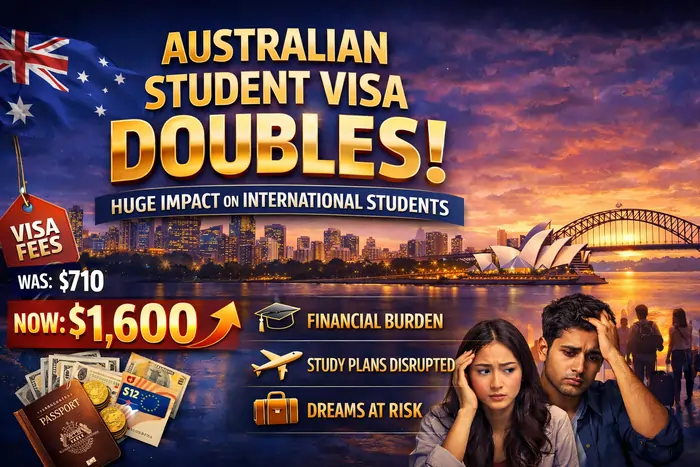
Australia’s decision to dramatically increase student visa fees has reshaped the cost of studying in the country, especially for international students who are carefully budgeting every peso or dollar. In this guide, you will see what changed, why it matters, and how to adapt your plans while using trusted external resources linked directly in the content.
Overview: Australian student visa cost doubles
In recent policy changes, the cost of applying for an Australian student visa has more than doubled compared to previous years, making it one of the most expensive student visas among major study destinations. For many prospective students, this higher upfront cost now sits on top of tuition, living expenses, travel costs, and proof‑of‑funds requirements, turning what was already a big financial decision into an even bigger one.
If you are still at the research stage, start with the official Student visa (subclass 500) page, which outlines who can apply, what this visa allows you to do, and the key conditions you must follow. For a more narrative overview written specifically for prospective students, the Study Australia student visa guide is also a helpful first read.
What changed in the Australian student visa cost
The headline change is the sharp jump in the Visa Application Charge (VAC) for international students. Where students previously paid a significantly lower fee, the new structure has pushed the cost into a higher bracket that many students did not anticipate when they first began planning their study abroad journey.
To understand the current official amounts and any recent updates, always refer to the Student visa (subclass 500) page, which lists the current VAC and notes any indexation or policy changes. Because these figures can shift with new budgets or announcements, relying on secondary blogs or old posts is risky; the official page is your most reliable source.
For a more analytical perspective on how Australia effectively doubled its student visa fees and how that compares with other countries, you can read the article on doubled student visa application fees from an international education research outlet. It explains how Australia’s student visa fee now sits well above typical application fees in competitors like Canada and the United States, and why this move has been controversial in the industry.
Why the fee increase is a big deal for international students
For many international students, the visa application fee is not just another expense; it is a high‑risk, non‑refundable cost. If your application is refused, you don’t get the fee back, and with the new pricing, that loss can be painful.
An in‑depth analysis in the doubled student visa application fees article explores how this higher sunk cost could deter students who feel their chances of approval are not strong enough. Another piece discussing a subsequent policy signal, student visa fee increase analysis, shows that the government has framed these moves as part of a broader plan to reshape migration settings and tighten entry to those considered “genuine” students.
Mainstream coverage like Australia doubles foreign student visa fee also highlights that this decision is not just an education issue but part of a larger strategy to manage migration numbers. That broader context is important when you are planning a long‑term pathway that may include post‑study work or skilled migration.
Financial capacity: the other cost shock
Beyond the application fee itself, Australia has also increased the financial capacity requirements for student visa applicants. This means you need to show more money available to you (or your sponsor) to prove that you can support yourself during your stay.
The article on minimum funds requirement for student visas explains how the benchmark amounts have been raised to align more closely with estimated living costs in Australia. This includes higher amounts for the primary applicant, any spouse or partner, and each dependent child, as well as higher assumed school costs for school‑age children.
To see the numbers broken down clearly by applicant type (student, partner, child) and funding pathway (savings, income, sponsorship), practical guides like student visa financial capacity requirements can be very useful. They take the raw official figures and present them in a way that makes it easier to check whether your current budget is likely to meet the threshold.
Policy logic vs student reality

From the government’s perspective, the increases in both visa fees and financial capacity requirements are often framed as tools to ensure that students are genuinely prepared for study, not using the student visa as a backdoor migration pathway, and less vulnerable to exploitation due to financial stress. Official messaging around this is reinforced in pages like the Genuine Student requirement, which sets out the criteria used to judge whether an applicant is genuinely coming to study.
However, from a student’s point of view, the changes can feel like a double hit: higher upfront fees and stricter financial checks. Articles such as doubled student visa application fees and minimum funds requirement for student visas document how some providers and student advocates worry that genuine but less wealthy students will be squeezed out, especially those from developing countries.
Another perspective is provided by regional coverage like how the visa fee hike affects international students, which focuses on Indian applicants but offers insights that are just as relevant for students from Southeast Asia. It explains, with practical examples, how the combined effect of higher fees and stricter rules can push students toward cheaper or more predictable alternatives.
How this affects your total cost of studying in Australia
When you build a realistic budget for studying in Australia, you need to look beyond tuition and rent. The increased visa fee and higher financial capacity threshold change the profile of your upfront and ongoing costs.
Key components you now have to factor in include:
- The visa application fee, payable at the time of application, based on the current figure listed on the Student visa (subclass 500) page.
- Proof‑of‑funds requirements, as outlined in articles like minimum funds requirement for student visas and detailed in guides such as student visa financial capacity requirements.
- Possible additional costs for any family members included in your application, both in terms of extra VAC and higher required funds.
- Health insurance (Overseas Student Health Cover), flights, initial settlement costs, and emergency funds.
Many students underestimate how big a difference the visa fee jump and higher financial capacity requirement can make to their initial cash‑outlay. Reading analyses like doubled student visa application fees can give you a better sense of the scale of this change and how it compares to the situation just a few years ago.
Planning your application under the new rules
To navigate these changes confidently, you need a structured application plan. This means gathering documents early, verifying all numbers, and making sure your story as a student is consistent and well‑supported.
Start by studying the student visa application steps guide, which outlines what to prepare before you apply, how to create your online account, and how to avoid common mistakes that can lead to refusals or delays. Then, cross‑check your understanding with the visa application process guide from Study Australia, which presents the process in simple language that many students find easier to follow.
As you build your application, pay special attention to the Genuine Student requirement, because meeting this standard is crucial in a tougher screening environment. You should be ready to show that your course choice makes sense for your background, that you understand the costs involved, and that your long‑term plans are realistic.
Because higher fees also mean a higher cost for delays and mistakes, it is worth monitoring visa processing times so you can lodge your application early enough to get your outcome before your intended start date. This can also help you decide when to pay deposits, book flights, or give notice at work.
Impact on destination choice and competition
With the student visa cost now significantly higher, some students are starting to compare Australia more critically to other countries where the visa fee is lower and the financial capacity requirements are more manageable. In the doubled student visa application fees analysis, you can see comparisons between Australian fees and those in Canada, the United States, and other destinations.
The student visa fee increase analysis article suggests that while Australia may lose some price‑sensitive students, it is aiming to attract fewer but more financially secure students. Whether this strategy will succeed in the long term remains to be seen, but as an applicant, you need to decide whether the higher cost is acceptable relative to the quality of education, lifestyle, and post‑study opportunities you expect to receive.
At the same time, external coverage like Australia doubles foreign student visa fee reinforces the public perception that Australia is tightening the tap on international students. This perception alone can influence how your family, sponsors, or agents view your plans and may prompt them to suggest alternative destinations.
Practical tips for students adapting to the higher cost
Despite the higher costs, many students will still choose Australia because of its universities, work opportunities, and quality of life. If you decide that Australia is still your top choice, you can adapt by planning more carefully.
Here are some practical strategies:
- Use the Study Australia student visa guide to understand the full pathway from application to arrival, then list all costs involved.
- Confirm every financial figure in the Australian Student visa (subclass 500) page and cross‑check your savings against both official requirements and the examples in student visa financial capacity requirements.
- Build a buffer above the minimum funds requirement to account for currency fluctuations, unexpected expenses, and delays.
- Stay updated on processing times via visa processing times so that you can apply early and reduce stress.
- If you are applying from the Philippines or have questions specific to your situation, review the Australian Embassy in the Philippines – visas and citizenship page for local instructions and contact details.
Reading multiple perspectives – official pages, analytical reports such as doubled student visa application fees, and practical guides like minimum funds requirement for student visas – will give you a more complete picture and help you decide if this path is right for you.
As Australian student visa costs and financial requirements rise, it becomes even more important to study smarter, not just harder. One useful read for students trying to future‑proof their skills is Education Perfect 2026: The Vital New AI Learning Roadmap, which explores how AI‑powered platforms and data‑driven tools can help you personalise your learning, stay motivated, and get more value from every hour you invest in study.