

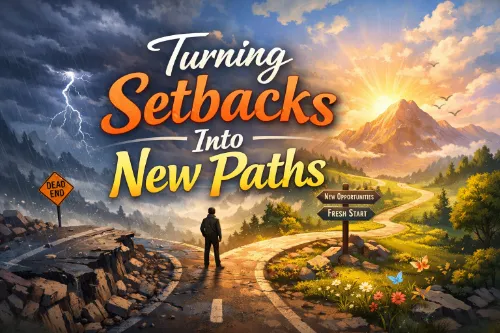
Everyone encounters setbacks—failed projects, layoffs, broken relationships, health scares, or personal crises that shake your identity. While they’re painful, they also contain information: about what matters to you, where your limits are, and which paths might fit you better than the one you were on.
This article explores how to transform setbacks into new paths, drawing on psychology, career research, and real‑world stories, with external resources you can explore for deeper support.
1. Reframe Setbacks as Signals, Not Verdicts
The way you interpret a setback shapes what you do next. A LinkedIn guide, How to Turn Setbacks into Opportunities, suggests starting with a simple reframe: ask “What opportunity might be hidden in this?” rather than “Why did this happen to me?”.
Chevening’s article Turning career setbacks into opportunities points out that sometimes a setback is telling you something—maybe the goal wasn’t the right fit, or it revealed a skill gap that’s worth addressing. Instead of treating failure as a verdict on your worth, you can see it as feedback about direction, skills, or environment.
Motivational speaker Scott Burrows frames it powerfully in Turning Setbacks into Opportunities: The Art of Reinvention: setbacks are catalysts for transformation, not just obstacles to endure.
2. Feel First, Then Analyze What Happened
A common temptation is to “power through” a setback without processing it. But growth requires honesty and emotional acknowledgment.
deVere Destinations’ Turn career setbacks into growth opportunities emphasizes that the first step is to fully acknowledge what happened and allow yourself to experience the emotional impact. Rather than brushing off a failure, they recommend taking time to objectively assess the situation: what factors contributed—external circumstances, skill gaps, or misalignment with your goals?
Similarly, Turning Challenges into Career Opportunities on Jobillico advises calmly reflecting on the problem, admitting where you played a role, and seeing that as a starting point for improvement. Without this honest look, it’s easy to repeat the same patterns.
3. Adopt a Growth Mindset: “Not Yet,” Not “Never”
A growth mindset doesn’t deny difficulty; it just insists that ability and circumstances can change. Makana Partners’ The Growth Mindset in 2025: Adapting Today, Thriving Tomorrow explains that people with a growth mindset see challenges as chances to develop new skills and treat mistakes as learning moments.
Key ideas include:
- Viewing failures as feedback—not as a final judgment.
- Using a “not yet” mindset (“I can’t do this yet”) to stay motivated.
- Focusing on effort, learning habits, and adaptability over innate talent.
Research summarized in Growth Mindset Interventions to Make Failure Desired in Learning shows that when learners reinterpret failure as useful information, they become more persistent and willing to attempt harder tasks. The same applies to careers and life decisions: when you believe you can grow, new paths feel possible.
4. Recognize Post‑Traumatic Growth: When Adversity Changes You for the Better
Sometimes setbacks are more than inconvenient—they’re traumatic: serious illness, loss, divorce, or major upheaval. Psychology research shows that while trauma can certainly harm, it can also catalyze post‑traumatic growth—positive psychological changes like deeper relationships, clearer priorities, and a renewed sense of purpose.
Käte Naess’s article Turning Adversity into Strength: The Power of Posttraumatic Growth explains that adversity can reveal unexpected strengths and possibilities. People often report:
- New possibilities they wouldn’t have considered before.
- More appreciation for life and relationships.
- Stronger inner resilience and confidence.
11th Hour Clinic’s Post-Traumatic Growth: Transforming Adversity into Strength stresses that this isn’t about sugar‑coating pain; it’s about acknowledging both the hurt and the ways struggle can reshape your identity and goals. Recognizing this potential helps you see big setbacks as turning points, not permanent scars.
5. Rebuild Confidence with “Wins” and Support
Setbacks often crush confidence and identity, especially after job loss or public failure. deVere Destinations recommends creating a “win list”—a record of accomplishments, compliments, and successes—to remind yourself of your capabilities when you’re doubting yourself.
Triad Goodwill’s How to Comeback Stronger After a Career Setback argues that setting new goals and taking proactive steps—like upgrading skills, attending networking events, or volunteering on projects aligned with your new direction—helps restore motivation and direction. Small wins compound and rebuild your self‑image.
LinkedIn coach articles like Lost Your Job? Transform Your Career Setback into Strategic Comeback emphasize treating job loss as an opportunity to rebuild with intention, not as proof that you’re “finished.” They suggest updating your resume and LinkedIn, exploring alternatives like consulting or freelancing, and intentionally addressing the “mental game” of rejection.
6. Strengthen Resilience: The Skill of Bouncing Back
Resilience is not an innate trait you either have or lack; it’s a set of habits and perspectives you can cultivate. LinkedIn’s The Art of Resilience – Bouncing Back Stronger From Setbacks outlines steps to become more resilient, starting with reframing negative situations and focusing on what you can improve.
Blue Cross Blue Shield ND’s Rocking resilience: Bouncing back from setbacks to catapult your success describes resilience as the ability to rebound, learn, and adapt—and shows that research links resilience to higher job satisfaction and better health. They recommend:
- Getting connected—building strong, positive relationships.
- Making every day meaningful—doing something purposeful daily.
- Learning from past hardships—reusing strategies that worked before.
- Remaining hopeful—anticipating change and seeing challenges as manageable.
- Taking care of yourself—sleep, movement, nutrition, and stress management.
These practices don’t erase difficulty, but they dramatically improve your ability to navigate it.
7. Turn Career Roadblocks Into Growth Plans
When the setback is career‑related—like layoffs, missed promotions, or toxic workplaces—you can treat it as a prompt to design a more intentional path.
Chevening’s Turning career setbacks into opportunities suggests that failed applications or rejections can highlight skill gaps worth closing or goals that aren’t truly aligned with your strengths. Jobillico’s Turning Challenges into Career Opportunities recommends stepping back to evaluate what went wrong, taking responsibility where appropriate, and using those lessons to improve your performance and decision‑making.
Triad Goodwill’s comeback guide advocates “charting a new course”: pinpoint skills to improve, set new goals, take courses, and volunteer for projects aligned with your new direction. Combined with LinkedIn’s “strategic comeback” advice, this creates a practical framework: analyze, upskill, experiment, and reposition yourself—rather than trying to force a return to the exact situation that failed.
8. Use Setbacks as a Springboard for Reinvention
Sometimes the most powerful response to a setback is not to return to the old path at all, but to create a new one. Scott Burrows’ Turning Setbacks into Opportunities: The Art of Reinvention defines reinvention as voluntarily changing your identity, choices, or path in response to disruption.
Triad Goodwill encourages using setbacks as a springboard: take courses, attend networking events, volunteer on projects that align with your new goal, and actively design your next chapter rather than waiting for things to go “back to normal.” LinkedIn’s “Lost Your Job?” guide also suggests exploring alternatives like consulting, related industries, or starting a side hustle as ways to turn involuntary change into chosen reinvention.
When you ask “If this door is closed, what new doors might open?” you move from rumination to design thinking—treating your life like a creative project.
9. Draw Strength from Stories of Triumph Over Adversity
Nothing normalizes setbacks like hearing how others navigated theirs. Triumph Over Adversity: Stories of People Who Turned Failure Into Success collects real‑world examples from entrepreneurs, athletes, and creators who failed, regrouped, and came back stronger.
The article recounts stories like:
- Dev Gadhvi, who grew up in hardship, rose in corporate life, then left a stable job in his mid‑30s to build the Passionpreneur Movement.
- Supriya Jatav, a karate champion who overcame physical injuries, mental setbacks, and lack of recognition to break gender norms and achieve sporting success.
The common thread: they embraced their failures, learned from them, and used those lessons as fuel, demonstrating that failure is not the opposite of success—it’s part of it. Reading such stories can shift your question from “Why me?” to “What could this make possible?”
For career‑specific setbacks, Forbes’ 10 Strategies To Transform Setbacks Into Career Success offers concrete strategies, like focusing on the upside, reframing losses, and “stacking your positivity deck” by deliberately noticing gains within difficulties.
10. A Step‑By‑Step Framework to Turn Setbacks into New Paths
Bringing these ideas together, you can follow a simple, repeatable framework whenever you hit a major setback:
- Acknowledge and feel.
- Reframe and reflect.
- Adopt a growth mindset.
- Rebuild confidence and resilience.
- Design a growth plan.
- Experiment with new paths.
- Treat this period as a testing ground, as many reinvention resources suggest: try freelance work, new roles, or side projects related to what’s calling you.
- Use your experiments as data to refine your direction, not as pass/fail verdicts.
- Look for post‑traumatic growth.
- Stay inspired by others’ journeys.