


Business Entrepreneurship in Australia is powered by a strong ideas culture, disciplined execution, and smart use of government support, funding networks, and global ambitions. This guide walks through the journey from idea to scale‑up, using Australian examples and practical resources you can click and use as you build.
Why Australia Is A Great Place To Launch A Startup
Australia’s startup scene has matured into a serious engine of innovation, particularly across AI, fintech, deep tech, and climate tech. Funding has rebounded strongly, and global investors are actively backing Australian founders again.
Capital is flowing into fewer, higher‑quality deals, which means strong teams with clear value propositions can still raise meaningful rounds. AI‑native businesses are especially prominent, with a large share of total funding now going to companies that embed AI at the core of their product.
If you are building in Australia, you’re stepping into an ecosystem where success stories like Canva, Atlassian, and Airwallex have already proven that local startups can become global category leaders. You can deepen your understanding of the environment and regulations by working through the official guide to starting a business in Australia, which breaks down the process from idea to launch in clear steps.
How Australians Turn Ideas Into Viable Startup Concepts
Most Australian founders don’t begin with a perfect Business Entrepreneurship plan; they start with a problem they understand intimately. The pattern you see across leading startups is a relentless focus on real‑world pain points rather than abstract “startup ideas.”
Canva simplified graphic design for non‑designers and turned it into an intuitive, web‑based experience that anyone could use. Atlassian built tools like Jira and Confluence that software teams urgently needed but couldn’t find in traditional corporate software. Airwallex grew from a Melbourne café’s frustration with expensive cross‑border payments into a global fintech infrastructure player.
To follow a similar path, begin by mapping your own frustrations at work or in daily life and ask which ones are shared by thousands of people or businesses. Talk to potential users in local communities, meetups, and online groups, and test whether the problem is frequent, costly, and urgent enough that people will pay to solve it. As you explore, keep the Are you ready to start a business? checklist nearby to pressure‑test your idea and your personal readiness.
Validating Your Business Entrepreneurship Model In The Australian Market
The line between a hobby and a startup is validation. You need real customers, real demand, and real willingness to pay, even if your product is still rough.
A practical approach used by many Australian founders is to build a minimum viable product (MVP) or even a manual “concierge” version of the service you envision. Launch to a small, well‑defined group—such as a niche industry community—and gather feedback aggressively. Iterate every couple of weeks rather than waiting until the product feels perfect.
As you refine your model, it helps to put your thinking into a simple plan. You can use government templates to develop your business plan and map out revenue streams, costs, marketing channels, and milestones in a structured way. For a more founder‑centric view, MYOB’s How to start a business in Australia checklist gives you a step‑by‑step rundown from validation through to launch.
Choosing The Right Business Entrepreneurship Structure In Australia
Your Business Entrepreneurship structure affects tax, liability, investor expectations, and even how credible you appear to partners and customers. The main structures in Australia are sole trader, partnership, company (Pty Ltd), and trust.
Most scalable, investor‑backed startups opt for a proprietary limited company. A company structure separates your personal assets from Business Entrepreneurship liabilities, makes it straightforward to issue shares to co‑founders, employees, and investors, and is the structure most investors are familiar with. It does involve more compliance, but the trade‑off is usually worth it if you’re aiming for serious growth.
Because this decision has long‑term consequences, take time to choose your business structure carefully. Compare tax implications, control, and setup complexity for each option, and get professional advice where needed. If you want another angle, MYOB’s broader starting a business guides also break down structures and how they intersect with your growth ambitions.
Business Entrepreneurship – Legal And Registration Essentials (Step‑By‑Step)
Once your concept and structure are clear, you need to set up the legal and compliance foundations that allow you to operate and scale confidently.
1. Register Your Business
If you’re incorporating a company, you’ll register with ASIC to obtain your Australian Company Number (ACN) and certificate of registration. Then, regardless of structure, you’ll need an Australian Business Number (ABN) for invoicing, tax, and identification, and you’ll usually register a business name unless you trade solely under your personal name as a sole trader.
To streamline this process, you can register your business online through the Australian Government’s Business Registration Service. In a single workflow, you can apply for an ABN, register your business name, and connect to other key registrations you might need.
2. GST, TFN, And Basic Tax Setup
If your projected annual turnover is at least $75,000, you must register for Goods and Services Tax (GST). You’ll also need a Tax File Number (TFN) for the business entity if you are operating as a company, partnership, or trust. Your accountant or cloud accounting software can then help you manage BAS lodgements and ongoing obligations.
The official guide to starting a business in Australia walks you through these essentials, including GST registration, PAYG withholding if you employ staff, and record‑keeping requirements. Cross‑checking each step with a comprehensive ultimate checklist for starting a business in Australia can help ensure you don’t miss items like insurance, WorkCover, and superannuation obligations.
3. Licences, Permits, And Local Rules
Depending on your industry and location, you may need additional licences or approvals—such as food handling permits, health licences, building approvals, or financial services licences.
For New South Wales, the Start or grow a business in NSW portal outlines the licences, permits, and council approvals that might apply, plus leasing and premises considerations. For Western Australia, the Small Business Development Corporation offers a detailed how to start a business in WA guide tailored to WA regulations. Queensland founders can use the Business Queensland starting a business hub to check requirements, industry‑specific licences, and available support.
If you want a broader view across these state resources, it’s worth bookmarking the main Service NSW business resources page and your state’s small business portal to stay on top of updates.
Using Australian Government Support The Smart Way
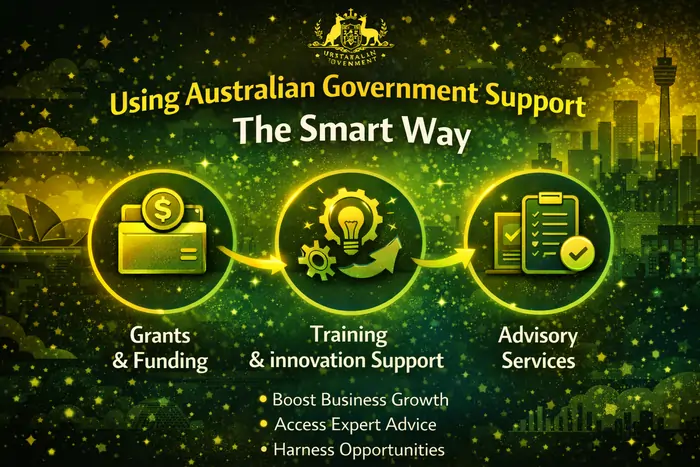
Government support can dramatically reduce your early costs and de‑risk your journey if you know where to look and apply early.
At the federal level, the main starting point is business.gov.au. Beyond the startup guide, you’ll find planning templates, structure and registration explainers, and tools for compliance and risk. As your business grows, you can explore the broader guides to help your business grow, which cover hiring, cash flow, marketing, and innovation.
For founders working on innovative or R&D‑heavy products, there are targeted incentives and programs that can offset eligible R&D expenditure and connect you with expert advisors. Alongside these, you can search for grants and assistance using the same registration portal you used to set up your business, filtering by location, industry, and business stage.
At the state level, portals such as Service NSW business resources, the Business Queensland starting a business hub, and the WA Small Business Development Corporation’s how to start a business in WA give you state‑specific guidance, templates, and grant information.
Funding Options: From Bootstrapping To Venture Capital
How you fund your startup will shape your growth trajectory and the amount of control you retain. Australians use the full spectrum—from self‑funded experiments through to large venture rounds.
In the earliest phase, many founders bootstrap by keeping consulting income or part‑time work while they validate their idea. Others build a service offering alongside their product to generate revenue quickly. This approach can work especially well in B2B SaaS and professional services where you can sell early and refine the product with real client feedback.
As traction builds, you might seek capital from angel investors or early‑stage funds. To understand the current funding climate—who’s investing, in what sectors, and at what stages—review the State of Australian Startup Funding, which breaks down funding volumes, sector trends, and deal structures. If you’re exploring debt, grants, or alternative finance, pairing that report with the government’s guides to help your business grow and a targeted search for grants and assistance can give you a broad funding map.
Business Entrepreneurship – Lessons From Australian Unicorns
Studying local success stories is one of the fastest ways to internalise what works in the Australian context.
Canva, founded in 2012, demonstrates the power of product‑led growth and accessibility. By making complex design tasks simple and collaborative, Canva spread virally through schools, small businesses, and eventually enterprises worldwide. Atlassian shows how B2B collaboration tools can be built from Australia for a global audience using self‑serve onboarding and bottom‑up adoption inside organisations.
Airwallex highlights the opportunity in tackling difficult, regulated problems like cross‑border payments, starting from a single local pain point and scaling globally. For more examples, you can explore founder interviews and overviews such as Lawpath’s roundup of high‑growth Australian tech firms and supplement this with broader startup checklists like the ultimate checklist for starting a business in Australia to see how your own journey compares.
Business Entrepreneurship – Building A Strong Startup Culture “The Aussie Way”
Culture is one of the most underrated levers in Australian startups, and many successful founders treat it as a long‑term strategic asset.
Common traits among high‑performing teams include radical customer focus, transparent communication, and a strong ownership mentality. Teams are typically lean, cross‑functional, and trusted to own outcomes end‑to‑end rather than operating in rigid silos. This suits Australia’s talent market, where many people wear multiple hats and expect a degree of autonomy.
From day one, articulate your mission and values, and embed them into hiring, onboarding, and performance reviews. As you grow, you can use tools from the guides to help your business grow to formalise policies around HR, health and safety, and risk while keeping the entrepreneurial spirit alive.
If you want a deeper dive into what makes a successful entrepreneur, this breakdown of core entrepreneurial traits and mindset shifts adds practical, real‑world context to the characteristics discussed here.
Business Entrepreneurship Step‑By‑Step: A Practical Startup Roadmap
To pull this all together, here is a concise roadmap you can follow as an aspiring Australian founder:
- Clarify your idea and customer
- Interview potential users and stress‑test their pain points.
- Use the Are you ready to start a business? resource to assess both the opportunity and your personal readiness.
- Choose your business structure
- Decide whether you will begin as a sole trader, partnership, company, or trust.
- Work through choose your business structure to compare options and implications.
- Plan your model and operations
- Draft a lean plan using government templates to develop your business plan.
- Cross‑check tactical items with MYOB’s How to start a business in Australia checklist for a founder‑friendly view.
- Register and set up legally
- Register your business online to obtain your ABN, business name, and related registrations in one place.
- Register for GST once you’re approaching the $75,000 turnover threshold, and ensure you have the right TFN and basic accounting systems in place.
- Handle licences and local compliance
- Use state portals such as Start or grow a business in NSW, the Business Queensland starting a business hub, or the WA SBDC how to start a business in WA to identify licences, permits, and local rules.
- Build and test your MVP
- Launch the smallest version of your product that solves the core problem.
- Iterate based on real‑world feedback, and keep your plan updated using tools from the guide to starting a business in Australia.
- Explore funding strategically
- Start with bootstrapping or friends and family, then approach angels and early‑stage funds as your traction strengthens.
- Use the State of Australian Startup Funding to understand current investor appetites and the sectors attracting the most capital.
- Supplement this with a targeted search for grants and assistance to uncover non‑dilutive funding options.
- Invest in culture and systems
- Codify your mission, values, and operating principles early.
- Lean on guides to help your business grow as you introduce HR processes, risk management, and scaling infrastructure.
Bringing It All Together
Building a Business Entrepreneurship startup in Australia today means standing on the shoulders of a rapidly maturing ecosystem while still having room to carve out something genuinely new. If you anchor your idea in a real problem, validate quickly with customers, choose the right structure, and make full use of government support and funding networks, you’ll be following a proven path many Australian founders have already taken.
Use the guide to starting a business in Australia as your regulatory compass, combine it with practical tools like the MYOB How to start a business in Australia checklist, and keep exploring specialised portals such as Service NSW business resources or the Business Queensland starting a business hub as you grow.