

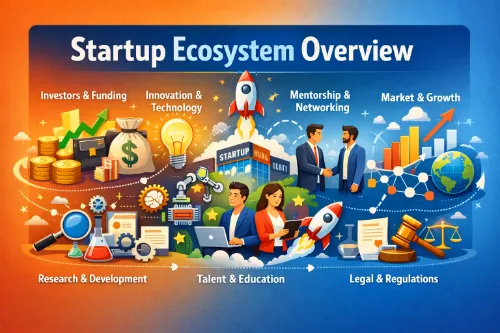
A startup ecosystem overview is the interconnected network of founders, talent, investors, universities, corporates, support organizations, and public policies that work together to help new ventures launch, grow, and scale in a specific city, region, or industry.
When these pieces align—supported by capital, skills, infrastructure, and a collaborative culture—startup ecosystems can become powerful engines for innovation, jobs, and economic growth. Global benchmark reports that track thousands of hubs worldwide show how these ecosystems are reshaping national economies and the global innovation map.
What Is a Startup Ecosystem Overview?
A startup ecosystem is more than just a cluster of startups. It is a structured environment where the right people, institutions, and resources continually interact to create and grow new ventures. Introductory explainers like GeeksforGeeks’ article on startup meaning, ecosystem elements, and how they work and Innoloft’s guide to what a startup ecosystem is, types, benefits, and how to build one break this down in accessible terms.
Key components of a startup ecosystem typically include:
- Founders and startups: Entrepreneurs building new products and services across sectors, from SaaS and fintech to climate tech and health.
- Investors: Angel investors, venture capital funds, corporate venture arms, accelerators, and crowdfunding platforms that provide capital and guidance.
- Support infrastructure: Incubators, accelerators, co‑working spaces, innovation districts, and ecosystem builders that offer mentoring, programs, and networks.
- Universities and research institutions: Sources of talent, research, spin‑outs, and entrepreneurship education.
- Government and policy: Public agencies shaping regulation, grants, tax incentives, visas, and innovation precincts.
- Corporates and industry partners: Established companies that act as customers, partners, or acquirers for startups.
- Community and culture: Events, meetups, conferences, and informal networks that encourage knowledge sharing, collaboration, and risk‑taking.
Other primers, such as Ramotion’s article on what a startup ecosystem is, its elements, and strategies and KCTBS’s explanation of what a startup ecosystem is, key components, and benefits, emphasise that it is the interaction and density of these components—not just their existence—that determine how strong an ecosystem becomes.
Why Startup Ecosystems Matter
Strong startup ecosystems matter because they concentrate the ingredients needed for innovation and economic growth. They help transform ideas into globally competitive companies and create a pipeline of new industries and high‑value jobs.
- Economic impact: High‑performing ecosystems generate thousands of jobs, attract global investment, and create new sectors over time. The Global Startup Ecosystem Report 2025 (GSER 2025) by Startup Genome estimates that top ecosystems collectively create trillions of dollars in economic value.
- Innovation and competitiveness: Startups drive technological change and force incumbents to innovate, helping countries maintain competitiveness in fields like AI, fintech, deep tech, and climate solutions.
- Resilience and diversification: A diverse base of startups reduces dependence on a few legacy industries and can make regions more resilient to global shocks.
Global benchmark studies such as Startup Genome’s GSER 2025 and StartupBlink’s Global Startup Ecosystem Index Report 2025 show that cities and countries with robust ecosystems tend to attract more talent and capital, enjoy higher growth, and have more tools to respond to technological disruption.
How Global Startup Ecosystems Are Ranked
Several organizations publish annual rankings that compare startup ecosystems across countries and cities. These indexes assess factors such as performance, funding, talent, market reach, infrastructure, and connectedness.
- Startup Genome – Global Startup Ecosystem Report 2025: This report analyses data from more than 5 million startups across over 350 ecosystems, in partnership with 185+ economic and innovation ministries. It ranks leading and emerging ecosystems, tracks trends, and offers policy recommendations. You can explore global and regional rankings in the GSER 2025 overview and full ecosystem report PDF.
- StartupBlink – Global Startup Ecosystem Index 2025: StartupBlink ranks ecosystems across 100 countries and more than 1,400 cities using an interactive startup map with over 100,000 ecosystem stakeholders. The Global Startup Ecosystem Index report offers country and city scores, regional spotlights, and industry case studies.
- Dealroom – Global Tech Ecosystem Index 2025: Dealroom’s Global Tech Ecosystem Index 2025 – Sector Edition ranks tech ecosystems in 288 cities across 69 countries, highlighting venture capital attraction, talent, and sector‑specific strengths.
Startup Genome describes itself as a “trusted advisor to global innovation policy leaders”, while StartupBlink positions its index as a “Michelin Guide” for innovation ecosystems. These reports are used by governments, investors, and ecosystem builders to benchmark performance and understand where to focus efforts.
Core Elements of a Healthy Startup Ecosystem
Although each startup ecosystem is unique, successful hubs tend to share several core characteristics. These elements are widely cited in ecosystem literature and global reports.
Capital and Funding Pathways
Access to capital across all stages—pre‑seed, seed, series A/B, and growth—is fundamental to a thriving ecosystem.
- Early‑stage capital often comes from angel investors, micro‑VCs, accelerators, and grant programs.
- Growth capital comes from larger VC funds, corporate venture arms, private equity, and strategic investors.
- Well‑designed public instruments (e.g., co‑investment funds, R&D grants, tax incentives) can catalyse private investment rather than crowding it out.
Startup Genome’s GSER 2025 and StartupBlink’s Global Startup Ecosystem Index 2025 both highlight funding depth and deal flow as critical metrics separating top‑tier ecosystems from those that struggle to scale their startups beyond the early stages.
Talent and Education
High‑quality, diverse talent is another pillar of a strong startup ecosystem.
- Universities and technical institutes produce graduates in engineering, design, business, and other disciplines, and often run entrepreneurship and innovation programs.
- Research institutions generate IP and spin‑outs in deep‑tech fields such as biotech, AI, and advanced manufacturing.
- Immigration policies and remote‑work trends shape whether ecosystems can attract and retain global talent.
Introductory resources like GeeksforGeeks’ startup ecosystem elements guide and Ramotion’s ecosystem strategies article emphasise that talent density and experience (including serial founders) are often decisive factors in an ecosystem’s success.
Support Infrastructure and Programs
Support organizations help founders move faster and avoid common pitfalls, especially in the early stages.
- Accelerators and incubators provide structured programs, mentorship, investor access, and sometimes seed funding.
- Co‑working spaces, labs, and innovation precincts create physical hubs for serendipitous encounters and collaborations.
- Ecosystem builder organisations coordinate initiatives, convene stakeholders, and help founders navigate resources.
Innoloft’s article on startup ecosystem types and benefits and Ramotion’s ecosystem elements and strategies both highlight the role of these structures in turning an isolated set of actors into a cohesive ecosystem.
Government Policy and Public‑Sector Support
Policy can either accelerate or constrain ecosystem development.
- Pro‑innovation regulation (e.g., sandboxes for fintech or healthtech) and ease of doing business encourage experimentation.
- Public investments in innovation districts, broadband, and R&D support create enabling infrastructure.
- Grants, tax incentives, and startup‑friendly procurement rules can ease early‑stage risk and attract investment.
Startup Genome’s reports and StartupBlink’s Index 2025 include case studies of cities like Singapore and Tel Aviv, where targeted policy reforms and government‑backed innovation hubs have propelled ecosystems into global top‑tier status.
Community, Culture, and Networks
Soft factors like culture and community are crucial for sustaining an ecosystem over the long term.
- Regular meetups, hackathons, conferences, and informal gatherings create trust, shared knowledge, and collaboration.
- A “give first” culture—where experienced founders, mentors, and investors support new founders without immediate expectations—helps ecosystems compound experience.
- Storytelling, media, and visible success stories (e.g., local unicorns) inspire new founders and attract outside attention.
Innoloft and Ramotion both argue that culture and community can be as important as capital or infrastructure, particularly in the early stages of ecosystem development.
Types of Startup Ecosystems
Startup ecosystems vary by geography, sector, and structure. Understanding these types can help stakeholders design better strategies.
- City or regional ecosystems: Hubs anchored in a city or metropolitan area (e.g., Sydney, Berlin, Bangalore), often the focus of ecosystem rankings and policy initiatives.
- National ecosystems: Country‑level ecosystems (e.g., “Australia’s startup ecosystem”, “India’s startup ecosystem”) analysed in global reports like the StartupBlink Global Index and GSER 2025.
- Sector‑specific ecosystems: Clusters focused on specific verticals such as fintech, healthtech, climate tech, or gaming, which may span multiple cities and countries.
- Virtual or remote ecosystems: Communities built on digital platforms and remote teams, less tied to a single geography but connected through online collaboration and shared interests.
Dealroom’s Global Tech Ecosystem Index 2025 and the GSER 2025 sector chapters emphasise how sector‑based ecosystems like AI or climate tech increasingly cut across traditional geographic boundaries.
Case Study: Sydney’s Startup Ecosystem
Sydney offers a concrete example of how these elements come together in a globally recognised startup ecosystem.
- Dealroom’s Global Tech Ecosystem Index 2025 ranks Australia 8th globally among tech ecosystems, with Sydney as its leading hub and one of the top ecosystems in the Asia–Pacific region.
- Startup Genome’s profile of the Sydney startup ecosystem describes it as a “thriving innovation ecosystem” and the leading tech hub in the Southern Hemisphere, with more than 3,000 tech startups.
- Global companies like Atlassian, Canva, Immutable, and Deputy have their global headquarters in Sydney, signalling the ecosystem’s ability to produce high‑impact, global‑scale firms.
Sydney’s ecosystem is underpinned by strong universities, a deep pool of tech and business talent, and a growing concentration of innovation infrastructure.
- The Tech Central innovation precinct near Central Station is designed as Australia’s largest technology and innovation hub, bringing together startups, scaleups, corporates, and research institutes.
- NSW Government initiatives such as the NSW Innovation Blueprint 2035 and investment in Tech Central aim to concentrate innovation activity and create a long‑term base for ecosystem growth.
Stone & Chalk’s 2025 review, “2025 in review: What happens when founders build together”, highlights how Tech Central now has the highest concentration of technology businesses in Australia, co‑locating companies like Atlassian and Canva with more than 150 research institutes and two world‑class universities. This density of talent, capital, and infrastructure typifies what global reports describe as the hallmarks of strong startup ecosystems.
Challenges Startup Ecosystems Face
Even mature ecosystems like Sydney, London, or Silicon Valley face recurring challenges, many of which are more acute in emerging hubs.
- Fragmentation and coordination: Multiple uncoordinated programs and communities can create confusion for founders and duplication of effort.
- Capital gaps: Ecosystems may lack pre‑seed or growth‑stage funding, or struggle to support capital‑intensive deep‑tech ventures with longer time horizons.
- Talent shortages and brain drain: Competition from larger hubs and global companies can make it hard to retain senior talent.
- Regulatory hurdles: Outdated or complex regulations in sectors like fintech, health, or mobility can slow innovation.
- Diversity and inclusion: Unequal access to capital and networks for under‑represented founders can limit ecosystem potential and create blind spots.
Articles like Ramotion’s startup ecosystem strategies piece and Innoloft’s ecosystem building guide discuss these pain points and propose approaches for ecosystem builders and policy‑makers to address them.
How Emerging Ecosystems Can Improve
Emerging startup ecosystems—whether in smaller cities, developing countries, or new sectors—can draw on lessons from global leaders to accelerate their development.
- Define a clear value proposition: Identify what makes your ecosystem unique (e.g., sector strengths, cost advantages, proximity to specific industries) and align branding, policy, and investment around that.
- Strengthen early‑stage support: Create or expand pre‑seed funds, accelerators, and founder education to widen the pipeline of viable startups.
- Build anchor institutions and precincts: Develop physical hubs—innovation districts, labs, co‑working spaces—anchored by universities or corporates to concentrate activity.
- Encourage “give first” culture: Incentivise experienced founders, operators, and investors to mentor and support early‑stage startups, including under‑represented founders.
- Plug into global networks: Use programs from Startup Genome, StartupBlink, and Dealroom to benchmark, participate in international initiatives, and attract global partners.
- Measure and iterate: Regularly track ecosystem KPIs—such as startup count, funding, exits, and diversity metrics—and refine strategies based on data.
StartupBlink’s Global Startup Ecosystem Index 2025 includes a section on “how emerging ecosystems can improve their ranking”, while Startup Genome’s ecosystem development programs provide frameworks and advisory support for governments and ecosystem organisations.
Using Global Reports as External Resources
If you want to explore specific cities, sectors, or regions in more depth, these external resources are particularly useful:
- Global Startup Ecosystem Report 2025 (Startup Genome) – in‑depth analysis of 350+ ecosystems, rankings, case studies, and policy recommendations.
- Global Startup Ecosystem Index Report 2025 (StartupBlink) – rankings for 100 countries and 1,400+ cities, with regional and industry breakdowns.
- Global Tech Ecosystem Index 2025 – Sector Edition (Dealroom) – data on tech ecosystem performance across 288 cities in 69 countries, including sector‑specific insights.
- What Is a Startup Ecosystem? (Innoloft) – overview of ecosystem types, benefits, and building blocks.
- Startup Ecosystem Meaning & Elements (GeeksforGeeks) – beginner‑friendly definitions and FAQs for students and new founders.
Together, these resources function as living maps and handbooks for the global startup landscape, helping founders, investors, and policy‑makers understand where opportunities lie, how their ecosystem compares, and which levers they can pull to strengthen it.