

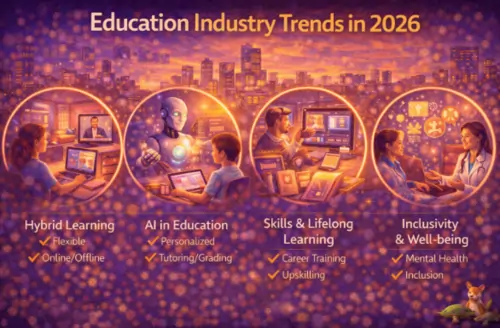
Education is changing faster than ever. The pandemic years forced schools to adopt digital tools quickly, but by 2026, education is no longer in “adjustment mode.” It is evolving into a more flexible, skills-focused, and technology-driven system.
For Filipino students, parents, teachers, and school owners, understanding Education Industry Trends in 2026 is no longer optional. It is necessary for staying competitive, employable, and financially prepared.
AI in Classrooms Becomes Normal
One of the biggest Education Industry Trends in 2026 is the mainstream use of artificial intelligence in learning.
AI is now used to:
- Help teachers create lesson plans
- Assist in grading quizzes
- Offer personalized practice questions
- Provide tutoring support outside school hours
But AI is not replacing teachers. Instead, it is becoming a teaching assistant. Teachers still guide discussions, encourage creativity, and build emotional intelligence.
However, schools must also address:
- AI misuse in assignments
- Overdependence on automated answers
- Academic honesty policies
In 2026, students are expected to know how to use AI responsibly, not avoid it completely.
Skills-Based Education Is Overtaking Degree-Only Thinking
Another key theme in Education Industry Trends in 2026 is the shift toward practical skills.
Employers are increasingly asking:
- What can you do?
- What projects have you completed?
- What tools can you use?
Instead of focusing only on diplomas, companies now look at:
- Certifications
- Portfolios
- Internships
- Real-world experience
In the Philippines, this matters because many graduates struggle with job mismatch. Schools that align programs with industry needs will become more attractive.
Students who build both technical skills and soft skills—communication, teamwork, critical thinking—will have stronger opportunities.
Hybrid Learning Is Now the Standard
Hybrid learning is no longer an emergency solution. It is one of the strongest Education Industry Trends in 2026.
Schools combine:
- Face-to-face discussions
- Online modules
- Recorded lectures
- Digital assessments
This model gives flexibility, especially for:
- Working students
- Students in provinces
- Those with transportation challenges
But hybrid learning only works when:
- Teachers are trained
- Platforms are reliable
- Students are disciplined
By 2026, schools that cannot manage hybrid systems efficiently may struggle to compete.
EdTech Platforms Are Becoming Smarter and More Secure
Education Industry Trends in 2026 also show that schools are reducing tool overload.
Instead of using many disconnected apps, institutions are:
- Integrating Learning Management Systems (LMS)
- Using centralized dashboards
- Tracking student performance in real time
Data helps schools:
- Identify struggling students early
- Monitor attendance patterns
- Improve completion rates
However, cybersecurity is now a major concern. Student data protection is becoming a top priority.
Schools must invest not only in tools—but also in security systems.
Mental Health Is a Core Priority
Academic performance alone is no longer enough. One of the most important Education Industry Trends in 2026 is the focus on mental health.
Schools are now:
- Hiring more counselors
- Teaching stress management skills
- Introducing social-emotional learning (SEL)
- Monitoring burnout signs
Filipino students face pressure from family expectations, social media comparison, and financial challenges. Schools that support emotional well-being will produce stronger long-term results.
Healthy students learn better.
Global Learning Opportunities Expand
Another powerful shift in Education Industry Trends in 2026 is global accessibility.
Students can now:
- Enroll in international online courses
- Join global competitions
- Attend remote internships
- Access certifications from global institutions
This increases competition—but also opportunity.
Filipino students are no longer limited to local exposure. However, it also means local schools must improve quality to remain competitive.
Alternative Education Pathways Are Growing
Traditional four-year degrees are still valuable, but Education Industry Trends in 2026 show a rise in alternative pathways.
Examples include:
- Coding bootcamps
- Digital marketing programs
- Technical and vocational training
- Short-term certification courses
- Employer-sponsored training
Many young professionals now combine:
- A degree + a certification
- A job + online courses
- A skill + freelance projects
This flexible model supports lifelong learning.
Data-Driven School Management
Behind the scenes, schools are becoming more analytical.
Education Industry Trends in 2026 include:
- Enrollment forecasting tools
- Dropout prediction models
- Performance analytics dashboards
- Budget optimization systems
Instead of guessing, school leaders now use data to make decisions.
For example:
- If attendance drops, they investigate patterns.
- If a course has high failure rates, they adjust teaching methods.
This makes education more strategic and sustainable.
Sustainability and Green Education
Climate awareness is influencing curriculum.
Many institutions now:
- Include environmental topics in subjects
- Promote energy-efficient campuses
- Encourage sustainability projects
Students today are more environmentally conscious. Schools that promote green initiatives build stronger community engagement.
Affordability and ROI Matter More
Education Industry Trends in 2026 show families are more practical.
Parents now ask:
- What job opportunities will this course provide?
- What is the return on investment?
- Is there internship support?
Schools that clearly show:
- Graduate employment rates
- Industry partnerships
- Practical training programs
will gain more trust.
Key Challenges in 2026
Even with progress, challenges remain:
- Digital divide in rural areas
- Teacher retraining for AI integration
- Budget constraints
- Student screen fatigue
- Academic dishonesty with AI tools
Education leaders must balance innovation with discipline.
What This Means for Different Groups
For Students
- Learn how to use AI responsibly.
- Build a portfolio, not just grades.
- Develop communication and adaptability skills.
For Parents
- Look beyond school reputation.
- Ask about technology use and student support.
- Monitor digital wellbeing at home.
For Educators
- Upskill in digital tools.
- Redesign assessments.
- Focus on critical thinking instead of memorization.
For School Owners
- Invest in integrated platforms.
- Prioritize cybersecurity.
- Build partnerships with industries.
The Big Picture
Education Industry Trends in 2026 show one clear message:
Education is no longer about memorizing information. It is about adaptability, digital literacy, emotional intelligence, and practical skill application.
The schools that will thrive are those that:
- Embrace technology wisely
- Support mental health
- Align with industry
- Use data intelligently
- Focus on student outcomes
The students who will succeed are those who:
- Stay curious
- Keep learning
- Build real-world skills
- Adapt to change
FAQs
Will AI replace teachers in 2026?
No. AI assists with tasks but cannot replace human mentorship and emotional support.
Are college degrees still valuable?
Yes, but skills and certifications are becoming equally important.
Is hybrid learning effective?
It can be, if properly structured and supported by trained educators.
What skills matter most in 2026?
Critical thinking, digital literacy, communication, and adaptability.
How can schools stay competitive?
By investing in technology, mental health support, and industry partnerships.