

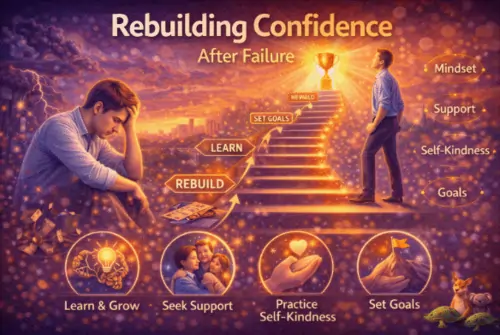
Failure can feel like a full stop. Not just a bad result, but a loud message that says, “You’re not good enough.” In real life, though, failure is usually simpler than the story we attach to it. It’s a broken plan, a weak system, a wrong assumption, or a timing issue—not a permanent label on your character.
Rebuilding Confidence After Failure is possible even when you feel empty, embarrassed, or scared to try again. Confidence is not something you “summon.” Confidence is something you build—by collecting proof that you can take action, learn, and recover.
Why failure hits so hard
Failure hurts more when it attacks identity. You don’t just think, “This didn’t work.” You think, “I’m the kind of person who can’t make things work.” That mental shift is the real damage—and it’s also what Rebuilding Confidence After Failure needs to repair.
Common reasons failure feels heavier:
Family and social pressure
Comments like “sayang,” “buti pa si…” or “kailan ka magsisimula ulit?” can make you feel like your value is measured by your latest achievement.
Comparison culture
Social media shows highlights. When you fail, you compare your behind-the-scenes to someone else’s best moment.
Financial stress
If your failure cost money, confidence doesn’t just drop—it collapses. You might feel guilty, especially if family was affected.
Fear of repeating the same mistake
Your brain tries to protect you: “Don’t try again, so you won’t get hurt again.” That protection can turn into paralysis.
What counts as “failure”?
People often think failure means losing everything. But many forms of failure trigger the same emotional crash:
Business failure
A shop closes, a side hustle flops, a client leaves, a product doesn’t sell.
Career failure
Not passing probation, being terminated, missing a promotion, or quitting after burnout.
Academic failure
Failing boards, missing a scholarship, or repeating a subject.
Relationship failure
A breakup, separation, betrayal, or choosing the wrong partner.
Personal failure
A health relapse, breaking a promise to yourself, or going back to an unhealthy habit.
Rebuilding Confidence After Failure starts by naming the failure clearly, not dramatically.
What failure actually teaches (if you listen)
Failure feels like proof that you’re weak. In reality, it’s often proof that your system was weak.
Failure can show you:
- where your plan lacked structure
- what skills you need to improve
- what assumptions were unrealistic
- what boundaries you didn’t protect
- what you truly value (because failure reveals what you care about)
When you treat failure as information instead of identity, Rebuilding Confidence After Failure becomes much easier.
Step 1: Stabilize first (before motivation)
The first step in Rebuilding Confidence After Failure is not to “think positive.” It’s to calm your body enough to think clearly.
For 7 to 14 days, focus on basics:
- sleep (even a small improvement helps)
- food (regular meals, not perfect meals)
- movement (walks count)
- hydration
- reduce alcohol or anything that worsens mood swings
Why this works: when your nervous system is overwhelmed, your brain cannot plan well. You will overreact, judge yourself harshly, and make risky decisions.
A simple rule: if your body is unstable, your decisions will be unstable.
Step 2: Name the failure clearly, without drama
Rebuilding Confidence After Failure requires clarity.
Write down:
- What was my goal?
- What actually happened?
- When did it start going wrong?
- What did I control? What did I not control?
Avoid vague labels like “I failed.” That’s too big and too emotional.
Instead:
- “My online store didn’t reach enough buyers.”
- “I didn’t prepare well for the exam.”
- “I accepted a job with unclear expectations.”
Clear language turns failure into a specific problem you can solve.
Step 3: Do a simple failure review (post-mortem)
A “post-mortem” is a calm review after something fails. This is a powerful tool for Rebuilding Confidence After Failure because it replaces shame with learning.
Answer these:
What worked?
Even small wins count. Maybe you learned marketing. Maybe you built discipline. Maybe you proved you can start.
What didn’t work?
Be honest but not cruel. Look for patterns.
What assumption was wrong?
Example: “If I post daily, sales will come.”
Reality: You might need product-market fit, better offers, or paid reach.
What would I do differently next time?
Choose 1 to 3 changes only. Too many changes overwhelm you.
This review turns your failure into a training experience instead of a trauma story.
Step 4: Repair confidence through evidence, not feelings
Here’s the truth: confidence is proof.
Rebuilding Confidence After Failure works best when you stop asking, “Do I feel confident?” and start asking, “What proof can I create today?”
Use a micro-wins system:
- Choose 1 small action you can do daily
- Keep it easy enough that you won’t quit
- Track it on paper or notes
Examples:
- 20-minute study session
- 10 job applications per week
- 15-minute walk daily
- one portfolio output per week
- one outreach message per day
Each completed action becomes evidence. Evidence becomes confidence.
Step 5: Fix the skill gap that caused the failure
Many failures are not about “talent.” They’re about missing a key skill.
Common skill gaps:
- sales and negotiation
- time management
- budgeting and cashflow
- communication and boundaries
- planning and execution
- emotional regulation under stress
For Rebuilding Confidence After Failure, pick one skill gap and run this loop:
Learn → Build → Show
- Learn daily for 30–60 minutes
- Build something small weekly
- Show it (apply, pitch, publish, submit)
Confidence grows when you see yourself improving.
Step 6: Reset your environment
Your environment can either rebuild you or pull you back down.
If you want Rebuilding Confidence After Failure to stick:
- reduce doomscrolling and comparison triggers
- unfollow accounts that make you feel “behind”
- fix your space to make good habits easier
- spend less time with people who shame you
You don’t have to fight everyone. You just need fewer triggers.
Step 7: Rebuild identity, not just outcomes
This is the heart of Rebuilding Confidence After Failure.
You need a new identity statement:
- Not “I’m successful.”
- But “I’m the kind of person who keeps promises to myself.”
Confidence becomes stable when it’s tied to character and systems, not outcomes.
Try this sentence:
“I am rebuilding. I take action even when it’s uncomfortable.”
Step 8: A practical 30-day comeback plan
Week 1: Stability + clarity
- fix sleep and meals
- write your failure review
- choose one goal for 30 days
Week 2: Micro-wins + skill focus
- daily habit for confidence proof
- learn one skill gap daily
- remove one major trigger (comparison, toxic contact, clutter)
Week 3: Low-risk exposure
- apply, pitch, submit, publish
- keep it small and repeatable
- focus on volume, not perfection
Week 4: Review + next steps
- what improved?
- what habit worked best?
- what should you stop doing?
- plan your next 60 days
This plan works because it rebuilds confidence through structure, not hype.
Handling fear of trying again
Fear is normal. Rebuilding Confidence After Failure doesn’t remove fear—it teaches you how to move with it.
Use smaller bets:
- test ideas before spending big
- do “trial runs”
- set stop-loss rules (when to pause, when to adjust)
Trying again doesn’t mean repeating the same approach. It means trying smarter.
Filipino reality check
If your family doesn’t understand your reset, you can still stay respectful without surrendering your mental health.
Practical script:
“Thank you for caring. I’m rebuilding step by step. I’ll update you when I have progress.”
You don’t owe daily explanations. Your job is to rebuild results—quietly and consistently.
FAQs
How do I stop feeling ashamed after failing?
Name the failure clearly, then turn it into a post-mortem. Shame shrinks when failure becomes specific and solvable.
How long does it take to rebuild confidence?
It depends, but micro-wins can improve confidence within weeks because proof accumulates quickly.
What if I lose confidence every time I try?
Lower the difficulty of your daily goal. Confidence grows when you keep promises to yourself consistently.
How do I try again without repeating mistakes?
Fix one skill gap and change one assumption. Don’t change everything at once.
What if my failure affected my family financially?
Stabilize your finances first. Build a realistic plan and communicate calmly. Responsibility plus structure rebuilds trust.